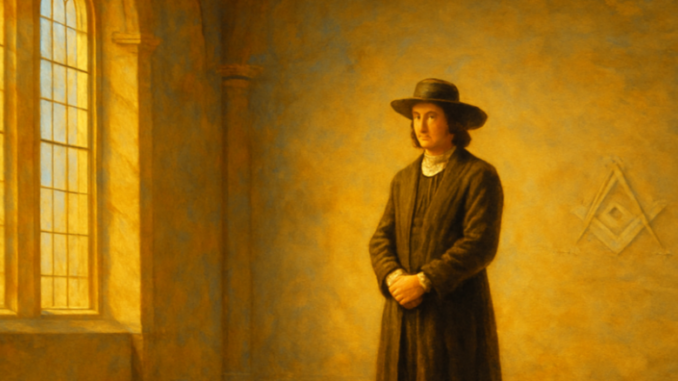
An empty chair in a circle. No minister, no liturgy, no prescribed words. Just people sitting together, waiting for whatever may arise from within. This image of a Quaker meeting evokes something that Freemasons instinctively recognize: the conviction that truth does not come from outside, but must be discovered in the depths of one’s own being. Today we explore the roots of the Religious Society of Friends and examine the threads that connect this movement to Freemasonry — as well as the places where their paths clearly diverge.
A Spark in Seventeenth-Century England
The Religious Society of Friends emerged in the 1640s, in the midst of an England torn apart by religious and political upheaval. George Fox, a restless young man from Leicestershire, found no answers in the churches of his day. In 1647, he experienced what he described as an inner revelation: there is no need for an outward priest or church building, because every human being carries an inner light directly connected to the divine.
This was a revolutionary insight. Fox traveled across the country, gathering like-minded seekers around him. They called themselves “Friends of the Truth.” The nickname “Quakers” came from their opponents, who described how these believers sometimes trembled during their silent meetings when the spirit moved them. What began as a small band of seekers grew into a movement that spread across the Atlantic Ocean and endures to this day.
The Inner Light as a Compass
At the heart of the Quaker faith lies one fundamental principle: within every person burns a spark of the divine. This inner light requires no dogmas and no intermediaries. It asks only for silence, attention, and the willingness to listen to what reveals itself within. Here, the Quaker tradition touches something that also stands at the center of Freemasonry: the conviction that moral and spiritual growth must come from within.
Both Quakers and Freemasons believe that truth is not imposed but discovered through inner work and sincere reflection. Freemasons speak of working the rough ashlar — the inner journey toward a better self. Quakers speak of obeying the inner light. The imagery differs, but the direction is the same: both traditions point inward, toward the place where the real work happens.
Silence as a Workshop
A Quaker meeting has no minister, no sermon, and no fixed liturgy. Those present sit together in silence, often in a circle, and wait. Sometimes someone stands to speak when the spirit prompts them. Sometimes the entire meeting passes in silence. This is not emptiness but a filled space in which inner work can take place.
Silence plays a meaningful role in Freemasonry as well. The Entered Apprentice is encouraged to listen more than to speak. The ritual creates a space in which the everyday world is temporarily set aside so that deeper layers can be reached. The lodge, like the Quaker circle, is a workshop where the outside world is briefly shut out to make room for inner exploration.
Where the Paths Diverge
Despite these affinities, there are significant differences. The Quakers are a religious movement, rooted in Christianity — though many contemporary Quakers interpret this very broadly. Freemasonry, by contrast, is explicitly not a religion. It asks of its members only a belief in a Supreme Being, without prescribing any specific faith.
Quakers have no rituals in the Masonic sense; their meetings are free of ceremony. Freemasonry works with symbols and a system of degrees, while Quakers reject hierarchy on principle. Quakers have historically been radically transparent about their beliefs, whereas Freemasons keep their rituals deliberately private.
The early Quakers refused to pay deference to anyone. They addressed everyone as “thou” at a time when this was considered disrespectful, and they refused to bear arms. Their testimonies of equality, simplicity, integrity, and peace formed a coherent way of life. Freemasonry shares the pursuit of moral improvement but places different emphases and maintains a structured ritual life that would be foreign to the Quaker tradition.
A Shared Heritage of Seeking
What connects Quakers and Freemasons most deeply may be their shared conviction that spiritual growth is a personal responsibility. No priest, no book can do the inner work for you. George Fox wrote that he wished to direct people toward “the teacher within their own hearts.” Freemasons would recognize this as the charge to work the rough ashlar into a more perfect form.
Both traditions arose in a time when people began to question external authorities and turned their gaze inward. The seventeenth-century search for direct spiritual experience outside the established churches created fertile ground for both the Society of Friends and, a few decades later, organized speculative Freemasonry. It is no coincidence that both movements flourished in England during a period of intense intellectual and religious ferment.
The Silent Question
If you were to step into a Quaker circle, you would be invited to sit down and listen to the silence. If you were to enter a Masonic lodge, you would be invited to take part in a ritual that lifts you out of the ordinary. In both cases, the question is the same: are you willing to look inward? Are you prepared to let go of the noise of the outside world and explore what lives in the depths?
The Society of Friends and Freemasonry offer different answers to many questions. But they share the conviction that the most important questions do not come from outside — and that the most meaningful answers are found not in doctrines or decrees, but in the quiet sanctuary of the self.
Quakers and Freemasons walk different paths, yet both begin at the same starting point: the belief that each individual carries within them something sacred and worth cultivating. Whether through unprogrammed silence or through carefully crafted ritual, both traditions call us to do the inner work that no one else can do for us. In a world that grows ever louder, that shared invitation to stillness and self-examination may be more relevant than ever.
Copyright text & image: devrijmetselaar.nl
Texts are based on the ideas and content of the author of devrijmetselaar.nl, reviewed, corrected, and supplemented with the assistance of OpenAI. Images are created based on the ideas of the author of devrijmetselaar.nl using OpenAI/DALL-E.


Be the first to comment