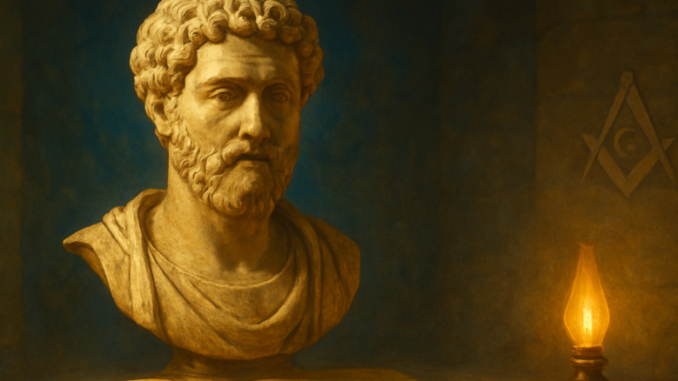
What makes a person who they truly are? Is it our position in the world, our deeds, or something deeper that lies beneath the surface? In Book VIII of his Meditations, the Roman Emperor Marcus Aurelius wrestles with precisely this question. He wrote these personal reflections not for publication, but as an inner dialogue with himself — a mirror in which he sought to know his own soul. Let us walk through this book together and explore what these Stoic insights still have to say to us today.
What Is the Central Theme of Book VIII?
At the heart of Book VIII lies a fundamental question: what is the true nature of man, and how can we live in harmony with that nature? Marcus Aurelius examines the relationship between individual consciousness and the greater whole of the cosmos. He does not see human beings as isolated creatures, but as inseparable threads in a universal fabric.
The emperor emphasizes again and again that our true essence does not reside in our bodies or our possessions, but in what the Stoics called the hegemonikon — the ruling part of the soul that has the power to choose how it responds to the world. This inner self is like a citadel that cannot be taken from the outside, unless we ourselves open the gates to disruptive influences.
How Does Marcus Aurelius Describe Impermanence?
One of the most powerful themes in this book is the contemplative gaze upon impermanence. Marcus Aurelius invites us to look back at the great names of history: where are the courts of Augustus now? What became of Alexander the Great’s ambitious plans? Everything, he argues, eventually dissolves into the river of time.
The true nature of man does not lie in what perishes, but in how we relate to that impermanence.
Yet this is far from a cynical or gloomy message. On the contrary, Marcus Aurelius uses impermanence as a liberating force. If everything passes, why cling to anger, jealousy, or fear? The knowledge that nothing is permanent paradoxically makes it possible to be fully present in the here and now.
What Examples Does the Emperor Use?
Marcus Aurelius was no abstract philosopher writing from an ivory tower. As Emperor of Rome, he knew the daily struggle of power, responsibility, and human weakness. In Book VIII, he regularly draws on concrete situations and historical figures to illustrate his points.
He writes about the bustling activity of the Roman court and how quickly all that commotion fades into oblivion. He speaks of death as the great equalizer, making no distinction between emperor and slave. He describes how a simple act — such as eating a fig — can remind us of the seasons of life.
These examples make the abstract Stoic philosophy tangible. They show that wisdom is not separate from daily life but stands right in the middle of it.
What Does This Mean for the Seeker of Self-Knowledge?
Here, the thoughts of Marcus Aurelius touch upon a universal human endeavor that has remained recognizable across the centuries. The Stoic ideal of self-knowledge, as articulated in Book VIII, shows striking parallels with other traditions that place the inner self at the center of their teaching. The ancient injunction “Know Thyself,” once carved into the Temple of Apollo at Delphi, echoes through every passage.
Freemasonry shares a similar emphasis on the rough stone — the ashlar — that must be refined. Although Marcus Aurelius was not a Freemason, Brethren who read his work will recognize much: the idea that the true work takes place within, that outward honors are fleeting, and that a man must come to know himself before he can truly serve others. The Stoic emperor’s inner workshop is remarkably similar to the symbolic lodge where every Mason labors on his own character.
How Can We Read This Book as a Mirror?
Marcus Aurelius wrote his Meditations as a personal exercise, not as teaching material for others. Yet these notes have survived the centuries because they strike a universal chord. Book VIII invites the reader not merely to read, but to reflect: which parts of my life are truly mine? What would remain if all externalities were stripped away?
The power of this work lies in the honesty with which the emperor examines his own shortcomings. He grants himself no exemptions, asks for no special treatment. In that sense, he serves as an example: if a mighty ruler could question himself this rigorously, surely we can do the same.
What Remains After Reading?
After working through Book VIII, what lingers most is the invitation to look at ourselves differently. Marcus Aurelius does not ask us to adopt his philosophy blindly. Instead, he asks us to pose the same questions he posed to himself. What truly matters? How do I respond to adversity? Am I able to preserve my inner calm when the world around me storms?
These questions are not new, but they remain urgent. In a world saturated with distraction and superficiality, this ancient book offers a compass for anyone who seeks depth. It reminds us that the true nature of a human being is not found in what we own or achieve, but in the stillness of the inner life where we dare to face ourselves.
Book VIII of the Meditations of Marcus Aurelius is a timeless invitation to self-examination. The Roman emperor demonstrates that the question of human nature is not an abstract philosophical puzzle, but a daily practice. Whether we live in the second century or the twenty-first, the challenge remains the same: to look beyond transient appearances and discover what is truly of value. For every seeker willing to turn that gaze inward — whether Stoic philosopher, Freemason, or simply a thoughtful human being — this book offers a wise and gentle guide.
Copyright text & image: devrijmetselaar.nl
Texts are based on the ideas and content of the author of devrijmetselaar.nl, reviewed, corrected, and supplemented with the assistance of OpenAI. Images are created based on the ideas of the author of devrijmetselaar.nl using OpenAI/DALL-E.
Frequently Asked Questions
What is the central theme of Marcus Aurelius's Book VIII of Meditations?
The central theme of Book VIII is the question of what constitutes the true nature of man and how to live in harmony with that nature. Marcus Aurelius examines the relationship between individual consciousness and the greater cosmic whole, emphasizing that our true essence does not reside in our bodies or possessions, but in the hegemonikon—the ruling part of the soul that has the power to choose how it responds to the world.
How does Marcus Aurelius use the concept of impermanence in Book VIII?
Marcus Aurelius uses impermanence as a liberating force rather than a source of despair. By reflecting on how all great historical figures and their accomplishments eventually fade away, he argues that our true nature does not lie in what perishes. This understanding of impermanence paradoxically frees us from anger, jealousy, and fear, allowing us to be fully present in the here and now.
What approach does Marcus Aurelius take when illustrating philosophical concepts in Book VIII?
Rather than writing abstract philosophy, Marcus Aurelius draws on concrete situations and historical figures to illustrate his points. As Emperor of Rome, he regularly references the bustling activity of the Roman court, great historical figures like Augustus and Alexander the Great, and the concept of death as the great equalizer to make his Stoic teachings tangible and relatable to daily human experience.


Be the first to comment