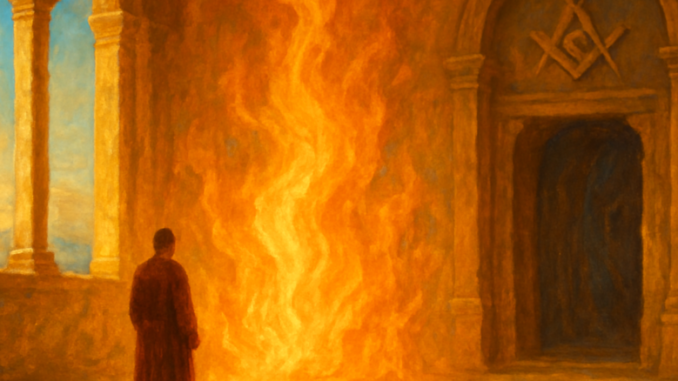
In Dan Brown’s thriller Inferno, a shadowy organization sits at the heart of a conspiracy driven by fears of overpopulation. The novel weaves together historical locations, scientific theories, and mysterious secret societies into a gripping narrative. But how much of it is actually true? What’s wildly exaggerated, and what’s purely invented? In this fact-check, we hold the book’s claims up against historical and scientific sources — and take a closer look at how its portrayal of secret societies compares to the reality of fraternal organizations like Freemasonry.
What Inferno Claims About Secret Societies
In Inferno, Dan Brown introduces a fictional organization called the Consortium — a kind of shadow corporation that helps clients execute their plans invisibly, without any moral oversight. The book implies that organizations like this have existed for centuries, quietly influencing the course of history from behind the scenes. At the same time, historical societies such as Freemasonry and the Illuminati are frequently lumped together with conspiracy theories in popular culture. Brown plays into this sentiment deliberately: the reader is drawn into a world where nothing is what it seems and every organization harbors a hidden agenda.
It’s essential to distinguish fiction from fact here. The Consortium, as described in Inferno, is entirely a creation of Dan Brown’s imagination. There is no historical evidence for the existence of such a commercial shadow organization operating globally to facilitate the plans of wealthy clients. The concept borrows elements from real-world private intelligence firms, but the scale and moral vacuum depicted in the book are literary exaggeration — nothing more.
The Illuminati and Freemasonry: Two Very Different Worlds
Anyone familiar with Dan Brown’s work knows he has placed the Illuminati at the center of previous novels. In the popular imagination, the Illuminati and Freemasonry have become deeply entangled, but historically speaking, they are very different organizations. The Bavarian Illuminati were founded in 1776 by Adam Weishaupt, a professor at the University of Ingolstadt. It was a short-lived society with radical Enlightenment ideals that was banned by the Bavarian Elector as early as 1785.
Freemasonry, on the other hand, has a much longer and broader history, with roots in the medieval stonemason guilds and a formal organizational structure dating back to the founding of the Grand Lodge of London in 1717, shaped by figures such as James Anderson and Jean Théophile Desaguliers. While the Illuminati explicitly pursued political goals, Freemasonry focuses on personal and moral development. The fraternity has no secret master plan for the world — it does, however, practice rituals in private settings.
This distinction is crucial, and it is rarely made clear in popular thrillers, including Inferno. The result is that readers often struggle to draw the line between historical fraternities and fictional conspiratorial organizations. A secret society in a novel is entertainment; a fraternity in reality is a community of people working together toward self-improvement and charity.
Overpopulation Fears: Fiction Versus Demographic Science
The driving force behind the conspiracy in Inferno is the conviction that overpopulation will lead humanity to ruin. Dan Brown references the ideas of Thomas Robert Malthus, the eighteenth-century British economist who warned in his 1798 work An Essay on the Principle of Population that population growth would outstrip food production. This is historically accurate: Malthus did indeed formulate this theory, and his ideas influenced debates about population policy for generations.
What Inferno exaggerates, however, is the urgency and inevitability of a Malthusian catastrophe. Modern demography paints a far more nuanced picture. Global population growth has been slowing for decades. According to the United Nations, growth is expected to level off significantly around the middle of this century. The Green Revolution, improved agricultural techniques, and declining birth rates across much of the world have undermined Malthus’s original predictions. That doesn’t mean there are no challenges related to food security and climate, but the apocalyptic tone of the book is scientifically unsustainable.
What’s True, What’s Exaggerated, and What’s Pure Fiction?
Here’s a summary of the key claims from Inferno, tested against the facts:
Historically true: Thomas Robert Malthus warned about the consequences of unchecked population growth. His theories are real and were genuinely influential.
Historically true: The Bavarian Illuminati actually existed but were dissolved in the eighteenth century.
Exaggerated: The suggestion that secret societies carry out complex global conspiracies. Historical fraternities like Freemasonry are far more transparent than popular culture suggests, with public Grand Lodges, published constitutions, and visible charitable work.
Exaggerated: The inevitability of a population catastrophe. Demographic data tells a very different story than the novel presents.
Pure fiction: The Consortium as an organization does not exist. There is no evidence for a commercial network offering amoral services on a global scale as described in Inferno.
Two Perspectives: The Reader and the Freemason
For the casual reader, Inferno is an exciting adventure that stimulates through its interplay of art, science, and mystery. The book invites you to rediscover Dante Alighieri, to visit Florence, and to reflect on the future of humanity. That is a genuine merit of the novel.
From the perspective of a Freemason, however, the book also evokes a familiar frustration. For centuries, the fraternity has been confronted with misconceptions and conspiracy theories that bear little resemblance to its actual practices. Freemasonry is not a secret society plotting world domination — it is a fraternal organization dedicated to moral growth, brotherly love, and service to the community. Its meetings are private, but its existence, principles, and charitable activities are very much public.
The challenge posed by novels like Inferno is that they blur the boundary between entertainment and reality. When millions of readers absorb a fictional narrative about secretive organizations manipulating global events, it reinforces stereotypes that real fraternities then have to work against. Understanding that distinction — between a novelist’s imagination and a brotherhood’s actual mission — is key to appreciating both the book and the Craft for what they truly are.
Dan Brown’s Inferno is a masterfully constructed thriller that blends real history with imaginative fiction. Its references to Malthus and the Illuminati are grounded in fact, but the conspiratorial framework and shadowy organizations are literary invention. For anyone curious about Freemasonry, the most important takeaway is this: the fraternity’s real story — one of self-improvement, fellowship, and charity — is far more interesting and meaningful than any fictional conspiracy could ever be.
Copyright text & image: devrijmetselaar.nl
Texts are based on the ideas and content of the author of devrijmetselaar.nl, reviewed, corrected, and supplemented with the assistance of OpenAI. Images are created based on the ideas of the author of devrijmetselaar.nl using OpenAI/DALL-E.
Frequently Asked Questions
Is the Consortium from Dan Brown's Inferno a real organization?
No, the Consortium is entirely fictional. There is no historical evidence of a global shadow corporation that helps clients execute plans without moral oversight. While the concept borrows elements from real-world private intelligence firms, the scale and moral vacuum depicted in the book are literary exaggeration created by Dan Brown for his thriller.
Are Freemasonry and the Illuminati the same organization?
No, they are very different organizations that have become entangled in popular imagination. The Bavarian Illuminati were founded in 1776 by Adam Weishaupt and were banned by 1785, making them short-lived. Freemasonry has a much longer history with roots in medieval stonemason guilds and formal organization dating back to the Grand Lodge of London in 1717.
How accurate is Dan Brown's portrayal of secret societies in Inferno?
Dan Brown deliberately blurs the line between fiction and reality in Inferno by weaving together historical locations, scientific theories, and secret societies into a gripping narrative. While the book references real organizations like Freemasonry and the Illuminati, it exaggerates their roles and capabilities for dramatic effect. It's important to distinguish the novel's fictional elements from historical facts when evaluating its claims.

Be the first to comment