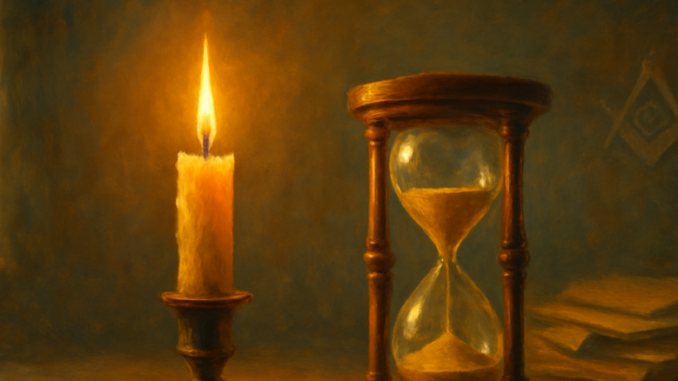
When election results hang in the balance — sometimes for days or even weeks — millions of people find themselves trapped in an uncomfortable limbo. The urge to jump to conclusions is overwhelming. Pundits contradict each other, social media erupts with speculation, and uncertainty gnaws at our composure. Yet hidden within that uneasy waiting is a profound lesson about character — one that Freemasonry has been teaching its members for centuries.
Why Waiting Feels So Unbearable
Imagine you’ve cast your vote, or you’re following election coverage from across the globe. Early projections trickle in, but they’re contradictory. Some districts are so close that recounts are inevitable. Commentators disagree. Your social media feed is a firestorm of hot takes. You feel the pull to pick a side, to find certainty where none yet exists.
That impulse is deeply human. Our brains are wired to seek patterns, to demand closure, to know how things stand. Uncertainty registers as a threat, and our instinct is to eliminate it as quickly as possible — even if that means forming judgments based on incomplete information. But it’s precisely in that reflex to judge too soon that we reveal something important about our character.
Freemasonry: A School for Patience
Within Freemasonry, patience is not a passive trait — it’s an active virtue, deliberately practiced and refined. Ritual plays a central role in this cultivation. A candidate who enters a Lodge progresses through degrees, and each degree unfolds at its own pace. Nothing is rushed. The Entered Apprentice learns to listen and observe before he may speak. The Fellowcraft develops through study and reflection. The Master Mason comes to understand that true wisdom demands time.
Benjamin Franklin, himself a Freemason and one of the architects of American democracy, understood that patience and democratic governance are inseparable. He knew that sound decisions are not made under pressure but mature through deliberation and careful thought. His life exemplified the principle that rushing to judgment serves neither the individual nor the republic.
Johann Wolfgang von Goethe, who was a member of the Lodge Amalia in Weimar, wrote extensively about the importance of inner maturation. His life’s work demonstrates that the formation of character doesn’t happen in moments of hasty action, but in the capacity to endure uncertainty — and to emerge from it stronger.
What Uncertainty Reveals About Your Character
How you respond to uncertainty says far more about your character than how you behave when everything is clear. Consider your own life: How do you react when a job application goes unanswered? When medical test results are delayed? When a conflict with someone you care about remains unresolved? Do you leap to conclusions? Do you become angry or anxious? Or can you sit with the tension and wait for the facts to speak?
In Freemasonry, this capacity is described as “working the rough ashlar.” The rough stone represents the unrefined personality that every person starts with. The work of shaping that stone is lifelong, and it demands the greatest discipline precisely in moments of uncertainty.
Those who learn to wait without judging are building the strongest quality a person can develop: a character that doesn’t depend on circumstances.
Four Practical Steps to Cultivate Patience
One of the beautiful aspects of Freemasonry is that its insights need not remain behind closed doors. Anyone can begin practicing patience as a character trait today. Here are four concrete steps you can apply immediately — whether you’re watching election results or waiting for something else entirely.
1. Recognize the impulse. Notice when you feel the urge to form a quick judgment. Say to yourself consciously: “I don’t need to know how this ends right now.” That awareness alone slows your reaction and creates space for nuance.
2. Ask questions instead of making statements. When you find yourself wanting to voice an opinion based on incomplete information, formulate three questions first: What do I know for certain? What am I assuming? What information is still missing? Marcus Aurelius, the Stoic emperor and philosopher, recommended precisely this method in his personal meditations.
3. Create a daily moment of silence. Take five minutes each day in which you deliberately do nothing — no checking your phone, no forming opinions, no consuming information. This isn’t meditation in any spiritual sense; it’s a practical exercise in tolerating emptiness. In the Lodge, every meeting begins with silence — not as a formality, but as preparation for truly listening.
4. Evaluate your reactions in hindsight. At the end of each week, look back on moments when you were impatient. Was your first assessment correct? Would waiting have led to a better outcome? By doing this regularly, you train yourself to pause a little longer before reacting next time.
Democracy and Brotherhood: The Same Foundation
It’s no coincidence that Freemasonry is historically intertwined with the development of democratic values. Voltaire was initiated as a Freemason in Paris in 1778, shortly before his death, as the crowning moment of a life devoted to tolerance and reason. James Anderson’s Constitutions of 1723 — the foundational rules of modern Freemasonry — emphasize that Brethren of all backgrounds and convictions must come together in peace. That requires exactly the same quality now being asked of millions of people waiting for election results: the ability to suspend judgment and allow the process to unfold.
Democracy only works when people are willing to wait — to accept that their vote is just one among many, and to respect an outcome that may not align with their wishes. This doesn’t call for passivity, but for a mature, deeply felt patience. It calls for character.
The Act of Waiting as an Act of Building
In the architectural metaphor of Freemasonry, every moment of patience is a stone added to your inner temple. It’s not the quick victories that define who you are, but the quiet moments when you chose restraint over reaction, reflection over reflex. Each time you resist the urge to judge prematurely, you lay another course of masonry in the structure of your character.
The election cycle, with all its suspense and uncertainty, offers a surprisingly powerful mirror. It shows us who we are when we don’t yet know the answer — and it invites us to become the kind of people who can hold that space with dignity and grace.
Whether you’re waiting for election results, a life decision, or simply the next chapter in your personal journey, remember that patience is not the absence of action — it’s the most deliberate action you can take. Freemasonry teaches us that the rough stone becomes a perfect ashlar not through speed, but through steady, intentional work. The next time uncertainty grips you, don’t fight it. Use it. Build with it. That is the true craft.
Copyright text & image: devrijmetselaar.nl
Texts are based on the ideas and content of the author of devrijmetselaar.nl, reviewed, corrected, and supplemented with the assistance of OpenAI. Images are created based on the ideas of the author of devrijmetselaar.nl using OpenAI/DALL-E.
Frequently Asked Questions
What does Freemasonry teach about patience?
Within Freemasonry, patience is an active virtue that is deliberately practiced and refined through ritual. Candidates progress through degrees at a deliberate pace, where an Entered Apprentice learns to listen and observe before speaking, a Fellowcraft develops through study and reflection, and a Master Mason comes to understand that true wisdom demands time. This structured approach teaches members that sound decisions are not made under pressure but mature through deliberation and careful thought.
How do elections demonstrate the importance of character during uncertainty?
Elections often create periods of uncomfortable limbo when results hang in the balance for days or weeks. During this time, the urge to jump to conclusions is overwhelming, and our brains are wired to seek patterns and eliminate uncertainty quickly. How we respond to this uncertainty reveals our character—whether we form judgments based on incomplete information or whether we exercise patience and allow the process to unfold properly.
Why did Benjamin Franklin believe patience and democracy are connected?
Benjamin Franklin, a Freemason and architect of American democracy, understood that patience and democratic governance are inseparable. He knew that sound decisions are not made under pressure but mature through deliberation and careful thought. His life exemplified the principle that rushing to judgment serves neither the individual nor the republic, highlighting the necessity of patience in maintaining a healthy democracy.

Be the first to comment