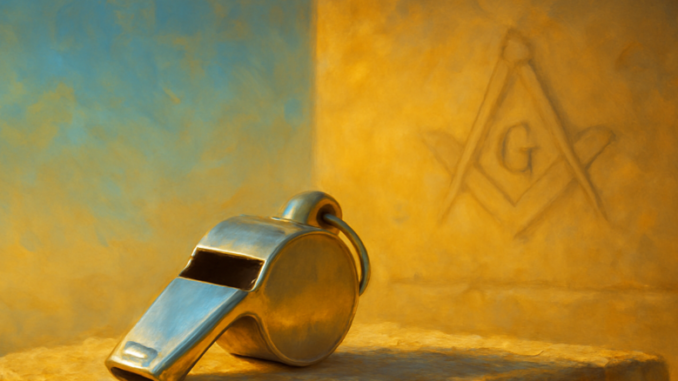
A match ends. The ball rolls to a stop. And then something erupts that has nothing to do with sport. The recent decision by a national football association to file complaints against hateful messages directed at players after a World Cup elimination reveals a deeper societal issue. How is it that people who were cheering moments ago can transform, in the blink of an eye, into judges who strip fellow human beings of their dignity? Behind this phenomenon lies a symbolic truth that Freemasons have explored for centuries: the struggle between the lower and higher self, and the choice that every moment demands of us.
The Whistle as a Symbol of Final Judgment
A referee’s whistle is a small object. Metal, simple, functional. Yet it carries an enormous symbolic weight. The moment it sounds, a match is frozen into a result. Win or lose. Hero or scapegoat. The complexity of ninety minutes of effort, dozens of decisions, and countless variables is reduced to a single number. This is the paradox of every judgment: it brings clarity, but it sacrifices nuance.
In Freemasonry, we know a comparable symbol: the gavel. The Worshipful Master strikes it at decisive moments — not to condemn, but to open a space for reflection. The difference is fundamental. The referee’s whistle ends something; the Master’s gavel invites inner work. When the final whistle blows and people reach for their phones to unleash their fury, they choose the former. They shut down. They judge. They reduce a fellow human being to a performance.
The Crowd and the Mask of Anonymity
Online communication has a peculiar effect on the human psyche. The screen becomes a mirror that reflects only one’s own convictions. The other person disappears behind pixels, profile pictures, and names that mean nothing. In this environment, the mask of civility falls away quickly. What remains is raw, primitive, and often shameful.
Freemasons wear symbolic garments during rituals that remind them of equality. No ranks, no status, no prejudice. Every person stands as a rough stone before the workshop — noble in potential, but still in need of shaping. It is precisely this sense of equality that seems to evaporate in the digital crowd. The anger targets skin colour, heritage, visible characteristics. The individual is replaced by a category. The person becomes a symbol of everything the screamer rejects.
Those who dehumanize others dehumanize themselves above all.
The Rough Stone and the Work Upon Yourself
One of the core concepts within Freemasonry is the transformation of the rough ashlar into the perfect ashlar. This image refers to the continuous work on one’s own character. The stone is not perfect at the outset. It has irregularities, cracks, and rough edges. It is up to the Mason to chisel, polish, and refine with patience and insight.
The hateful messages that flood in after a sporting defeat reveal how many people have never begun this inner work — or have abandoned it altogether. The rage that pours outward is often a projection of internal dissatisfaction. Disappointment over a match becomes a channel for deeper frustrations. But it is a false relief. After sending such a message, the sender is not lighter. The stone has not become smoother. On the contrary, new cracks have appeared.
Brotherhood Beyond Borders
Freemasonry recognizes no boundaries of nationality, faith, or background. In lodges around the world, people meet as brothers and sisters, regardless of their passport or the colour of their skin. This is not a modern ideal but a principle that reaches back to the very origins of the Craft. The building guilds of the medieval cathedrals brought together craftsmen from every corner of the known world, united in a single purpose: to build something greater than themselves.
When a football team fails in the eyes of the masses, the reaction reveals who we truly are as a society. Are we builders or destroyers? Do we form a brotherhood that endures adversity, or a mob that seeks a scapegoat? The legal action against racist messages is more than a juridical gesture. It is a mirror held up to society itself.
From Judgment to Reflection
What would happen if every person took three seconds of silence before sending a message? Three seconds in which a question arises: does this contribute to building something good, or does it tear something down? This is not naïve idealism. It is the essence of a contemplative approach to life that Freemasons practise at every meeting.
Pause before you react. Ask yourself: am I speaking from my higher self or my lower self? Acknowledge the humanity of the other, even in disappointment. Choose words that build, not words that demolish.
The referee’s whistle will keep sounding. Matches will be lost. Disappointment will always be part of the human experience. But the choice of how we deal with that disappointment always lies in our own hands. Those hands can throw stones — or they can continue to shape and refine the stone within.
The recent events surrounding the national football team are more than a sporting incident. They expose where our society still has room to grow. Freemasonry offers no ready-made answers, but it does offer a direction: the ongoing work on one’s own inner temple. When we learn to temper our judgment, to see the other as an equal human being, and to transform our disappointments into self-reflection, we build together something that transcends any match result. The question is not who wins or loses. The question is who we choose to be when the whistle blows.
Copyright text & image: devrijmetselaar.nl
Texts are based on the ideas and content of the author of devrijmetselaar.nl, reviewed, corrected, and supplemented with the assistance of OpenAI. Images are created based on the ideas of the author of devrijmetselaar.nl using OpenAI/DALL-E.
Frequently Asked Questions
What does Freemasonry teach about judging others?
Freemasonry teaches that true judgment should invite reflection and inner work rather than condemnation. The symbolic gavel of the Worshipful Master represents opening space for self-improvement, not shutting down dialogue or reducing people to their worst moments. Freemasons are encouraged to see the potential in every person, like a rough stone that deserves careful shaping rather than harsh dismissal.
How does Freemasonry promote equality and respect?
Freemasonry emphasizes that all members stand equal before the workshop, regardless of rank, status, or background. During rituals, symbolic garments remind Masons that prejudice and external characteristics are irrelevant to a person's inherent dignity and worth. This principle of equality is fundamental to the Masonic belief that every individual deserves respect and has the potential for moral growth.
What is the concept of the 'rough ashlar' in Freemasonry?
The rough ashlar represents the continuous personal development that every Mason undertakes. Just as a rough stone must be carefully chiseled and polished to become perfect, Masons work patiently on their own character, removing rough edges and imperfections through self-reflection and moral improvement. This teaches that transformation is a lifelong commitment requiring discipline, insight, and dedication to becoming a better person.
How can Masonic principles help address online hatred and dehumanization?
Freemasonry teaches that dehumanizing others ultimately dehumanizes oneself, and that every person deserves to be seen as an individual with inherent worth rather than reduced to a category or symbol. By embracing Masonic values of equality, compassion, and the ongoing work of self-improvement, individuals can resist the impulse to judge harshly and instead choose reflection and respect. These principles offer a powerful antidote to the anonymity and cruelty that can flourish online.

Be the first to comment