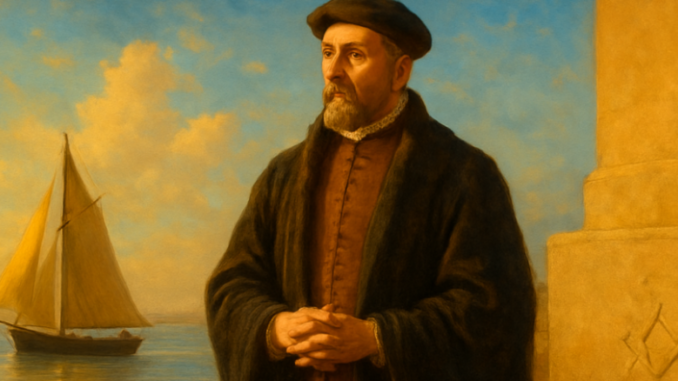
A stone being worked bears the marks of many hammer blows. Some make it smoother; others leave cracks behind. This is precisely how the sixteenth-century thinker Michel de Montaigne viewed the human soul — as a piece of work that never quite reaches completion, continually shaped by contradictory forces. His essay on the inconsistency of our actions drew from a rich philosophical tradition reaching back to antiquity. Which thinkers whispered to him what it truly means to be human in all our inconsequence?
The Rough Ashlar as Starting Point
In Freemasonry, the rough ashlar is a well-known symbol: the unworked stone representing the apprentice at the beginning of his path. This stone is not flawed — it is simply unfinished. It awaits the work of reflection and experience. Montaigne would have recognized this image immediately. His essay on inconsistency opens with the observation that we human beings possess no fixed core, but instead consist of layers, fractures, and surprising turns. The philosopher treated himself as his own subject of study and discovered within a fundamental mutability that did not trouble him, but fascinated him.
This view of the human being as a work in progress had deep roots in Renaissance thought. Montaigne wrote during a time when the rediscovery of ancient texts was transforming the intellectual landscape. The printing press made the works of Greek and Roman philosophers accessible to a broader audience than ever before. In his tower study, surrounded by books, Montaigne entered into dialogue with voices from a distant past — and what they told him about the nature of the self would resonate through the centuries.
Plutarch: The Mirror of Many Faces
No author left a deeper imprint on Montaigne than the Greek biographer and moralist Plutarch. His Lives of the Noble Greeks and Romans and especially his Moral Essays served as an inexhaustible source of anecdotes and insights. Plutarch wrote about heroes who had moments of failure, about philosophers who did not live up to their own principles, and about the gap between word and deed. He presented human beings not as heroes or villains, but as complex creatures full of contradictions.
Montaigne himself wrote: “We are all patchwork, and so shapeless and diverse in composition that each bit, each moment, plays its own game.” These words echo Plutarch’s spirit perfectly. The symbolism speaks volumes: the human being as mosaic, not as monolith. Each fragment tells a different story. This vision stands in direct opposition to the ideal of the unwavering hero or the perfect sage. Plutarch taught Montaigne that even the greatest figures in history were unpredictable in their actions — and that this unpredictability was not a defect but a defining feature of being human.
Stoic Echoes and Their Limits
Stoicism, championed by thinkers such as Seneca and Epictetus, formed another crucial influence on Montaigne’s thought. The Stoics strove for constantia — steadfastness of character and imperturbability amid life’s storms. They believed that the wise person could build an inner fortress, untouchable by the whims of fortune. It is an attractive ideal, and one that has appealed to thoughtful people across millennia.
Montaigne admired this ideal, but ultimately could not bring himself to believe in it. His observations of himself and others revealed that even the most disciplined mind remained subject to moods, physical discomforts, and unexpected passions. He read Seneca with enthusiasm — but also with a smile. The Stoic sage was a beautiful dream, not an achievable reality. In Masonic terms, one might say: the perfect ashlar is a guiding principle, not a final destination. The cubic stone serves as a compass for our efforts, but we should not mistake the compass for the journey itself.
Skepticism as Liberation
Perhaps even more fundamental to Montaigne’s thinking was Pyrrhonian skepticism. This ancient school, named after the philosopher Pyrrho, taught that true knowledge is ultimately unattainable. We cannot know with certainty how things really are. On the surface, this sounds like intellectual defeat. But Montaigne experienced it as liberation.
If we cannot even know ourselves fully, how can we presume to understand others? The famous motto that Montaigne had engraved in his tower study — “Que sais-je?” (What do I know?) — encapsulates this attitude perfectly. It is not a cry of despair, but an invitation to humility. Within the context of Freemasonry, this resonates powerfully with the emphasis on self-knowledge as the foundation of all further wisdom. The compasses and the square do not measure only the external world — they also measure the inner one. True Masonic work begins not with judging others but with the honest appraisal of one’s own rough edges.
Renaissance Humanism: The Human Being as Center and Riddle
Montaigne wrote in the autumn of the Renaissance, a period that celebrated the human being as the measure of all things. Humanists such as Erasmus and Pico della Mirandola had sung the praises of human dignity, placing mankind at the very center of creation. But Montaigne added a critical note. Yes, the human being stands at the center — but what exactly is that center? A shifting point. A moving target.
The philosophical threads that wove through Montaigne’s essay are worth considering together: the influence of Plutarch on understanding human contradiction; the Stoic dream of steadfastness as a contrasting ideal; skepticism as the source of intellectual humility; and the humanistic elevation of the individual, tempered by rigorous self-criticism. These influences merged in Montaigne’s writing into something genuinely new. He did not adopt any single school uncritically but distilled from each tradition what seemed most truthful. His inconsistency was not weakness — it was the honest recognition of a deeper truth about human existence.
The Stone That Is Never Finished
Symbolically, Montaigne’s vision offers genuine consolation to anyone who struggles with their own inconsistencies. The rough ashlar does not need to be carved into a perfect cube within a single lifetime. Every hammer blow — including the ones that miss, including failure itself — is part of the process. The philosopher who examined himself so honestly in his essays demonstrated that acknowledging one’s own changeability is not a source of shame, but a form of wisdom. To be aware of our contradictions is already a step toward that self-knowledge the ancient mysteries and modern Freemasonry alike have always held sacred.
In the Lodge, as in Montaigne’s tower, we are invited to look honestly at who we are — not at who we wish we were. The tools we are given are not meant to create perfection, but to encourage continuous, humble effort. Montaigne, who never claimed membership in any brotherhood, nonetheless embodied the spirit of that work: patient, curious, unflinching in self-examination, and always aware that the next hammer blow might reveal something unexpected.
Montaigne’s essay on the inconsistency of our actions invites us on an inward journey. The philosophical sources from which he drew — from Plutarch to the skeptics, from the Stoics to the humanists — together form a rich soil for self-examination. The stone being worked always remains somewhat rough. And perhaps that is precisely the point. In acknowledging our incompleteness, we find not failure but the very essence of what it means to grow. The rough ashlar is not a problem to be solved — it is a lifelong invitation to keep working, keep questioning, and keep discovering what lies beneath the surface.
Copyright text & image: devrijmetselaar.nl
Texts are based on the ideas and content of the author of devrijmetselaar.nl, reviewed, corrected, and supplemented with the assistance of OpenAI. Images are created based on the ideas of the author of devrijmetselaar.nl using OpenAI/DALL-E.
Frequently Asked Questions
What does the rough ashlar symbolize in Freemasonry, and how does it relate to Montaigne's philosophy?
The rough ashlar represents the unfinished apprentice at the beginning of his Masonic journey, symbolizing potential rather than deficiency. Montaigne viewed the human soul similarly — as an unfinished work continuously shaped by experience and reflection, much like the stone awaiting the craftsman's careful work. This shared vision connects Freemasonry's understanding of self-improvement with Renaissance philosophy, showing how the Craft encourages members to embrace their ongoing development.
How did Montaigne's study of ancient philosophers influence his view of human nature?
Through his extensive reading of Greek and Roman texts, particularly Plutarch, Montaigne discovered that even the greatest figures in history were full of contradictions and inconsistencies. Rather than viewing this as a flaw, he embraced human complexity as a fundamental truth, teaching that we are 'patchwork' beings where each moment reveals different aspects of ourselves. This philosophy of accepting our multifaceted nature aligns beautifully with Freemasonry's goal of helping members understand and perfect themselves.
Is Montaigne's philosophy of inconsistency pessimistic or optimistic?
Montaigne's view is fundamentally optimistic and liberating rather than pessimistic. He did not find the mutability of the human soul troubling; instead, it fascinated him and freed individuals from the impossible demand of being perfectly consistent or unchanging. This perspective resonates with Freemasonry's constructive philosophy, which teaches that change, growth, and self-reflection are valuable and necessary parts of the human experience.
What can Freemasons learn from Montaigne's approach to understanding ourselves?
Montaigne's emphasis on honest self-examination and acceptance of our contradictions provides valuable guidance for Masonic self-improvement. Rather than seeking to eliminate inconsistency, Masons can learn to observe themselves with curiosity and compassion, recognizing that growth comes through acknowledging all our facets. This philosophical approach deepens the Craft's practical work of refining character and developing wisdom throughout a Mason's lifetime.

Be the first to comment