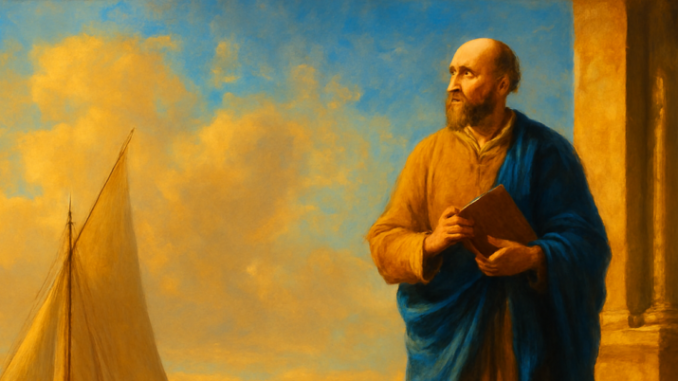
When Michel de Montaigne placed the laughing Democritus opposite the weeping Heraclitus in the fiftieth essay of his first book, he was doing far more than recounting an anecdote. He was positioning himself within a centuries-old philosophical debate about the proper attitude toward human existence. Behind that seemingly simple contrast lies a rich tapestry of influences: Greek Skeptics, Roman Stoics, Renaissance humanists, and classical biographers. This article examines that philosophical background and explores how the same intellectual tradition echoes in the way Freemasonry approaches human judgment.
Two Ancient Philosophers as Mirrors
The image of the laughing and weeping philosopher is far older than Montaigne himself. Democritus of Abdera, the fifth-century BCE atomist philosopher, was portrayed in antiquity as the thinker who responded to human folly with laughter. Heraclitus of Ephesus, the obscure philosopher of eternal flux, was cast as the one who shed tears over that same humanity. This contrast was not described in these terms by Democritus or Heraclitus themselves — it was a later construction that reached the European imagination primarily through Seneca and Juvenal.
Montaigne knew this imagery firsthand. In his famous tower library at the Château de Saint-Michel-de-Montaigne, he had direct access to the works of Seneca, whose dialogue On the Tranquility of the Mind articulated the opposition between Democritus and Heraclitus with striking concision. Seneca wrote that Democritus, every time he appeared in public, could not help but laugh, while Heraclitus wept — because the former regarded everything people do as ridiculous, and the latter as pitiable. Montaigne adopted this image but then turned it on its head in a manner entirely his own.
The Skeptical Tradition as Foundation
The deepest philosophical foundation of Montaigne’s essay lies in Pyrrhonist skepticism, the school of thought that traces back to Pyrrho of Elis. Pyrrho taught that we cannot make certain pronouncements about the true nature of things, and that the wisest stance is therefore the suspension of judgment. Montaigne encountered this tradition through the Outlines of Pyrrhonism by Sextus Empiricus, a work that enjoyed renewed interest during the sixteenth century. The famous personal motto Montaigne had engraved on a medal — Que sais-je? (What do I know?) — remains the most celebrated expression of this skeptical program.
In the essay on Democritus and Heraclitus, this skepticism translates into a fundamental reluctance to pass judgment. Montaigne does not definitively choose laughter or tears. He explores both attitudes, weighs them against each other, and leaves the reader with an open question. This is not indecisiveness — it is a deliberate method: by suspending judgment, space opens up for deeper insight.
Stoic and Humanist Layers
Alongside skepticism, Stoicism plays a crucial role in Montaigne’s thought. The Stoic philosophers — particularly Seneca, Epictetus, and Marcus Aurelius — emphasized the distinction between what lies within our power and what does not. This distinction resonates in Montaigne’s choice not to judge the world as a whole, but to examine our own reaction to it. The laughter of Democritus and the tears of Heraclitus, read in this light, are not so much verdicts on reality as expressions of an inner disposition — a choice about how one relates to the world.
The essay also situates itself firmly within the tradition of Renaissance humanism. Montaigne was an admirer of Plutarch, whose Lives and Moralia he cited extensively. Plutarch offered Montaigne not only anecdotes about Greek and Roman thinkers but also a method: comparing lives and ideas in order to arrive at deeper understanding. The comparative structure of the essay — Democritus placed alongside Heraclitus — directly echoes this Plutarchian approach. Cicero, too, with his eclectic engagement with various philosophical schools, fed Montaigne’s tendency not to follow a single system but to adopt whatever proved most useful from every tradition.
Personal Judgment and Freemasonry
Here a striking parallel emerges with the intellectual and spiritual attitude cultivated within Freemasonry. The Freemason is not asked to deliver a final verdict on the world, but to engage in continuous self-examination and self-improvement. Much like Montaigne, who suspends judgment to make room for nuanced insight, the Freemason strives for an attitude of openness: listening to diverse perspectives, daring to question one’s own position, and meeting the unknown with curiosity rather than prejudice.
True wisdom does not begin with the answer — it begins with the willingness to suspend one’s own judgment and to look at humanity and the world with fresh eyes.
Montaigne’s essay thus reveals a tradition of thought that runs from Greek antiquity through the Renaissance to modern Freemasonry. Each of these traditions revolves around the same core question: how do I, as a thinking being, relate to a world I can never fully fathom? Democritus chose laughter, Heraclitus chose tears, the Pyrrhonists chose the silence of suspension. Montaigne chose the essay as a form in which all these answers could be laid side by side, without definitively favoring one over another.
Two Worlds, One Quest
When we place the perspective of the academic philosopher next to that of the Freemason, what stands out is how deeply both traditions prioritize inner attitude over outward judgment. The philosopher analyzes skepticism as a school of thought, reconstructs influences, and contextualizes arguments. The Freemason experiences those same principles as living practice — in the lodge, in conversation with brothers and sisters, and in the daily effort to meet the world with humility and an open mind.
The Masonic tradition, like Montaigne’s essays, does not demand that its members arrive at a single, fixed conclusion about the nature of existence. Instead, it invites a continuing journey of reflection and discovery. The tools are different — the philosopher wields argument and analysis, the Freemason works with symbol and ritual — but the underlying aspiration is remarkably similar: to cultivate a mind that remains alert, receptive, and honest about the limits of its own understanding.
Montaigne understood, as the best Masonic thinkers have always understood, that certainty can be a trap. The willingness to hold multiple perspectives in tension, to resist the comfortable closure of a final verdict, is not a weakness but a discipline. It is the philosophical equivalent of the rough ashlar being shaped, slowly and deliberately, into something more refined — not through the imposition of dogma, but through the patient, ongoing work of self-examination.
Montaigne’s engagement with Skeptics, Stoics, and humanists offers more than an exercise in intellectual history. It illuminates a disposition toward knowledge and selfhood that Freemasonry has long embraced. Whether we laugh with Democritus or weep with Heraclitus, the deeper task remains the same: to question our own assumptions, to hold judgment lightly, and to recognize that the most meaningful work is not the conquest of certainty but the cultivation of wisdom. In this shared commitment to humble, open-minded inquiry, the philosopher’s study and the Masonic lodge prove to be closer neighbors than one might expect.
Copyright text & image: devrijmetselaar.nl
Texts are based on the ideas and content of the author of devrijmetselaar.nl, reviewed, corrected, and supplemented with the assistance of OpenAI. Images are created based on the ideas of the author of devrijmetselaar.nl using OpenAI/DALL-E.
Frequently Asked Questions
Who were Democritus and Heraclitus, and why did Montaigne use them as philosophical contrast?
Democritus of Abdera was a fifth-century BCE atomist philosopher known for responding to human folly with laughter, while Heraclitus of Ephesus was portrayed as weeping over humanity. Montaigne used this contrast, derived from sources like Seneca and Juvenal, to position himself within a centuries-old philosophical debate about the proper attitude toward human existence and human judgment.
What is Pyrrhonist skepticism and how did it influence Montaigne?
Pyrrhonist skepticism, traced back to Pyrrho of Elis, teaches that we cannot make certain pronouncements about the true nature of things and that the wisest stance is suspension of judgment. Montaigne encountered this tradition through Sextus Empiricus's Outlines of Pyrrhonism and adopted its philosophy, famously expressing it through his personal motto 'Que sais-je?' (What do I know?).
What philosophical sources did Montaigne draw from in his essay on Democritus and Heraclitus?
Montaigne drew from multiple philosophical traditions including Greek Skeptics, Roman Stoics, Renaissance humanists, and classical biographers. His primary direct sources were the works of Seneca, particularly On the Tranquility of the Mind, which he accessed in his famous tower library at Château de Saint-Michel-de-Montaigne, as well as the skeptical writings of Sextus Empiricus.


Be the first to comment