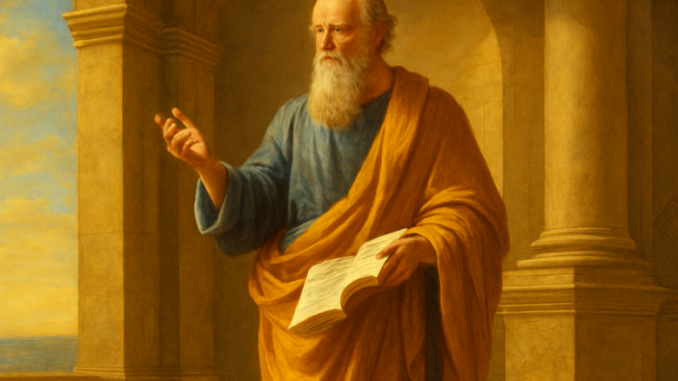
Imagine sitting in a room with your closest friends, knowing this conversation will be your last. What would you want to talk about? For Socrates, in the final hours before his death, the answer was clear: the immortality of the soul and the meaning of a life well lived. In Plato’s dialogue Phaedo, we find not only a philosophical masterpiece on life and death, but also a wellspring of insights that resonate remarkably with the core principles of Freemasonry.
The Setting of a Final Farewell
The Phaedo unfolds in Socrates’ prison cell on the day of his execution. His students — Phaedo, Simmias, Cebes, and others — gather around their teacher for one last conversation. What follows is neither a lament nor a bitter goodbye, but a calm, profound exploration of what it means to live and die as a philosopher. Socrates faces his own death with a serenity that both astonishes and inspires his companions.
This composure is not indifference or denial. It is the fruit of a life devoted to self-reflection and the pursuit of truth. Socrates spent his entire existence examining the human condition, asking difficult questions, and challenging false certainties. Now, at the end, he reaps the harvest of that inner labor.
The Soul as an Imperishable Principle
Throughout the Phaedo, Socrates presents several arguments for the immortality of the soul. He speaks of the soul as something that partakes of the eternal — something akin to the unchanging Ideas that lie behind the visible world. The soul, he argues, does not depend on the body for its existence. On the contrary, the body is a temporary dwelling, an instrument through which the soul makes its earthly journey.
“The true philosopher practices dying at every moment, for philosophy is nothing other than the liberation of the soul from the chains of the body.”
This notion — that the soul must free itself, must grow beyond its temporary limitations — touches on something fundamental. It is not about denying physical life, but about recognizing a deeper dimension within our existence. A dimension that calls for cultivation, attention, and conscious development.
Where Philosophy and Freemasonry Converge
Anyone familiar with both traditions will recognize in Plato’s words themes that also stand at the heart of Freemasonry. Consider the emphasis on inner growth and moral perfection. Both the Socratic path and the Masonic journey invite us into a continual labor upon ourselves — not to reach some fixed endpoint, but because the work itself is meaningful, because it refines the soul.
Freemasonry speaks of the quest for light and knowledge. In the Phaedo, Socrates describes how the soul, once purified of ignorance and desire, gains access to higher forms of understanding. The light the Mason seeks is closely related to the clarity Plato describes: a state of insight in which reality reveals itself, in which truth is no longer hidden behind appearances.
Brotherhood in the Face of Mortality
What makes the Phaedo so deeply moving is the spirit of brotherhood that permeates the entire conversation. Socrates’ friends are grief-stricken, yet their teacher invites them to transform their sorrow. He asks them not to mourn his body, but to rejoice in the liberation of his soul. This is no cold rationalization — it is an invitation to see differently.
In Freemasonry, we find the same emphasis on a brotherhood that reaches beyond the superficial. The bonds between Brethren are not built on temporary advantage or social standing, but on a shared devotion to growth and truth. When a Brother passes away, the Lodge mourns, but it also remembers what endures: the influence he had, the virtues he embodied, the spark he passed on to others.
The Daily Practice of Dying
One of the most provocative claims in the Phaedo is that the true philosopher constantly practices dying. It sounds morbid at first, but Socrates means something quite specific. He is talking about releasing the attachments that weigh down the soul — shedding vanity, unfounded fears, and the endless chase after possessions and recognition.
This process of purification involves several disciplines that will feel familiar to any Mason:
- Self-reflection as a daily practice
- Distinguishing between fleeting desires and lasting values
- The courage to look honestly at oneself
- Virtue as the foundation of a meaningful life
This inner refinement is not a one-time event. It is a lifelong endeavor — a continual shaping of character and understanding. The Freemason who works upon his rough ashlar knows this principle intimately. Every stroke of the gavel is a small death: the chipping away of an imperfection, the surrender of a resistance, the growth beyond a limitation.
Why This Conversation Still Resonates
Nearly two and a half millennia after the death of Socrates, we still read the Phaedo. Not as a historical curiosity, but as a living text that has something vital to say to us. The questions Plato raises — about the soul, about what remains when everything passes away, about how to live in the light of death — are still our questions.
Freemasonry preserves a similar wisdom within its rituals and symbolism. It reminds us that we are more than our temporary existence, that our actions and intentions leave traces, and that the search for truth and light is not an individual whim but a shared calling. In this sense, Plato and Freemasonry are allies — both oriented toward that mysterious point where knowledge, virtue, and brotherhood converge.
Perhaps you have wondered what remains when everything falls away. The Phaedo invites you not to avoid that question, but to explore it with the same calm and courage Socrates demonstrated in his final hours. For those who walk the Masonic path, this is familiar territory — the recognition that the quest for light never truly ends, and that it is in the asking itself that we find meaning.
Copyright text & image: devrijmetselaar.nl
Texts are based on the ideas and content of the author of devrijmetselaar.nl, reviewed, corrected, and supplemented with the assistance of OpenAI. Images are created based on the ideas of the author of devrijmetselaar.nl using OpenAI/DALL-E.
Frequently Asked Questions
What is the main connection between Plato's Phaedo and Freemasonry?
Both traditions share an emphasis on inner growth, moral perfection, and a continual labor upon oneself. They invite practitioners into a lifelong journey of self-reflection and the pursuit of truth, recognizing a deeper spiritual dimension within human existence that calls for cultivation and conscious development.
What does Socrates mean by 'the true philosopher practices dying at every moment'?
Socrates means that philosophy involves the liberation of the soul from the chains of the body and its temporary limitations. This is not about denying physical life, but rather recognizing that the soul must free itself and grow beyond material constraints through continuous self-examination and pursuit of truth.
Why did Socrates remain calm and serene facing his own execution in the Phaedo?
Socrates' composure came from a lifetime devoted to self-reflection, asking difficult questions, and pursuing truth. His serenity was the fruit of inner labor and philosophical practice. He faced death not with indifference, but with the wisdom gained from examining the human condition throughout his life, demonstrating what it means to live and die as a philosopher.

Be the first to comment