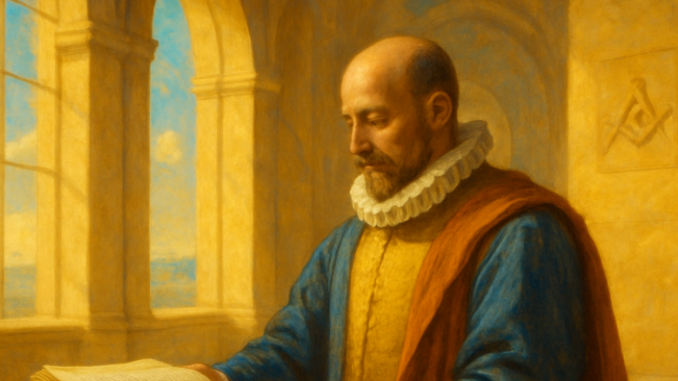
You’ve been there before: a meeting where someone delivers an eloquent speech, yet afterward you wonder — what was actually said? Or a conversation where someone uses just a few words and hits the mark perfectly. Michel de Montaigne recognized this difference back in the sixteenth century. In his essay “On a Saying of Caesar’s,” he dissects the gap between eloquence and authenticity. For Freemasons, this touches something essential: how do you build real connection — not through rhetoric, but through sincerity? This article translates Montaigne’s insights into concrete steps you can put into practice starting tomorrow.
When Words Block Rather Than Build Connection
Picture this: you’re sitting in a meeting, a lodge evening, or even a dinner with friends. Someone launches into a lengthy speech. The sentences are polished, the arguments sound convincing. But when the conversation ends, you feel a strange emptiness. Much was said, but nothing truly landed.
Montaigne describes exactly this phenomenon when he reflects on the way Julius Caesar expressed himself. Caesar was renowned for his direct, spare style. No embellishment, no rhetorical tricks. What he wrote, he meant — and what he meant, he wrote without preamble.
Montaigne poses an uncomfortable question: do we use language to reveal something, or to conceal it? In everyday life, we recognize this all too well. We talk to impress, to avoid conflict, to fit in. But genuine connection rarely emerges from ornate sentences. It arises when someone takes the risk of being simple and honest.
What Montaigne Teaches Freemasons About Sincerity
Within Freemasonry, this theme plays a central role. The search for truth is not an abstract ideal — it is a daily practice. In the lodge, brethren learn to speak from the heart, not from a need to be right or admired. Masonic ritual is steeped in the idea that inner growth begins with honesty toward yourself and others. The plumb line, which reminds the Mason of uprightness and integrity, is telling: it points straight down, without deviation, without decoration.
Montaigne aligns with this seamlessly. He admired Caesar not because Caesar was the greatest military commander, but because Caesar wrote the way he lived: without a mask. Montaigne, who as a writer constantly examined himself, knew how tempting it is to hide behind beautiful words. His entire essayistic project — visible throughout his collected Essays — revolves around peeling away those layers until something authentic remains.
Real connection doesn’t come from saying more. It comes from daring to say what you truly mean — without rhetorical protection.
Three Practical Steps Toward More Truthful Speech
It’s all well and good to read about sincerity, but how do you actually apply it? Below are three concrete exercises inspired by both Montaigne’s philosophy and Freemasonry’s tradition of self-reflection and moral improvement.
Step 1: Recognize Your Rhetorical Habits
Over the coming week, pay deliberate attention to moments when you use more words than necessary. When do you take a detour to make a point? When do you use humor, jargon, or vague formulations to avoid the heart of the matter? Montaigne kept a sharp record of his own thinking habits. You don’t need to keep a formal journal, but a brief moment of reflection at the end of each day can be remarkably clarifying. Ask yourself: did I say what I meant today, or did I wrap it up in packaging?
Step 2: Practice the Short, Honest Answer
Caesar was a master of the short, powerful sentence. Try consciously giving one short, honest answer per day in a conversation where you would normally elaborate at length. Not blunt or rude — but concise and sincere. “I don’t know” instead of a vague story. “That moves me” instead of a deflecting joke. You’ll find that brief honesty often creates more connection than a lengthy monologue.
Step 3: Listen as If You’re Working the Rough Stone
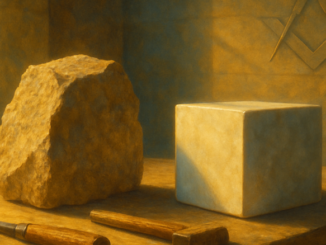
In Freemasonry, working the rough ashlar is a powerful symbol of personal growth. Apply this image to the way you listen. When someone speaks, listen not to respond, but to understand. Chip away the excess layers: your own judgment, your pre-prepared reply, your need to appear clever. What remains is attention in its purest form — and that is precisely where connection begins.
Key takeaways to practice daily:
- Notice when you use words as a shield instead of a bridge.
- Practice brevity: say what you mean, without preamble.
- Listen actively, without having your answer ready in advance.
- Reflect each day: was I sincere in my communication today?
Brotherhood as the Fruit of Honesty
Freemasonry does not regard brotherhood as something that automatically arises when people join the same organization. Brotherhood is the result of shared vulnerability — of daring to show who you truly are. Cicero, Caesar’s contemporary and the supreme orator, understood that eloquence was a form of power. But Montaigne showed that this power is also a trap. Those who always choose the perfect words sometimes lose contact with the truth behind them.
In the lodge, this becomes tangible. When a brother speaks during a presentation from personal experience — without the protection of abstract theories — something remarkable happens. The atmosphere in the room shifts. Others recognize themselves in what is being shared. That’s not magic; it’s the result of a conscious choice for honesty over eloquence. It’s exactly what Caesar did when he wrote, and exactly what Montaigne encourages us to try.
The beauty of Montaigne’s message is that you don’t need a library full of philosophy to act on it. You can start today — in your next conversation with a colleague, a friend, or in the lodge. Choose the shorter sentence. Embrace the discomfort of honesty. Because in that discomfort lies something Freemasons have always known: the rough stone cannot be shaped without the willingness to remove what is unnecessary. And the truest connections are built not with grand words, but with genuine ones.
Copyright text & image: devrijmetselaar.nl
Texts are based on the ideas and content of the author of devrijmetselaar.nl, reviewed, corrected, and supplemented with the assistance of OpenAI. Images are created based on the ideas of the author of devrijmetselaar.nl using OpenAI/DALL-E.


Be the first to comment