You may have noticed the headlines: calls for more physical power, more hormone-driven toughness in the military. It’s the kind of rhetoric that makes you pause. Because what does such a call actually say about how we view human strength? And more importantly — what does it say about how you view your own character?
The Exterior as the Measure
When defense circles start treating physical strength as the ultimate measure of fitness for service, something fundamental is at play. It implies that the exterior — the measurable body — matters more than what lives within. Muscle mass becomes the standard. Hormone levels become the test. But is that really where strength comes from?
You probably know this from your own experience. Those moments when you were physically exhausted but kept going. Not because your muscles carried you, but because something else held you upright. Willpower. Conviction. Or simply the refusal to let down someone who was counting on you. That is the kind of strength no laboratory can measure.
Character as the Foundation
In Freemasonry, there is an ancient piece of wisdom that speaks directly to this: you are not your body, you are not your title, you are not your possessions. You are what you do when no one is watching. Your character — that is the rough stone you work on throughout your entire life. Not to impress others with a polished surface, but to come closer to your true self.
This idea stands in stark contrast to a worldview that measures human worth by quantifiable achievements. Of course, physical fitness has its place. But when we reduce strength to bodily capacity alone, we lose sight of something essential. The courage to speak an unpopular truth. The patience to truly listen to another person. The integrity to uphold your principles under pressure.
The Four Cardinal Virtues
Classical philosophy, which also plays a significant role in Freemasonry, identifies four cardinal virtues: wisdom, justice, courage, and temperance. Notice that only one of these — courage — touches on what we might traditionally consider “masculine” strength. And even then, it’s not about physical power, but about the inner resolve to do the right thing despite fear.
Wisdom calls for reflection and self-knowledge. Justice demands empathy and honesty. Courage requires steadfastness, not aggression. Temperance asks for self-control and balance.
Together, these virtues form a character that is truly strong — not because it can dominate others, but because it knows itself and has mastery over its own impulses.
The Rough Stone and the Perfect Ashlar
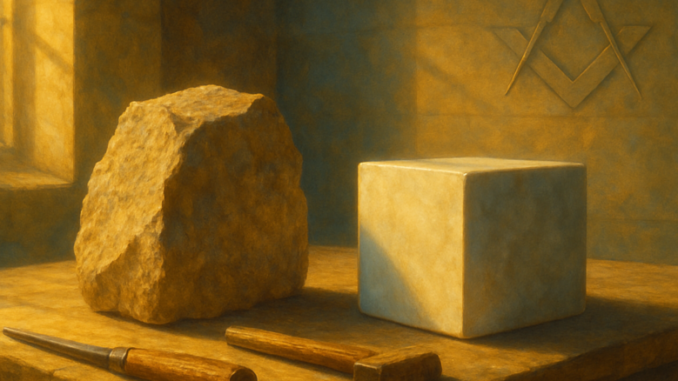
One of the central symbols in Freemasonry is the transformation of the rough stone into the perfect ashlar. This image resonates because it touches something universal. We are all born as rough stones — full of potential but also full of sharp edges and irregularities. The work of a lifetime is to shape that stone.
The chisel with which you shape yourself is not made of hormones or muscle mass. It is forged from self-reflection, from honest confrontation with your own shortcomings, and from the willingness to grow.
This doesn’t mean the body is unimportant. On the contrary, caring for your body is a form of self-respect. But the body is the vehicle, not the destination. The character you develop, the values you embody, the way you treat others — that is what ultimately matters.
Strength Through Connection
There is another dimension often overlooked in debates about individual strength: the power of connection. No soldier, however physically strong, can win a war alone. No person, however independent, can lead a meaningful life in isolation.
In Freemasonry, this is embodied in the concept of brotherhood. Not as a sign of weakness, but as a source of strength. When you know others stand behind you, you can go further than you ever could alone. When you are willing to support others, your own character grows stronger. This is the paradox of true strength: it grows by being shared.
The Question to Ask Yourself
So when you read about calls for more physical dominance, more hormone-fueled power, let it prompt a personal question. Not: how strong is my body? But rather: how strong is my character? How do I respond under pressure? Am I someone others can rely on?
These are not easy questions. They require the willingness to look at yourself honestly — including the parts you’d rather keep hidden. But they are the questions that truly matter. Because in the end, you won’t be remembered for your muscle mass. You’ll be remembered for who you were to the people around you.
The current debate about what makes a strong military can serve as a mirror for a deeper question: what makes a strong human being? Freemasonry doesn’t offer a definitive answer, but it points in a clear direction. True strength lies not in dominating others, but in mastering yourself. It lies in developing a character that is honest, steadfast, and capable of both gentleness and firmness — depending on what the moment requires. That is the stone worth working on.
Copyright text & image: devrijmetselaar.nl
Texts are based on the ideas and content of the author of devrijmetselaar.nl, reviewed, corrected, and supplemented with the assistance of OpenAI. Images are created based on the ideas of the author of devrijmetselaar.nl using OpenAI/DALL-E.
Frequently Asked Questions
What does Freemasonry teach about true strength?
Freemasonry teaches that true strength comes from character and inner resolve, not physical power alone. It emphasizes that you are defined by what you do when no one is watching, and that your character is the rough stone you continuously work to refine throughout your life. This understanding helps members develop genuine strength rooted in wisdom, justice, courage, and temperance rather than external measures.
What are the Four Cardinal Virtues in Freemasonry?
The Four Cardinal Virtues are wisdom, justice, courage, and temperance. Freemasonry teaches that these virtues form the foundation of true character and strength. Rather than focusing on physical dominance, these virtues call for self-reflection, empathy, steadfastness in doing what's right, and self-control—qualities that create a person of genuine integrity and mastery.
What does the 'rough stone to perfect ashlar' symbol mean?
This central Freemasonry symbol represents the lifelong journey of personal development and self-improvement. Each person begins as a rough stone full of potential but also with imperfections, and through dedication and self-work, they shape themselves into a perfect ashlar—a refined, balanced individual. It's a powerful reminder that personal growth is an ongoing process of refinement guided by character and virtue, not external accomplishments.
How does Freemasonry view human worth and character?
Freemasonry teaches that human worth is not measured by possessions, titles, or physical attributes, but by the strength of one's character and the integrity of one's actions. The organization values qualities like the courage to speak unpopular truths, the patience to listen to others, and the ability to uphold principles under pressure. This perspective encourages members to focus on developing their inner character as the truest measure of their value.
Why does Freemasonry emphasize character over physical strength?
Freemasonry emphasizes character because it recognizes that lasting strength comes from inner conviction, moral integrity, and self-mastery—not from external or measurable physical traits. This ancient wisdom acknowledges that true leadership and personal power arise from wisdom, justice, and courage in one's principles and actions. By focusing on character development, Freemasonry helps members build strength that transcends time and remains unshakeable regardless of circumstances.


Be the first to comment