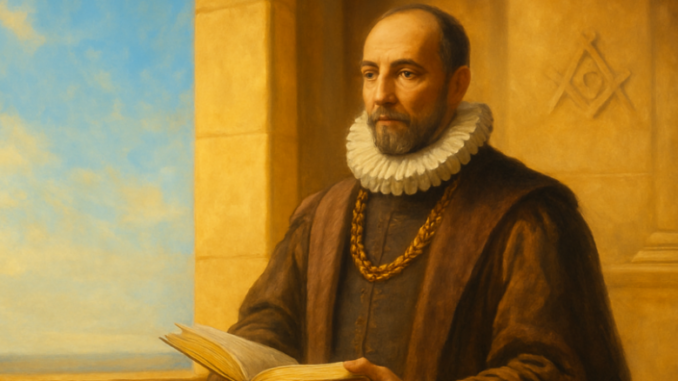
A single sentence can carry the weight of an entire philosophical edifice. When Michel de Montaigne pauses in his fifty-third essay to reflect on a remark attributed to Julius Caesar, he opens a window onto ancient philosophical traditions that continue to resonate today. Behind that one observation about eloquence and action lie the echoes of Stoicism, Skepticism, and Renaissance Humanism — the very same wellsprings from which Freemasonry draws its contemplative power. This article digs into the philosophical roots of Montaigne’s essay and traces how a word from antiquity became a mirror for self-knowledge.
The Word as Stone: What Caesar Said and Why It Matters
The remark Montaigne uses as his starting point is one attributed to Julius Caesar: that deeds outweigh words, and that true eloquence resides not in ornamental language but in the force of substance. For Caesar, language was an instrument in the service of action. Montaigne picks up this idea and turns it over in his hands the way a stonemason studies a rough ashlar. He examines not only what Caesar meant, but what the thought reveals about the relationship between appearance and essence, between rhetoric and authenticity.
This theme was far from arbitrary. In sixteenth-century France, torn apart by wars of religion and political deceit, the question of sincerity was a matter of life and death. Montaigne, who served as mayor of Bordeaux in the thick of those storms, understood that words could function as bridges or as weapons. His essay is therefore no academic exercise — it is a deeply personal quest for the truth behind the mask.
Stoic Foundations: Seneca and the Virtue of Sobriety
Stoic philosophy forms one of the most important pillars beneath Montaigne’s thinking in this essay. Lucius Annaeus Seneca, the Roman philosopher and statesman, serves as an unmistakable guide. Seneca repeatedly warned against embellished language. In his letters to Lucilius, he wrote that an excess of style is a sign of inner weakness: whoever truly has something to say needs no ornaments. Montaigne embraces this principle and applies it to his own writing practice. His essays are deliberately unpolished, searching, more groping than asserting.
Stoicism teaches that a person should focus on what lies within their power: their own thoughts, judgments, and actions. Marcus Aurelius, the philosopher-emperor, framed this as a daily exercise in self-mastery. Montaigne translates the idea into the domain of language. Whoever loses themselves in rhetorical artifice loses their grip on themselves. Whoever speaks from inner conviction practices a form of virtue. This insight finds deep resonance in Freemasonry, where the ritual word is never intended to impress but to unlock an inner truth.
Skepticism as Method: The Doubt That Liberates
Alongside Stoicism, Skepticism is the second great philosophical current that colours Montaigne’s approach. Pyrrhonism, named after the Greek philosopher Pyrrho of Elis, holds that human beings cannot attain definitive knowledge and that the suspension of judgment offers a path to tranquillity. Montaigne had the famous motto Que sais-je? — What do I know? — engraved into the beams of his library ceiling. The question is not an expression of despair but of intellectual humility.
In the essay on Caesar’s remark, this Skepticism operates like a dissecting blade. Montaigne does not simply accept the statement at face value — he interrogates it. What does it truly mean to place substance above form? Is that always possible? Isn’t the writer who claims to avoid rhetoric being most cunningly rhetorical of all? This self-undermining honesty makes Montaigne a philosopher who refuses to spare himself. It is precisely this attitude that Freemasonry encourages: the willingness to examine one’s own rough stone with a critical eye before beginning to shape it.
The philosopher who dares to investigate their own doubt lays the foundation for genuine wisdom, just as the Freemason builds upon themselves by looking honestly into the mirror.
Plutarch and the Art of Comparison
A third philosophical source flowing through this essay is the work of Plutarch. The Greek biographer and moralist, whose Lives and Moralia Montaigne consulted constantly, offered him a method: comparing great figures in order to distil moral lessons. Plutarch placed Greek heroes alongside Roman generals not to declare a winner but to move the reader toward reflection. Montaigne does something similar when he sets Caesar’s view on eloquence beside that of Cicero. Where Cicero elevated rhetoric to an art in its own right, Caesar saw it as subordinate to action.
This comparative way of thinking is closely related to what happens in Freemasonry when brethren in the lodge place diverse perspectives side by side — not to win an argument, but to dig deeper together. Plutarch gave Montaigne the tools to look beyond the surface of a statement, and those tools have proved useful for centuries.
Renaissance Humanism: The Human Being as the Measure of All Things
The intellectual climate in which Montaigne wrote was steeped in Renaissance Humanism. Thinkers such as Desiderius Erasmus and Giovanni Pico della Mirandola had paved the way for a philosophy that placed human dignity and individual judgment at the centre. The rediscovery of classical texts — from Aristotle to Plato, from Cicero to Seneca — created a world in which a country gentleman from the Dordogne could draw from the entire reservoir of Greek and Roman wisdom.
Montaigne’s essay on Caesar’s remark is a quintessential product of that culture. It takes a fragment from antiquity, places it within a personal context, and transforms it into a living question. This is not antiquarian curiosity but something far more vital: a demonstration that the ancient texts remain alive whenever a reader has the courage to engage with them honestly. In the same spirit, Freemasonry preserves ancient symbols and rituals not as museum pieces but as working tools for moral and spiritual growth.
The Rough Ashlar and the Polished Word
What binds all of these philosophical traditions together in Montaigne’s essay is a single conviction: that the pursuit of truth demands the stripping away of pretence. The Stoics called for sobriety of expression. The Skeptics called for the suspension of hasty judgment. Plutarch called for careful comparison. The Humanists called for a return to the original sources. In each case, the goal is the same — to move beyond ornamentation and arrive at something real.
For Freemasons, this idea takes symbolic form in the rough ashlar. The unworked stone represents the self before conscious effort has shaped it. Montaigne’s essay enacts this process on the page. He takes an inherited idea — Caesar’s preference for substance over style — and works it, questions it, turns it, and in doing so reveals not only the meaning of the original remark but the contours of his own mind. It is an exercise in philosophical self-improvement that any Brother would recognise.
The enduring genius of Montaigne lies in his refusal to offer easy answers. He does not tell us that Caesar was right or wrong. Instead, he invites us to think alongside him, to test our assumptions against the wisdom of the ancients, and to accept that the search itself — rather than its conclusion — may be the truest form of knowledge. That invitation remains as powerful today as it was when it was first written in a tower library in sixteenth-century France.
Montaigne’s meditation on a single remark by Julius Caesar reveals something far greater than a literary curiosity — it exposes the deep philosophical roots from which the essay tradition grew. Stoicism, Skepticism, Plutarch’s method of comparison, and Renaissance Humanism all converge in a text that asks us to look past the surface of language and into the heart of meaning. These are the same traditions that inform Masonic thought: the commitment to self-examination, the courage to question, and the belief that working on oneself is the noblest endeavour of all. In Montaigne’s essay, as in the lodge, the rough stone waits to be shaped — and the first tool is honest reflection.
Copyright text & image: devrijmetselaar.nl
Texts are based on the ideas and content of the author of devrijmetselaar.nl, reviewed, corrected, and supplemented with the assistance of OpenAI. Images are created based on the ideas of the author of devrijmetselaar.nl using OpenAI/DALL-E.
Frequently Asked Questions
What is the main philosophical idea Montaigne draws from Caesar's remark about eloquence?
Montaigne uses Caesar's observation that deeds outweigh words to explore the relationship between appearance and essence. Caesar believed true eloquence resides in the force of substance rather than ornamental language, and Montaigne examines this idea as a personal quest for authenticity and truth behind the mask, particularly relevant in sixteenth-century France during the religious and political turmoil of his time.
How does Stoic philosophy influence Montaigne's approach to writing and language?
Stoicism, particularly through the teachings of Seneca and Marcus Aurelius, profoundly shapes Montaigne's philosophy. Seneca warned against embellished language as a sign of inner weakness, and Montaigne applies this principle to his own writing by deliberately keeping his essays unpolished and searching. Stoicism's emphasis on self-mastery and focusing on what lies within one's power translates into Montaigne's belief that sincere thought needs no ornaments.
What is the connection between Montaigne's essay and Freemasonry mentioned in the article?
The article suggests that behind Montaigne's reflection on Caesar lie philosophical traditions including Stoicism, Skepticism, and Renaissance Humanism—the same wellsprings from which Freemasonry draws its contemplative power. The essay serves as a mirror for self-knowledge, connecting ancient philosophical wisdom to Freemasonry's contemplative traditions.

Be the first to comment