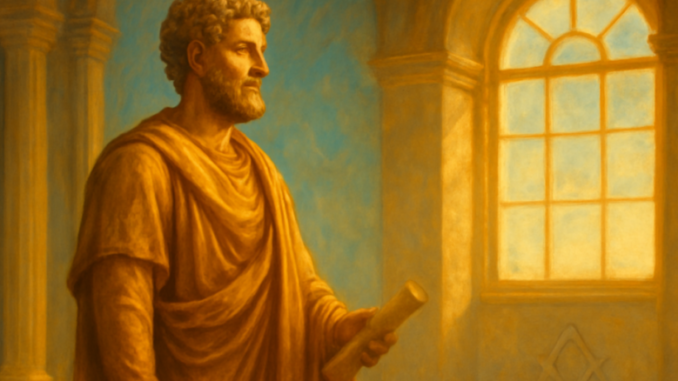
In the first book of his Meditations, Marcus Aurelius compiles a remarkable list of people to whom he owes a debt of gratitude. Far from being a mere personal tribute, this catalogue reveals the foundations of a philosophical tradition that elevates learning from others to the status of a core virtue. For the Freemason, this resonates deeply: the relationship between master and apprentice lies at the very heart of the lodge, embodied in rituals and symbols that transcend generations. How do these two worlds relate to each other, and what can we learn from their shared emphasis on intellectual and moral formation?
The Stoic Tradition of Grateful Reflection
Marcus Aurelius never wrote his Meditations for publication. They were personal exercises in self-reflection. Yet the first book is strikingly public in nature: it reads as a catalogue of virtues he learned from specific people in his life. This practice is rooted in Stoic philosophy, particularly in the teachings of Epictetus, whose Discourses Marcus studied as a young man. Epictetus taught that wisdom does not come from books alone but from the living examples around us. A philosopher who forgets his teachers forgets himself.
The Stoics distinguished themselves from other Greek schools through their emphasis on practical wisdom over theoretical knowledge. While Plato and Aristotle pursued abstract truths, thinkers like Zeno of Citium, Cleanthes, and Chrysippus sought the art of living well. Seneca, who lived a century before Marcus, refined this tradition through his Letters to Lucilius, in which he also stressed the importance of good role models. Marcus deliberately places himself in this lineage when he acknowledges what he owes to each of his teachers.
Plutarch and the Art of Moral Biography
Beyond the Stoic tradition, Marcus drew from another powerful source: the moral biographies of Plutarch. This Greek writer, who lived in the first century AD, composed lives of famous Greeks and Romans not as historical documents but as ethical portraits. His Parallel Lives demonstrated how character traits manifest themselves through action. Marcus’ enumeration of teachers follows the same structure: each person is distilled into one or a few virtues they embodied.
This approach is fundamentally different from modern biography. Plutarch and Marcus were not seeking psychological complexity or historical completeness. They were looking for usable examples — moral templates the reader could internalize. Marcus’ grandfather represents modesty, his mother stands for piety without superstition, and his teacher Rusticus embodies the art of absorbing insults without seeking revenge. Each portrait is a lesson in concentrated form.
The Masonic Vision of Master and Apprentice
In Freemasonry, the relationship between master and apprentice takes on a ritual form that shows a striking kinship with the philosophical tradition of Marcus Aurelius. The apprentice enters the lodge as a rough ashlar — unworked and unformed. Through instruction, ritual, and personal reflection, he is gradually shaped into a more perfect cube. This symbolism of the rough and perfect stone expresses the same truth Marcus articulated: we are formed by what we receive from others.
Gratitude toward our teachers is not a weakness but the recognition that wisdom never arises in isolation.
The ritual transmission of knowledge within the lodge mirrors the Stoic view that philosophy is a living tradition. Just as Marcus drew his wisdom not from abstract principles but from real people, so the Freemason learns not only from texts but from the living chain of brethren who walked the path before him. The symbols of the square and compasses, of the gavel and chisel, are not decorations but memory aids for virtues passed down from generation to generation.
Two Worlds, One Truth
The Stoic philosopher and the Freemason approach the question of moral formation from different angles, yet they arrive at remarkably similar conclusions. Marcus Aurelius emphasizes individual responsibility: it falls to the student to recognize and cultivate the virtues of his teachers. Freemasonry adds a communal dimension: the lodge serves as the sacred space where this transmission is ritually enacted and collectively experienced.
What both traditions share is the conviction that no one is truly self-made. The illusion of complete autonomy — so beloved in modern societies — is rejected by both. Marcus explicitly states that he owes his patience to his father, his intellectual curiosity to Rusticus, and his simplicity to Diognetus. The Freemason similarly acknowledges that his insights are not self-invented but received from brethren who illuminated the way before him.
The Enduring Relevance of Gratitude
In an age that glorifies individual achievement, the philosophy of Marcus Aurelius offers a powerful counterweight. His first book is not a catalogue of personal accomplishments but of gifts received. This attitude of gratitude is not merely ethically sound — it is psychologically healthy. Those who acknowledge what they have received from others lose the anxious compulsion to constantly prove themselves.
Freemasonry institutionalizes this wisdom by systematically confronting the apprentice with his dependence on the brotherhood. Initiation is not a celebration of individual strength but a ritual acknowledgment of collective wisdom. Just as Marcus begins his meditations with gratitude, so the Freemason begins his journey with the recognition that he needs help to shape the rough stone that he is.
Lessons for the Modern Seeker
The philosophical background of Marcus Aurelius’ gratitude list reaches far beyond historical curiosity. It invites us to undertake the same exercise: Who has shaped us? Which virtues have we absorbed from the people around us — perhaps without even realizing it? Both Stoic philosophy and Masonic tradition remind us that the most profound growth happens not in solitude but in relationship. The teacher needs the student just as the student needs the teacher, and every lodge, like every philosophical school, thrives on this reciprocal exchange.
Whether you approach this question as a philosopher, a Freemason, or simply as someone seeking to live a more examined life, the message is the same: take the time to name your teachers and the gifts they gave you. In doing so, you honor not only them but the tradition of moral formation that stretches from ancient Athens to the modern lodge — and beyond.
Marcus Aurelius and the Masonic tradition both teach us that wisdom is never a solitary achievement. It is received, cultivated, and passed on. By practicing gratitude toward those who have shaped us, we place ourselves within a living chain of moral formation — a chain that connects the ancient Stoics to the modern lodge and reminds us that the most enduring strength lies not in self-sufficiency but in the humble willingness to learn from others.
Copyright text & image: devrijmetselaar.nl
Texts are based on the ideas and content of the author of devrijmetselaar.nl, reviewed, corrected, and supplemented with the assistance of OpenAI. Images are created based on the ideas of the author of devrijmetselaar.nl using OpenAI/DALL-E.
Frequently Asked Questions
What is the connection between Marcus Aurelius's Meditations and Freemasonry?
Both emphasize the relationship between teacher and student as a core virtue. Marcus Aurelius's first book catalogs his debts to specific teachers, reflecting the Stoic value of learning from living examples. In Freemasonry, the master-apprentice relationship is central to the lodge, embodied in rituals and symbols passed down through generations. Both traditions elevate intellectual and moral formation through direct mentorship.
Why did Marcus Aurelius write his Meditations, and what makes the first book unique?
Marcus Aurelius wrote his Meditations as personal exercises in self-reflection, not for publication. However, the first book is distinctive because it reads as a public catalogue of virtues learned from specific people in his life. This practice stems from Stoic philosophy, particularly the teachings of Epictetus, who taught that wisdom comes from living examples rather than books alone.
How did Plutarch's moral biographies influence Marcus Aurelius's approach to listing his teachers?
Plutarch's Parallel Lives presented ethical portraits rather than historical documents, distilling character traits into virtues manifested through action. Marcus Aurelius followed this same structure in acknowledging his teachers, reducing each person to one or a few virtues they embodied. Rather than seeking psychological complexity, both Plutarch and Marcus identified usable moral examples that readers could internalize as ethical templates.

Be the first to comment