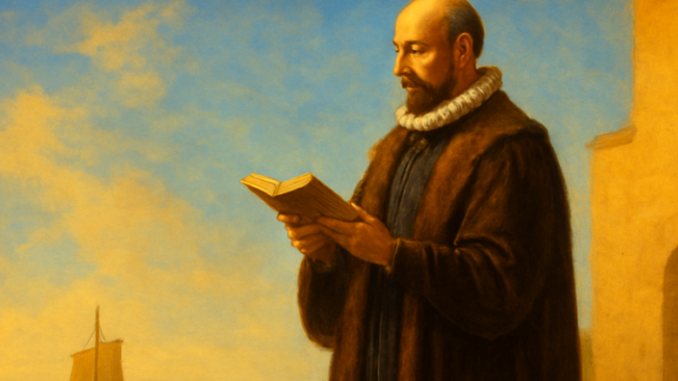
Can a name truly reveal something about the essence of a person, or is it merely an arbitrary label we paste onto reality? Michel de Montaigne wrestled with this paradox in his forty-sixth essay, “On Names.” It is a question that Greek philosophers, Roman Stoics, and medieval thinkers had already posed centuries before him. In this article, we explore the philosophical traditions that nourished Montaigne’s reflections on the power — and the powerlessness — of names, and why that same question continues to resonate in Freemasonry, where the granting and receiving of names and titles carries a distinctive ethical weight.
The Thesis: A Name Is Everything and Nothing at Once
Montaigne opens his essay with an apparent contradiction. On one hand, he acknowledges that names have enormous practical consequences: they shape reputations, steer expectations, and can even ignite wars. On the other hand, he argues that names are inherently hollow — arbitrary sounds devoid of intrinsic truth. This tension between the social reality of language and its philosophical emptiness forms the heart of the essay.
This was not an original paradox. Montaigne consciously leaned on a tradition stretching back to Greek thought about the relationship between word and reality. His genius lay not in inventing the question but in weaving it into the fabric of lived experience, forcing us to consider what names actually do to us — and what they fail to do.
Plato, Aristotle, and the Ancient Debate Over Language
The question of whether names belong to their bearers by nature or are merely assigned by convention was already sharply posed in the fifth century BCE. Plato addressed this theme at length in his dialogue Cratylus, where Socrates examines two opposing positions. Cratylus argues that every word possesses a natural correctness, while Hermogenes maintains that naming is purely a matter of convention. Plato deliberately lets the conversation end without resolution — a technique Montaigne would adopt centuries later.
Aristotle took a more pragmatic stance. In On Interpretation, he argued that words are signs deriving their meaning from human agreement, not from the nature of things themselves. Montaigne was well acquainted with this Aristotelian position, and his tendency to treat names as conventions clearly reflects that lineage. For both thinkers, the meaning of a word was something humans construct rather than something they discover embedded in the world.
Stoic and Skeptical Influences
The Stoics, notably Chrysippus and later Seneca, developed a nuanced philosophy of language. They distinguished between the spoken word, the meaning it carries, and the actual object to which it refers. This threefold division made it possible to acknowledge that names are practically functional without claiming that they contain metaphysical truths.
Seneca, one of Montaigne’s most beloved authors, repeatedly warned against confusing the name with the thing itself. In his Letters to Lucilius, he urges us to look beyond labels and examine the true nature of virtue and vice, regardless of what we call them. This Senecan impulse runs like a thread through Montaigne’s essay on names.
Equally important was the influence of Pyrrhonian skepticism, which Montaigne encountered through the writings of Sextus Empiricus. The Pyrrhonists held that we can reach no definitive certainty about any subject, and that the wise response is the suspension of judgment. For Montaigne, this attitude became a philosophy of life. His famous motto “Que sais-je?” — What do I know? — permeates his reflections on names as well: if we cannot even be certain about the reality behind things, how can we claim that a name captures that reality?
Plutarch and Renaissance Humanism
Alongside Seneca, Plutarch was the writer Montaigne cited and paraphrased most frequently. Plutarch’s Lives offered a treasure trove of historical examples showing how names could bring fame, disgrace, or confusion. Montaigne drew liberally from this source, using anecdotes about Roman generals and Greek statesmen to illustrate his philosophical points.
This approach was characteristic of Renaissance humanism: abstract ideas only became convincing when grounded in concrete human experience. Erasmus, writing a generation earlier, had employed the same method in his Adagia, where proverbs served as keys to deeper wisdom. Montaigne placed himself within this tradition but pushed further by making his own doubt and uncertainty the very subject of his writing. Where Erasmus collected the wisdom of others, Montaigne interrogated the limits of all wisdom — including his own.
Montaigne learned from the Stoics and the skeptics that a name does not contain the truth about a person. At best, it is an invitation to go searching for that truth.
The Medieval Problem of Universals as Background
Although Montaigne rarely referred explicitly to scholastic philosophy, his essay also echoes the medieval debate known as the problem of universals. This was the dispute between realists, who believed that general concepts such as “humanity” or “courage” have an independent existence, and nominalists, who argued that such concepts are merely names for collections of individual cases.
William of Ockham, the great nominalist, had argued that we should not multiply entities beyond necessity: if a name suffices as a practical tool, we need not invest it with metaphysical significance. Montaigne’s matter-of-fact attitude toward names aligns closely with this nominalist perspective, even though he expressed it in his own relaxed, essayistic style rather than in the formal language of scholastic debate. The echoes are unmistakable: names are tools, not truths.
The Ethical Dimension: Names in Freemasonry
This philosophical tension between name and essence is particularly relevant to Freemasonry. Within the Craft, Brothers and Sisters receive degrees, titles, and ritual designations. The question Montaigne poses reverberates here with special force: does the title make the person, or must the person live up to the title?
Freemasonry answers this question consistently in favor of inner merit over outward display. A degree is not a decoration but a charge — a call to further self-improvement. The title of Master Mason, for instance, is not a reward for past achievement but a commitment to ongoing moral and intellectual refinement. In this sense, the Masonic tradition embodies the very insight that Montaigne articulated: names and titles gain meaning only through the character and conduct of those who bear them.
In this regard, Montaigne was, without knowing it, a kindred spirit of the later Masonic tradition. Like the symbolic builders of the mind and spirit, he warned against the all-too-human tendency to mistake the label for the substance, the rank for the virtue, the name for the person. The Masonic lodge, at its best, is a place where titles serve as reminders of aspiration rather than markers of status — precisely the ethical posture that Montaigne’s essay invites us to adopt.
The ritual practice of conferring new names and words in Masonic ceremony is not mere formality. It is a conscious act of transformation, rooted in the understanding that receiving a name is the beginning of a journey, not its end. Every degree conferred is a question posed to the recipient: will you become worthy of what you have been called?
Montaigne’s essay on names may be nearly five centuries old, but its central question remains as vital as ever — perhaps especially within Freemasonry. The philosophical traditions he drew upon — Platonic inquiry, Aristotelian pragmatism, Stoic discernment, Pyrrhonian skepticism, and nominalist clarity — all converge on a single, enduring insight: a name is not a truth but a responsibility. For Freemasons, this means that every title received in the lodge is an invitation to inner work, not a certificate of completion. In learning to hold names lightly while taking their obligations seriously, we honor both Montaigne’s legacy and the deepest aspirations of the Craft.
Copyright text & image: devrijmetselaar.nl
Texts are based on the ideas and content of the author of devrijmetselaar.nl, reviewed, corrected, and supplemented with the assistance of OpenAI. Images are created based on the ideas of the author of devrijmetselaar.nl using OpenAI/DALL-E.
Frequently Asked Questions
What is the main paradox Montaigne explores in his essay 'On Names'?
Montaigne wrestles with the contradiction that names simultaneously have enormous practical consequences—shaping reputations and expectations—while being inherently hollow and arbitrary sounds devoid of intrinsic truth. This tension between the social reality of language and its philosophical emptiness forms the core of his philosophical inquiry.
How did ancient Greek philosophers approach the question of whether names have natural meaning or are merely conventional?
Plato's dialogue Cratylus presents two opposing views: Cratylus argued that words possess natural correctness, while Hermogenes maintained that naming is purely conventional. Plato deliberately left the question unresolved. Aristotle later took a more pragmatic stance, arguing in On Interpretation that words are signs deriving their meaning from human agreement rather than from the nature of things themselves.
Why does the question of naming carry distinctive ethical weight in Freemasonry?
The article suggests that in Freemasonry, the granting and receiving of names and titles carries a distinctive ethical weight, connecting Montaigne's philosophical inquiry about the power and powerlessness of names to the lived practices and traditions within Masonic orders, where naming ceremonies hold special significance and meaning.

Be the first to comment