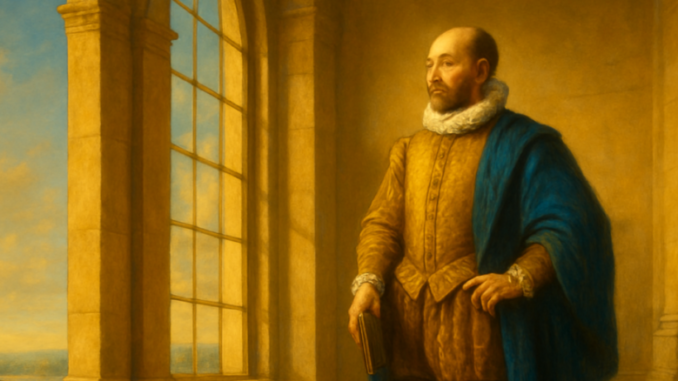
In December 1562, two French armies clashed on the plains near Dreux. Catholics and Huguenots fought a bloody battle that both sides simultaneously claimed as a victory. Michel de Montaigne, who witnessed the horrors of the Wars of Religion firsthand during his lifetime, devoted a short but striking essay to this event. In Essay 45 of the first book of his celebrated Essays, he examines how one and the same battle can be judged entirely differently depending on who is doing the looking. It appears to be a simple piece, but it touches on fundamental questions about truth, perspective, and the human tendency to shape reality to suit our own narrative.
A Nation Torn Apart: The Historical Context
The Battle of Dreux, fought on 19 December 1562, was one of the first major engagements of the French Wars of Religion — a devastating conflict that would tear France apart for nearly four decades. The Catholic forces were commanded by Anne de Montmorency and the Duke of Guise, while the Protestant army was led by Louis I de Bourbon, Prince of Condé.
What made this battle so remarkable was that both sides could credibly claim victory when the fighting was over. The Catholics ultimately held the battlefield — the traditional measure of who had won — but their commander-in-chief, Montmorency, was taken prisoner. The Huguenots suffered heavy losses, yet they in turn captured a key Catholic marshal. It was a chaos of shifting fortunes, where triumph and defeat were hopelessly intertwined.
Montaigne’s Central Insight
Montaigne does not use the Battle of Dreux to deliver a military analysis. His interest lies elsewhere entirely. He observes that the outcome of a battle is rarely as clear-cut as historians would have us believe. At Dreux, both sides claimed victory, and neither side was entirely wrong to do so. The Catholics had held the field, which was the conventional yardstick for determining the winner. But the Protestants had destroyed the enemy’s first line of battle and captured one of their most important commanders.
From this, Montaigne draws a broader conclusion: reality — even on the most concrete level of a military engagement with seemingly clear outcomes — is always subject to interpretation. This essay is characteristic of Montaigne’s method. He takes an apparently small or well-defined subject and reveals the vast philosophical questions hiding within it. In his hands, the Battle of Dreux becomes an illustration of a much larger theme: that absolute truth is often beyond our reach. What one side regards as a victory, the other experiences as a defeat, and both viewpoints rest on real facts.
According to Montaigne, Dreux demonstrates that every reality has multiple faces, and that true wisdom begins with acknowledging the perspective of the other.
Montaigne’s Examples and Line of Reasoning
In this brief essay, Montaigne keeps his argument deliberately compact. He describes the shifting fortunes of the day: how one wing of an army triumphs while the other is routed, how commanders are captured by an enemy that is itself on the verge of collapse. He points out that the conventional measure of victory — holding the battlefield — does not always do justice to what actually happened on the ground.
Montaigne also draws on classical examples from antiquity, showing that this phenomenon is timeless. Roman historians knew the problem just as well: battles whose outcomes remained disputed, victories that were barely distinguishable from defeats.
What Montaigne implicitly argues here connects to one of his great philosophical themes: the fallibility of human judgment. We are inclined to divide the world into neatly delineated categories — winners and losers, right and wrong. But reality is more stubborn than that. It refuses to be so easily split in two. Montaigne shared this insight with thinkers like Plutarch, whom he read and quoted extensively, and it resonates with the later skepticism of philosophers such as Baruch Spinoza, who likewise warned against forming judgments too hastily.
From the Battlefield to the Lodge: Perspective and Brotherhood
Montaigne’s observation about the ambiguity of reality touches on a core principle that also occupies a central place within Freemasonry. In the Lodge, people come together from diverse backgrounds, convictions, and worldviews. The brotherhood functions precisely because its members are willing to take the other’s perspective seriously, without treating their own viewpoint as the only truth.
The rituals of Freemasonry invite self-reflection: examining our own assumptions and recognizing that our view of the world is always colored by our position within it. Montaigne’s essay on the Battle of Dreux reminds us that even in seemingly factual matters — such as the outcome of a battle — there is room for multiple truths. This is not an argument for relativism or indifference, but for intellectual humility.
In the Masonic tradition, this is reflected in the ideal of the seeking individual: someone who knows that knowledge and understanding are always incomplete, and who therefore remains open to dialogue and shared inquiry. The ability to hold two seemingly contradictory truths in mind at once, and to resist the urge to declare one the sole winner, is a form of inner work that both Montaigne and Freemasonry ask of us.
The Key Themes at a Glance
Several important themes emerge from Montaigne’s compact essay. First, there is the ambiguity of historical events: facts are always embedded in interpretation, and no account of the past is entirely free from the perspective of the person telling it. Second, there is the fallibility of human judgment: we tend toward simplification where nuance is needed, sorting complex realities into tidy categories that rarely capture the full picture.
Third, there is the value of perspective: genuine knowledge only begins to emerge when we are willing to look through someone else’s eyes. And finally, there is intellectual humility — a fundamental attitude that Montaigne shares with the philosophical tradition of Freemasonry. Together, these themes form an enduring framework for approaching not just history, but everyday life with greater wisdom and openness.
In an age when public debates are so often reduced to sharp polarities — us versus them, right versus wrong, victory versus defeat — Montaigne’s brief meditation on the Battle of Dreux feels as urgent as ever. He reminds us that the world rarely cooperates with our desire for simple answers. The same event can be a triumph and a disaster, depending on where you stand. For Freemasons, this is more than an intellectual exercise. It is a lived practice, woven into every Lodge meeting where brothers sit together despite their differences, united not by agreement but by a shared commitment to seeking light. Montaigne, writing from the heart of a nation devouring itself over religious certainty, understood what the Craft has always taught: that wisdom begins not with knowing, but with the honest admission that our knowledge is never complete.
Copyright text & image: devrijmetselaar.nl
Texts are based on the ideas and content of the author of devrijmetselaar.nl, reviewed, corrected, and supplemented with the assistance of OpenAI. Images are created based on the ideas of the author of devrijmetselaar.nl using OpenAI/DALL-E.



Be the first to comment