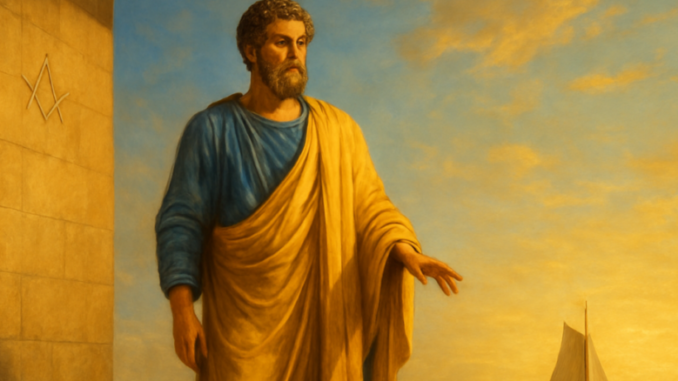
When Marcus Aurelius writes about the divine in the twelfth book of his Meditations, he draws on a philosophical tradition that stretches back five centuries before his time. His reflections on the cosmos as an ensouled whole, on the logos that pervades all things, are far more than private musings. They represent the culmination of a long chain of thinkers who grappled with the same fundamental question: what is the nature of the divine, and how does the human being relate to it? To truly understand his thought, we must return to the sources from which he drank.
The Legacy of Heraclitus
Stoic theology does not begin with the Stoics themselves, but with a solitary thinker from Ephesus who lived around 500 BCE: Heraclitus. This enigmatic philosopher introduced the concept of the logos as a cosmic ordering principle. For Heraclitus, reality was not chaos but an ongoing dance of opposites, held together by a divine reason he compared to an ever-living fire. When Marcus Aurelius writes of the fiery breath that pervades the universe, he echoes this ancient intuition.
Heraclitus did not see change as a threat but as the very essence of reality. Everything flows; nothing remains. Yet within that flow there is order — a hidden harmony that runs deeper than any visible contradiction. The Stoics adopted this insight and developed it into a complete metaphysics in which God and nature, reason and matter, converge in one all-encompassing whole.
Zeno and the Founding of the Stoa
Around 300 BCE, Zeno of Citium founded a new philosophical school in Athens. He taught in the Stoa Poikilē — the Painted Porch — from which the movement takes its name. Zeno built on Heraclitus but also integrated elements from Cynicism and the Socratic tradition. His concept of God was radically materialistic: God is not a supernatural being outside the cosmos, but the active force within matter itself.
This God, whom the Stoics also called Zeus, Nature, Fate, or Providence, is the logos that pervades and orders all things. Cleanthes, Zeno’s successor, composed a famous Hymn to Zeus in which he celebrates this deity as the lawgiver of the universe, the lightning bolt that steers the cosmos. Chrysippus, the third head of the school, systematized Stoic theology and defended it against the critiques of Epicureans and Skeptics alike.
The Roman Stoa: Seneca and Epictetus
By the time Stoicism reached Rome, the philosophy had taken a more practical and personal turn. Seneca, the wealthy advisor to Nero, wrote letters and essays that wove Stoic theology into the fabric of everyday ethics. For Seneca, God is the ratio that dwells within us — the divine seed that makes the human being a rational creature. In his Letters to Lucilius, he insists that to follow reason is to follow God.
The Stoic God is not a distant creator but the living reason present in every conscious being, actively at work within the cosmos itself.
Epictetus, the freed slave who taught in the first century CE, brought an existential depth to Stoicism that would prove decisive for Marcus Aurelius. His Enchiridion and Discourses, recorded by his student Arrian, became the emperor’s most direct source of inspiration. Epictetus emphasized the inner freedom that arises from accepting what lies beyond our control. For him, God is the guarantee that the universe is meaningful — even when suffering appears incomprehensible.
Platonic and Aristotelian Influences
Although the Stoics explicitly rejected Plato’s dualism of the world of Forms and sensible reality, they did absorb certain elements. The notion of a cosmic soul that animates the universe already appears in Plato’s Timaeus. Aristotle’s concept of God as the Unmoved Mover also resonated, even though the Stoics rejected his separation of form and matter.
Marcus Aurelius himself was educated by both Platonist and Aristotelian teachers. His Meditations bear traces of this eclectic formation. When he writes about the soul returning to its source, we hear Plato. When he reflects on purpose and function, Aristotle echoes through. Yet the core remains Stoic: God is not transcendent but immanent, not separate from the world but woven into every atom of reality.
The Cosmos as Temple
For the Freemason who studies this philosophical background, a striking perspective opens up. The Stoic vision of a cosmos pervaded by divine reason shows remarkable parallels with the Masonic image of the Great Architect of the Universe. Both traditions refuse to reduce the divine to a single dogma. Both emphasize that the individual is part of a larger, meaningful whole.
The Stoic logos is not a personal god who answers prayers, but the ordering principle that makes the cosmos a kosmos — literally, an ornament, a thing of beauty. This vision invites both wonder and responsibility. Anyone who recognizes that the same reason which moves the stars is also at work within their own mind cannot help but strive toward harmony with that greater whole.
The Open Question
What does it mean to regard God and nature as identical? Stoic theology does not resolve every question — it sharpens them. If everything is guided by the logos, how do we account for evil? Marcus Aurelius wrestled with this question in the silence of his military camp, far from Rome. His answer is not a final solution but an attitude: acceptance without resignation, cooperation with fate without evading personal responsibility.
The philosophical sources behind Book XII stretch from Heraclitus to Epictetus, from Athens to Rome. But the question they collectively pose remains urgently relevant: if the cosmos is indeed a structure pervaded by reason and order, what role does the human being play as co-builder?
It is a question that every seeker of wisdom — in whatever tradition they may stand — must eventually confront. The Stoic philosophers laid the groundwork, Marcus Aurelius gave it its most intimate expression, and the Masonic tradition continues to hold space for precisely this kind of inquiry. The temple is never finished. The question of our place within the grand design remains open, inviting each generation to take up the tools and build.
Copyright text & image: devrijmetselaar.nl
Texts are based on the ideas and content of the author of devrijmetselaar.nl, reviewed, corrected, and supplemented with the assistance of OpenAI. Images are created based on the ideas of the author of devrijmetselaar.nl using OpenAI/DALL-E.

Be the first to comment