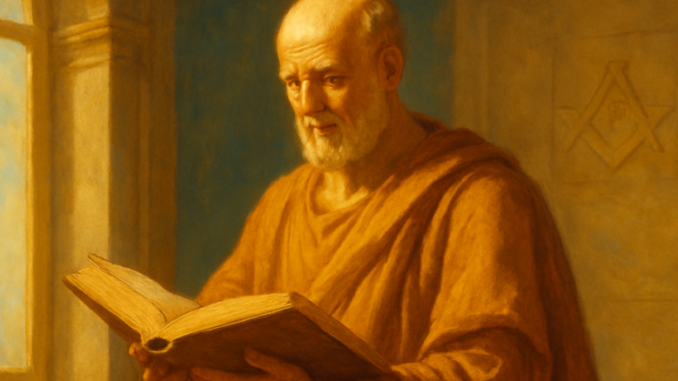
A candle flickers softly as a Freemason lingers after lodge, turning the yellowed pages of Seneca’s letters. He reads Letter V and recognizes something deeply familiar in the Roman philosopher’s words — a call to authenticity that echoes the very rituals he just experienced. Two thousand years ago, Seneca wrote about how philosophy connects us to humanity without alienating us from our fellow human beings. This idea holds up a surprising mirror for the modern Freemason.
The Paradox of Standing Out by Blending In
In his fifth letter to his student Lucilius, Seneca warns against two extremes. On one hand, there is the temptation to make such a show of philosophical practice that you repel ordinary people. On the other, there is the danger of conforming so completely to the crowd that you abandon your inner work altogether. Seneca advocates a middle path: live according to your principles, but without theatrical display. The true philosopher differs from others not by his clothing or outward behavior, but by the quality of his inner life.
This tension is intimately familiar to every Freemason. The fraternity does not operate discreetly out of secrecy for its own sake, but from an understanding that inner work requires no public spectacle. When a Mason leaves the temple, he returns to the outside world without outward signs of his initiation. His transformation is internal; his virtue is demonstrated through deeds, not by symbols on his lapel. Seneca would recognize this as the very essence of true philosophy.
Connection as the Foundation of Wisdom
What makes Seneca’s fifth letter so remarkable is its emphasis on connection with humanity. The philosopher does not withdraw from society — he actively seeks engagement with others. He learns from everyone, regardless of status or background. This aligns seamlessly with the Masonic ideal of brotherhood that transcends boundaries of class, religion, and origin. In the lodge, people meet as equals, united by a shared aspiration toward personal and collective improvement.
True wisdom does not alienate us from humanity — it binds us more deeply to our fellow human beings through shared vulnerability and shared purpose.
Seneca writes that we should neither despise the crowd nor fear it. The Freemason recognizes in this the tension between his lodge work and his daily life. He cultivates qualities in the privacy of the temple that he then carries into the world — not to elevate himself above others, but to become a better neighbor, colleague, and citizen. The chain that links brethren during ritual symbolizes this invisible bond with all of humanity.
The Dangers of Outward Display
Seneca directs sharp words at those who use philosophy as a means of drawing attention. Neglected clothing, unkempt hair, contempt for ordinary tableware — these, he argues, are not signs of wisdom but vanity in a different guise. The true philosopher distinguishes himself not by what he rejects, but by what he embraces: reason, moderation, and care for the soul.
This resonates with Freemasonry on a profound level. The rituals and symbols of the lodge are powerful tools, but they lose their value the moment they become ends rather than means. A Freemason who wears his membership as a status symbol falls into precisely the trap Seneca describes. The apron and gloves carry meaning only when these outward signs reflect an inner reality.
Inner Growth Without Isolation
The heart of Letter V revolves around a subtle balance. Seneca encourages Lucilius to pursue self-improvement, but warns that this work must never lead to estrangement from others. The philosopher remains among people, shares their joys and concerns, yet refuses to be swept along by their weaknesses. He is like an anchor holding firm while the ship moves upon the waves.
For the Freemason, this offers invaluable guidance. The search for light and knowledge is not a solitary endeavor. It takes place within brotherhood, in dialogue with others who walk the same path. The ritual work in the temple prepares us for the real challenge: applying those lessons in everyday life. Self-reflection without connection becomes narcissism; connection without self-reflection becomes conformism.
A Timeless Call to Authenticity
Two thousand years after Seneca, his message remains strikingly relevant. In an age of social media, where identity is often expressed through visible symbols and public declarations, his call to inner authenticity is more urgent than ever. The philosopher, like the Freemason, is not defined by what he shows the world, but by who he truly is when no one is watching.
The key principles from Seneca’s letter map directly onto Masonic values: authenticity springs from inner work, not outward display; connection with others strengthens rather than weakens personal growth; virtue is demonstrated through action in the world, not withdrawal from it; and symbols are always means, never ends in themselves.
Seneca closes his letter with a gift — a quotation from Epicurus on the value of poverty willingly embraced. Here again we encounter the paradox. Voluntary simplicity is fundamentally different from enforced deprivation. The Freemason who strives toward moral perfection does so not out of fear of the world, but out of love for the higher potential in himself and in others. This willing dedication to growth, shared with brothers and sisters worldwide, lies at the heart of both traditions.
Seneca’s fifth letter reveals a timeless truth that the Freemason intuitively recognizes: true wisdom grows in silence but blossoms in connection. The philosopher and the initiate share the same challenge — they must work on themselves without separating from the very humanity they seek to serve. In this ancient Stoic wisdom, the modern Mason finds not only a mirror but a compass, pointing always toward that delicate balance between inner transformation and outward engagement with the world.
Copyright text & image: devrijmetselaar.nl
Texts are based on the ideas and content of the author of devrijmetselaar.nl, reviewed, corrected, and supplemented with the assistance of OpenAI. Images are created based on the ideas of the author of devrijmetselaar.nl using OpenAI/DALL-E.
Frequently Asked Questions
What is the main connection between Seneca's philosophy and Freemasonry?
Both emphasize inner transformation over outward display. Seneca advocates for living according to principles without theatrical display, while Freemasons believe their true work is internal. When a Mason leaves the temple, his transformation is demonstrated through virtuous deeds in daily life rather than through visible symbols or outward signs of initiation.
What does Seneca mean by the 'paradox of standing out by blending in'?
Seneca warns against two extremes: making an ostentatious show of philosophical practice that repels ordinary people, or conforming so completely to the crowd that you abandon your inner work. The middle path is to live authentically according to your principles while maintaining a modest external presence. True distinction comes from the quality of your inner life, not from outward behavior or appearance.
How does Seneca's view on connection relate to Masonic brotherhood?
Seneca emphasizes that true wisdom requires active engagement with humanity and learning from everyone regardless of status or background. This aligns with Masonic ideals of brotherhood that transcend class, religion, and origin. Both philosophies teach that wisdom binds us more deeply to others through shared vulnerability and purpose, rather than elevating us above them.


Be the first to comment