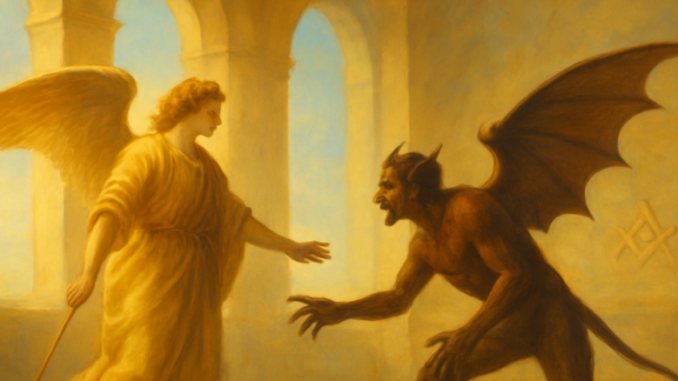
Imagine being able to create matter from nothing — to conjure something tangible from pure energy. Would that be a divine act or a scientific achievement? In his thriller Angels & Demons, Dan Brown weaves a story around antimatter as the ultimate weapon, stolen from CERN’s particle accelerator. The novel suggests that science has crossed into sacred territory. But how much of it is actually true? And more importantly, what can Freemasons — who have sought harmony between reason and spirituality for centuries — learn from the tension between physics and fiction?
Creation Is Not an Exclusive Domain
Let’s start with a paradox. In Angels & Demons, Dan Brown presents antimatter as proof that humanity can create — that science has seized the monopoly on creation from religion. The dramatic tension in the book springs precisely from this premise: a substance that can both annihilate everything and demonstrate that matter arises from energy. But is this truly a conflict between faith and science, or is Brown projecting a false dichotomy that barely exists in the actual history of scientific inquiry?
For Freemasons, this question is anything but new. Since the eighteenth century, Brethren such as Isaac Newton and later members of the Royal Society never regarded scientific discoveries as an assault on the sacred. Quite the opposite: understanding the laws of nature was, for them, a form of reverence — a way of studying the architecture of the universe as evidence of a higher order. The tension Dan Brown dramatizes in his novel is therefore less a scientific issue than a piece of literary stagecraft.
What Antimatter Actually Is
In physics, antimatter is not a mysterious energy source that can be bottled up and used to level cities. Antimatter consists of antiparticles — particles that carry the opposite charge of ordinary matter. When a particle meets its antiparticle, they annihilate each other and release energy. This process is called, fittingly, annihilation. At CERN, the European Organization for Nuclear Research in Switzerland, physicists do indeed produce antimatter — but in quantities so vanishingly small that you could barely warm anything with them, let alone cause destruction.
The total amount of antimatter CERN has produced in its entire history wouldn’t be enough to heat a cup of tea. Dan Brown takes considerable literary license in Angels & Demons by presenting a quarter gram of antimatter as a catastrophic weapon. In reality, producing such a quantity would cost trillions of euros and remains technically impossible with current technology. The science is spectacular, but not in the way the thriller suggests.
Why Fiction Still Has Value
You might reasonably ask: if the science doesn’t hold up, why bother thinking seriously about it? This is where Freemasonry enters the conversation. In our tradition, we work with symbols that are not literally true but nonetheless point toward truth. The square and compasses are no longer builders’ tools in our lodges — they are references to moral principles. In the same way, antimatter in Angels & Demons can be read as a symbol rather than as physics.
Fiction does not need to be factually accurate to be philosophically valuable. What matters is the questions a story raises, not the answers it provides.
Dan Brown poses a provocative question in his thriller: can science replace the sacred? For many readers, this is a genuine existential concern. Freemasonry offers a more nuanced perspective. The Enlightenment, during which our order took its modern form, never envisioned an absolute separation between reason and spirituality. Thinkers like Voltaire and later Goethe — both Freemasons — regarded scientific knowledge as an enrichment of the inner life, not a replacement for it.
Misconceptions About Secret Societies
One persistent misconception reinforced by Angels & Demons is the idea that secret societies such as the Illuminati and Freemasonry hoard scientific knowledge or wield it as a weapon. In reality, the historical Illuminati — founded in 1776 by Adam Weishaupt — were an Enlightenment society that actively promoted openness and rational thought. Freemasonry has never guarded antimatter or any other scientific secrets, for the simple reason that its purpose is moral development, not technological power.
What Freemasonry does do is encourage its members to be curious, to study, and to approach the world with a sense of wonder. Many scientists have been and continue to be Freemasons — not because the lodge offers secret knowledge, but because the values of inquiry, brotherhood, and ethical reflection align naturally with the scientific ethos.
The Search for Balance
At its core, the tension in Angels & Demons is not really science versus religion. It is the deeply human need to find meaning in a universe that grows ever more complex. Antimatter — however inaccurately it is portrayed in the thriller — stands as a symbol for that borderland where knowledge and wonder meet. For Freemasons, that borderland is sacred ground.
In Masonic ritual, we speak of building an inner temple. That temple is not constructed by science or faith alone, but through the willingness to integrate both. The particle physicist working at CERN and the Brother meditating on the Great Architect of the Universe in his lodge need not be adversaries. Both are searching for order, for understanding, for a glimpse of the greater whole.
If antimatter teaches us anything, it is that the universe contains opposites that cancel each other out — matter and antimatter, creation and destruction, light and darkness. The question that lingers after reading Angels & Demons is not whether science or faith holds the ultimate truth. It is whether we have the courage to stand at the threshold between the two, to hold both the square and the compass steady, and to keep building — even when we cannot yet see the final design of the temple we are raising.
Copyright text & image: devrijmetselaar.nl
Texts are based on the ideas and content of the author of devrijmetselaar.nl, reviewed, corrected, and supplemented with the assistance of OpenAI. Images are created based on the ideas of the author of devrijmetselaar.nl using OpenAI/DALL-E.

Be the first to comment