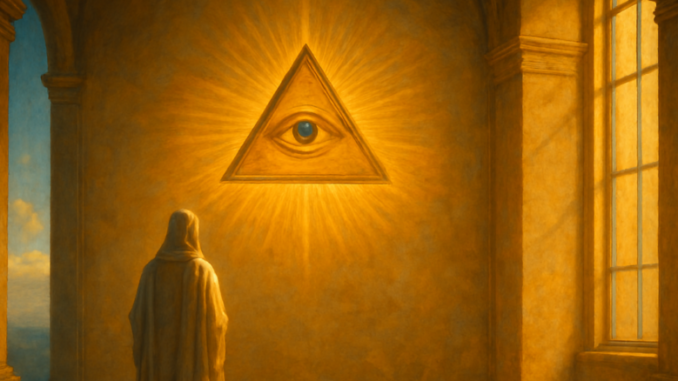
A candle that is blown out stops burning. But the wax remains, the wick stays intact, and the memory of the light lingers in the eyes of those who watched it glow. Such was the fate of the Order of the Illuminati, officially banned in Bavaria in 1785. The flame was extinguished, but the scent of the idea lingered — for centuries, right up to our own time. What drove this secret society? Why was it suppressed? And why is it so persistently confused with Freemasonry?
A Flame Lit in the Spirit of the Enlightenment
On May 1, 1776, Adam Weishaupt, a professor of canon law at the University of Ingolstadt, founded a secret society he called the Order of the Illuminati. Weishaupt was deeply influenced by the ideas of the Enlightenment. Thinkers such as Voltaire, Jean-Jacques Rousseau, and Baruch Spinoza had prepared the intellectual ground for a radical rethinking of religion, state power, and individual liberty. Weishaupt wanted to translate those philosophical ideals into a concrete organizational form: a brotherhood that, through secrecy and hierarchical degrees, would shape its members into enlightened citizens capable of reforming social structures from within.
The society grew rapidly, particularly among academics, civil servants, and members of the lower nobility. At its peak, the Order counted an estimated two to three thousand members, spread across Bavaria, Austria, and other parts of the German-speaking world. Its structure was layered: new members knew only their immediate mentors, never the full extent of the network. It was like a tree whose roots remain invisible — only the branches reaching toward the light could be seen.
Why Bavaria Banned the Order
In 1784 and 1785, the Bavarian Elector Karl Theodor issued several edicts banning all secret societies that had not been sanctioned by the state. This affected both the Order of the Illuminati and various Masonic lodges. The reasons were manifold. Disaffected former members had leaked internal documents revealing that the society pursued political reforms, including the separation of church and state and the curtailment of princely power. In an era when throne and altar were inseparable, this constituted a direct threat to the established order.
A moral panic soon followed. Pamphlets warned of a conspiracy by secret societies intent on undermining Christian civilization. In 1797, the Scottish natural philosopher John Robison published an influential work claiming that the Illuminati were behind the French Revolution. The French priest Augustin Barruel made similar assertions. Although historians have largely debunked these claims, they cemented the image of an invisible, all-powerful conspiracy — an image that popular culture and conspiracy theories continue to reproduce to this day.
The Persistent Confusion with Freemasonry
Here we arrive at a stubborn misconception that deserves explicit correction. The Order of the Illuminati and Freemasonry are not the same organization. That the two are confused is historically understandable but factually wrong. Weishaupt did draw inspiration from the degree structure of Freemasonry when building his Order, and several of his members were also members of Masonic lodges. Some Illuminati even deliberately infiltrated lodges to recruit new members. But the goals, structures, and philosophical foundations of the two were fundamentally different.
Freemasonry is a fraternity focused on personal inner growth, moral development, and brotherly connection — without a political program. The Order of the Illuminati, by contrast, had an explicit social and political reform agenda with a clear ideological direction. Masonic lodges have existed continuously since the early eighteenth century; the Order of the Illuminati effectively ceased to exist as an organized society after 1785. Freemasonry requires its members to believe in a Supreme Being without prescribing any specific religion; the Illuminati leaned toward rationalism and were sometimes openly critical of organized religion.
The Order of the Illuminati and Freemasonry shared a century, sometimes a building, and sometimes a member — but never an identity. Confusing the two is like claiming that every candle must have stood in the same candelabra.
The Smoke That Lingered: Spirituality Beyond the Organization
What makes the story of the Illuminati relevant to anyone engaged with spirituality and the search for meaning today? Perhaps this: every era knows the desire to look beyond the visible, to seek a deeper truth behind the surface of conventions and power structures. That desire is not the monopoly of any single society. It lives in the mystical traditions of Christianity, in the Sufi movements within Islam, in the Kabbalistic currents of Judaism, and in the contemplative practices of Buddhism. And it lives in Freemasonry, where ritual serves as a mirror for self-reflection — not a blueprint for social revolution.
Johann Wolfgang von Goethe, himself a Freemason and a contemporary of Weishaupt, wrote about the primacy of the inner journey over outward action. For Goethe, the true secret was not something that could be leaked in documents or forbidden by edicts. It was the transformation that took place in the heart of the searching individual. That thought resonates in Freemasonry to this day: the light a Freemason seeks is not a political program but an inner compass.
The Candle and the Candelabra
Let us return to the image of the extinguished candle. When the Bavarian authorities banned the Order of the Illuminati, they snuffed out a specific flame at a specific moment. But the longing for light — for knowledge, for truth, for a more just world — cannot be extinguished by decree. It simply finds new wicks, new wax, new holders. Understanding this distinction is essential: the Illuminati were a product of their time, a single bold experiment in organized Enlightenment thought. Freemasonry, on the other hand, continues as a living tradition — one that invites its members not to change the world by force but to change themselves through reflection, ritual, and fraternal bonds.
The next time you encounter a breathless claim linking Freemasonry to the Illuminati, remember the candle and the candelabra. They may have shared the same room, but they were never the same light. The Illuminati’s flame was political and time-bound; the light sought in Freemasonry is personal, moral, and enduring. One was extinguished by an edict. The other keeps burning, quietly, in every lodge where a brother turns inward to seek what no government can grant or forbid — the light within.
Copyright text & image: devrijmetselaar.nl
Texts are based on the ideas and content of the author of devrijmetselaar.nl, reviewed, corrected, and supplemented with the assistance of OpenAI. Images are created based on the ideas of the author of devrijmetselaar.nl using OpenAI/DALL-E.
Frequently Asked Questions
What was the Order of the Illuminati and when was it founded?
The Order of the Illuminati was a secret society founded on May 1, 1776, by Adam Weishaupt, a professor of canon law at the University of Ingolstadt. It was created to translate Enlightenment philosophical ideals into an organized brotherhood that would shape members into enlightened citizens capable of reforming social structures from within. The society grew to an estimated two to three thousand members across Bavaria, Austria, and other German-speaking regions before being banned.
Why did Bavaria ban the Order of the Illuminati?
In 1784 and 1785, Bavarian Elector Karl Theodor banned all unauthorized secret societies, including the Illuminati. The primary reasons were that leaked internal documents revealed the Order pursued political reforms such as the separation of church and state and the curtailment of princely power, which threatened the established order where political and religious authority were intertwined. A moral panic also ensued, with pamphlets warning of a conspiracy against Christian civilization.
Why is the Illuminati confused with Freemasonry?
While the article does not provide extensive details on this confusion, it notes that both the Order of the Illuminati and various Masonic lodges were banned by the Bavarian Elector in the same period (1784-1785). Both were secret societies with hierarchical structures and degrees of membership. This historical overlap, combined with their contemporaneous existence and similar organizational methods, has led to persistent confusion between the two organizations over the centuries.

Be the first to comment