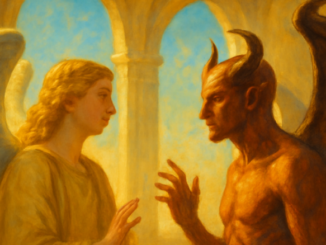
Ambigram design inspired by Dan Brown's Angels and Demons novel
Angels & Demons

Angels & Demons Ambigrams: Fact-Checking Dan Brown’s Symbols

The premise seems airtight at first glance: the ambigrams in Dan Brown’s thriller Angels & Demons prove the existence of an ancient secret society that concealed its messages through ingenious symbols. But what if this premise works in exactly the opposite direction? What if the symbols don’t confirm the fiction — but the fiction invented the symbols? This article examines the boundary between literary imagination and historical symbolism, and asks a question that is seldom posed aloud: what do we actually know about ambigrams, and what have we simply believed because a novel suggested it? The Claim: Ancient Secret Symbols In Angels & Demons, Dan Brown presents ambigrams as mysterious marks used by the Illuminati to signal their presence. The story suggests that these symmetrical word-images have existed for centuries and were recognized by initiates as signs of a hidden brotherhood. The protagonist discovers brands bearing words that are legible both right-side up and upside down. The implication is unmistakable: these are authentic historical artifacts of a secret society. And here is where the trouble begins. Historical reality tells an entirely different story. The ambigrams in the book were not unearthed from archives or excavated from old lodges. They were […]
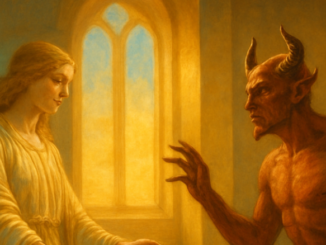
Ambigram design illustrating the relationship between fiction and Masonic symbolism
Angels & Demons

Ambigrams in Angels & Demons: Fiction vs. Real Symbolism

Imagine a word that reads exactly the same when you flip it upside down — symmetrical, mysterious, and seemingly impossible. In Dan Brown’s bestselling thriller Angels & Demons, these typographic designs called ambigrams play a starring role as alleged secret symbols of an ancient brotherhood. But what does the novel actually claim? And how do those claims hold up against what we genuinely know about symbols, secret societies, and Freemasonry? What Exactly Are Ambigrams? Let’s start at the beginning. The word “ambigram” derives from the Latin ambi (both sides) and gramma (letter). An ambigram is a typographic design that can be read in more than one way — most commonly by rotating it 180 degrees. It is an art form that truly came into its own during the twentieth century, developed by graphic designers and calligraphers experimenting with symmetry and legibility. Here’s the critical question: if ambigrams are a modern invention, how could they possibly be the secret signs of an eighteenth-century secret society? That contradiction takes us straight to the heart of what the novel claims. What Does the Novel Actually Claim? In Angels & Demons, ambigrams are presented as authentic, historical symbols of the Illuminati — the Bavarian […]

Historical illustration representing the founding of the Bavarian Illuminati in 1776
Illuminati

The Bavarian Illuminati: Origins and Spiritual Roots in 1776

On May 1, 1776 — while the American Declaration of Independence was taking shape across the Atlantic — a young professor in the Bavarian city of Ingolstadt founded a society that would captivate the imagination of historians and conspiracy theorists alike for centuries to come. Adam Weishaupt, a professor of canon law and former pupil of the Jesuits, established the Order of the Perfectibilists, later known as the Illuminati. This article examines the historical facts behind this eighteenth-century society and explores the spiritual ideals that connected Weishaupt’s vision to the Freemasonry of his era. The Intellectual Climate of the Late Eighteenth Century To understand the birth of the Bavarian Illuminati, we need to step into the Bavaria of the 1770s. The electorate was governed by a deeply conservative Catholic regime, even as the Enlightenment flourished elsewhere in Europe. Philosophers like Voltaire and Jean-Jacques Rousseau were spreading ideas about reason, natural rights, and religious tolerance. These ideas inevitably reached the university town of Ingolstadt, where the young Weishaupt immersed himself in ancient philosophy and contemporary Enlightenment thinkers. Weishaupt, born in 1748, had been orphaned at the age of five and entrusted by his godfather to the Jesuit order for his education. […]