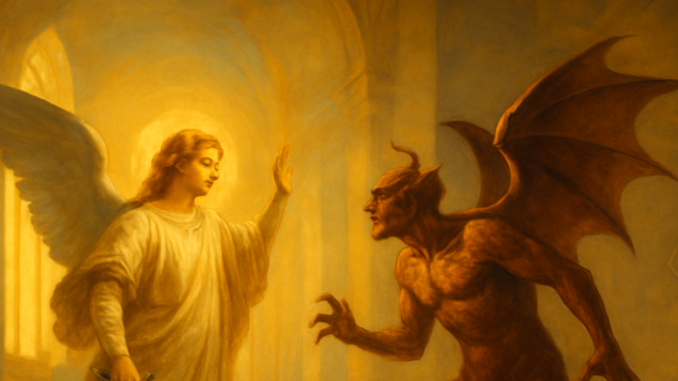
Imagine that science could create the ultimate force of destruction — a substance so pure and so powerful that it could undermine the very foundations of faith. This is not an idle thought experiment. It is the central premise of Dan Brown’s bestselling thriller Angels & Demons, a novel that places antimatter at the heart of a conflict between reason and religion, between laboratory and cathedral. But what does Brown actually suggest about this mysterious substance, and how does his fictional narrative connect to the symbolic quest that Freemasons have pursued for centuries?
The Promise of Total Annihilation
In Angels & Demons, Dan Brown presents antimatter as the most destructive material humanity has ever produced. According to the storyline, a minuscule quantity — captured within a specially designed containment system — would be enough to obliterate an entire city. The energy released when matter and antimatter collide, the book suggests, surpasses every conventional bomb and even nuclear weapons. Brown paints a scenario in which scientists at the European particle research center manage to produce and store measurable quantities of antimatter, unwittingly placing the key to apocalyptic devastation in human hands.
This depiction raises a fundamental tension that runs through the entire novel: the question of whether human knowledge has limits — or whether it should. It is a question Aristotle already posed when he distinguished between theoretical wisdom and practical prudence. The suggestion that science can create means that exceed the understanding of its own creators touches upon a deep philosophical unease. Here, Brown’s concerns and the reflections cultivated within Freemasonry intersect, for within the lodge the same question is asked: what do we do with the knowledge we acquire?
Science as the New Religion
One of the most striking elements in Brown’s narrative is the implicit claim that science and religion are competing for the same throne. Antimatter does not merely function as a plot device — it serves as a symbol for the presumption of modern science. By suggesting that scientists can replicate the Big Bang, that they can repeat the act of creation itself, Brown positions the laboratory as a secular temple governed by new high priests. The physicists in his novel are not neutral researchers; they are figures who, consciously or not, have entered the domain of the divine.
Antimatter in Angels & Demons is not a purely scientific phenomenon. It is a symbol of human hubris — the belief that we can equal the act of creation itself.
This symbolic weight makes the book particularly interesting for anyone who reflects on the relationship between knowledge and humility. Voltaire, who was himself a Freemason, warned against the dangers of unchecked intellectual arrogance. In his writings, he demonstrated that wisdom lies not in the accumulation of facts but in the recognition of one’s own limitations. Brown’s antimatter narrative echoes this warning, albeit dressed in far more sensational clothing.
The Container as Metaphor
In the story, the container that holds the antimatter plays a critical role. Without constant electromagnetic confinement, the substance would destroy everything around it. Brown uses this device to generate suspense — a ticking clock that drives the plot forward. But the container also carries deeper meaning. It represents the fragile structures that humanity has built to control destructive forces, whether those structures are technological, political, or moral.
For the Freemason, this image raises the question of what mastery truly means. In the rituals of the lodge, we speak of the rough and perfect ashlar — the work of shaping the self into a fitting part of a greater edifice. The container in Brown’s novel is an imperfect human construction that temporarily controls the uncontrollable. This mirrors the Masonic conviction that civilization, brotherhood, and morality are not givens but require constant effort. The moment we stop maintaining these structures, what they contain threatens to break free.
The Paradox of Progress
What Angels & Demons implicitly argues is that every scientific breakthrough carries a shadow side. The discovery of antimatter, presented in the book as a triumph of human ingenuity, contains within it the seed of annihilation. This is not a new insight. Francis Bacon, whose ideas about experimental science helped shape modern physics, already acknowledged that knowledge is power — and that power can build as readily as it can destroy. Brown translates this philosophical tension into a page-turner, but the underlying question endures: how do we contend with the ambiguity of our own creations?
Freemasonry does not offer ready-made answers to this question, but it does provide a framework for reflection. Within the lodge, every brother is invited to consider his role in the world and the responsibility that accompanies knowledge and influence. The tension Brown exploits in his thriller — the threat of antimatter — is essentially an updated version of an ancient struggle: how do we remain human in a world of our own making?
Fiction as a Mirror
It is tempting to dismiss Brown’s claims about antimatter as pure sensationalism. Yet the enormous popularity of Angels & Demons compels us to consider why these stories resonate so deeply. Millions of readers were captivated by the idea that somewhere, in a Swiss laboratory, scientists are playing with fire they do not fully understand. The appeal of this narrative lies not in its scientific accuracy but in its symbolic power. Antimatter becomes a stand-in for everything we fear and admire about modern science.
Plato might observe that Brown’s story is a shadow on the cave wall — an imaginative projection that points toward deeper truths without capturing them directly. For Freemasons, who work extensively with allegory and symbol, this observation carries particular weight. The value of Angels & Demons does not reside in its depiction of particle physics but in the questions it forces us to confront about the nature of knowledge, the limits of control, and the responsibilities that come with discovery.
In the end, Brown’s thriller — for all its dramatic license — serves as a reminder that the tools we create always reflect back on their creators. Whether we speak of antimatter in a fictional containment unit or the moral architecture of the lodge, the challenge remains the same: to build wisely, to contain what must be contained, and to approach the unknown with equal measures of courage and humility.
Dan Brown’s Angels & Demons may be a work of fiction, but the questions it raises are timeless. The tension between knowledge and restraint, between the power to create and the power to destroy, lies at the heart of both scientific inquiry and Masonic philosophy. Freemasonry teaches that true wisdom is not found in the accumulation of power but in the discipline to wield it responsibly. As we continue to push the boundaries of what science can achieve, the allegory of the antimatter container grows ever more relevant — a reminder that the greatest challenge is never the discovery itself, but what we choose to do with it.
Copyright text & image: devrijmetselaar.nl
Texts are based on the ideas and content of the author of devrijmetselaar.nl, reviewed, corrected, and supplemented with the assistance of OpenAI. Images are created based on the ideas of the author of devrijmetselaar.nl using OpenAI/DALL-E.


Be the first to comment