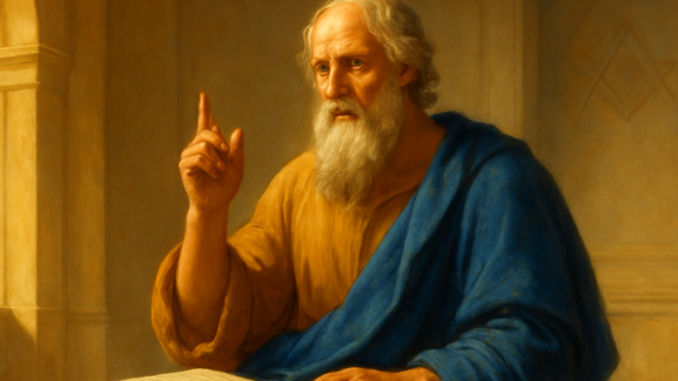
You probably know the feeling: you’re certain you know something, only to realize upon closer inspection that things are quite different from what you assumed. Plato explored this very phenomenon more than two thousand years ago in his dialogue Theaetetus. The central question was simple yet profound: what actually constitutes knowledge? For Freemasons, this question strikes at the heart of their craft. The search for light, for truth, for deeper understanding is not an abstract ideal — it is a daily practice. In this article, we explore how Plato’s insights can help you become more conscious of what you think you know and how to apply that awareness in your life.
The Question That Changes Everything
In the dialogue Theaetetus, Socrates poses a deceptively simple question to the young mathematics student Theaetetus: what is knowledge? Theaetetus offers several answers. First, he suggests that knowledge is perception. Then he tries “true belief.” Finally, he proposes “true belief accompanied by an account.” None of these definitions survive Socrates’ relentless examination.
This might seem frustrating — a philosophical dead end. But therein lies the true power of this dialogue. Plato demonstrates that acknowledging one’s own ignorance is the first step toward genuine wisdom. This is precisely what Freemasons experience during their initiation. The candidate enters the lodge as someone dwelling “in darkness,” seeking light. Not because he lacks intelligence, but because he recognizes that there is always more to discover.
Knowledge as a Process, Not a Possession
One of the most valuable insights from the Theaetetus is that knowledge is not an object you can own. It is an ongoing process of inquiry, reflection, and reconsideration. Socrates compares the mind to a wax tablet upon which impressions are stamped. But he also warns us: some impressions are clear, others are vague, and still others fade quickly.
In practical terms, this means regularly asking yourself: how do I know what I think I know? Is my conviction based on genuine inquiry, or have I simply accepted something without question? In Freemasonry, this kind of self-examination is encouraged through the method of ritual and symbol. The working tools of the Mason are not meant literally. They invite introspection. The square asks: am I acting with integrity? The compasses ask: do I know my limits?
True knowledge does not begin with collecting answers — it begins with the courage to keep asking the right questions.
Practical Steps for Daily Application
How do you bring these philosophical insights into your everyday life? Here are three concrete approaches you can put into practice today:
First, when facing an important decision, ask yourself: what do I actually know, and what am I merely assuming? Write both categories down. You will likely find that the column of assumptions is far longer than you expected.
Second, practice suspending your judgment. When you hear something that stirs an emotional reaction, pause deliberately before responding. Investigate first: is this accurate? What sources do I have? This is the intellectual discipline that Socrates modeled throughout his life.
Third, seek out conversations with people who think differently from you. Not to persuade them, but to understand them. In Freemasonry, brethren from vastly different backgrounds come together in lodge. That diversity is not an obstacle to truth — it is one of its most powerful instruments.
Connection Through a Shared Search
The Theaetetus is not a solitary endeavor. Socrates conducts his inquiry together with Theaetetus and his teacher Theodorus. The dialogue itself demonstrates that knowledge emerges through connection with others. You sharpen your thinking by voicing it, testing it, and allowing it to be questioned.
This is a core value within Freemasonry. The lodge is not a place where a single master proclaims the truth. It is a space where brethren work collectively on their inner development. The rituals, the symbols, the conversations that follow — everything is designed to help you progress further together than you ever could alone. Plato would recognize this principle immediately. For him, philosophy was never a solitary pursuit but a collaborative enterprise in which others help you see your own blind spots.
The Value of Not Knowing
At the end of the Theaetetus, the question of what knowledge is remains unanswered. This is not a failure. It is the lesson. Socrates famously called himself a midwife who helped others bring their ideas into the world. Sometimes the birth turned out to be a stillbirth — the idea did not hold up. But even then, something was gained. The seeker now understood more clearly what knowledge was not.
For Freemasons, this resonates deeply. The journey through the degrees is not a linear path toward a final destination where all answers await. Each degree opens new questions. Each ceremony reveals new layers. The true Master is not the one who knows everything, but the one who has mastered the art of continuing to search. That requires humility, openness, and the willingness to acknowledge that what you believed yesterday may not be what you believe today.
Put Your Own Convictions to the Test
What does all of this mean for you, concretely? This week, take a belief you hold dear and subject it to Socratic examination. Ask yourself: why do I believe this? What experience or argument convinced me? Could I persuade someone else using the same reasoning? And more importantly: am I willing to change my mind if my arguments do not hold up under scrutiny?
This is not an easy exercise. It demands intellectual honesty and personal courage. But it is precisely this attitude that Plato described and that Freemasons aspire to embody. The search for truth is not a luxury. It is a moral obligation — to yourself and to the people around you who rely on your judgment.
Plato’s Theaetetus offers no definitive answer to the question of what knowledge is. But that is precisely where its power lies. It reminds us that the search for truth is never finished — and that we undertake that search best when we do it together. For Freemasons, this is a daily practice: working on yourself, continuing to ask questions, and embracing the profound wisdom that comes from knowing you do not yet fully know.
Copyright text & image: devrijmetselaar.nl
Texts are based on the ideas and content of the author of devrijmetselaar.nl, reviewed, corrected, and supplemented with the assistance of OpenAI. Images are created based on the ideas of the author of devrijmetselaar.nl using OpenAI/DALL-E.

Be the first to comment