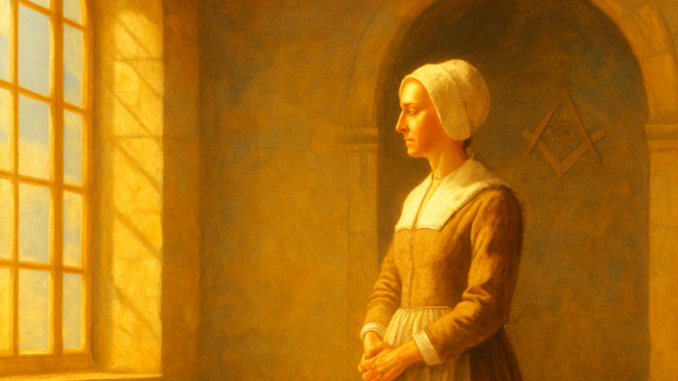
The meeting room is silent. There is no minister, no liturgy, no hymn. Dozens of people sit in a circle, waiting until someone feels moved to speak. This is a Quaker meeting — a gathering of the Religious Society of Friends, a faith community that has trusted the inner light within every person for centuries. From these quiet circles emerged a remarkable number of men and women who changed the world in profound ways. Their stories touch on a theme that Freemasonry also holds dear: the conviction that spirituality only gains meaning when it translates into action.
Who Were the Quakers?
The Religious Society of Friends was founded in mid-seventeenth-century England by George Fox. Fox believed that every human being could experience a direct connection with the divine — without the mediation of clergy or fixed creeds. This radical simplicity quickly attracted followers willing to endure persecution and imprisonment for their beliefs. The name “Quakers,” originally coined as an insult because they supposedly “trembled before God,” was eventually embraced with pride.
What makes the Quakers distinctive is their emphasis on equality, nonviolence, and personal conscience. There is no hierarchy of priests or bishops. Decisions are made in silence and by consensus. These principles turned the Society into a breeding ground for people who could not tolerate social injustice — and who had the courage to do something about it.
Pioneers of Freedom and Justice
William Penn, born in 1644 as the son of an English admiral, is perhaps the most famous Quaker in history. Penn founded the colony of Pennsylvania as a “holy experiment” — a society built on religious tolerance, democratic governance, and peaceful coexistence with Indigenous peoples. In an era when Europe was torn apart by religious wars, this was a revolutionary idea. Penn signed treaties with the Lenape tribes that held for decades, a rare occurrence in colonial history.
Another remarkable figure is John Woolman, an eighteenth-century tailor and preacher from New Jersey. For years, Woolman traveled throughout the American colonies to convince fellow Quakers that slavery was irreconcilable with the inner light. His journal, published after his death in 1772, became one of the most influential spiritual texts in American literature. Woolman refused to consume sugar, dye, and other products made through enslaved labor, making him an early pioneer of what we now call ethical consumerism.
Women Who Spoke Up
The Society of Friends was one of the first Christian communities in which women could speak and lead on equal footing. Margaret Fell, often called the “mother of Quakerism,” wrote the 1666 tract Women’s Speaking Justified — a powerful argument for the equality of women in religious life. She later married George Fox and continued writing and organizing well into old age.
In the nineteenth century, American Quaker Lucretia Mott devoted herself tirelessly to both the abolition of slavery and women’s suffrage. Together with Elizabeth Cady Stanton, she organized the famous 1848 Seneca Falls Convention — a turning point in the women’s rights movement. Susan B. Anthony, who also grew up in a Quaker household, became one of the most recognizable faces of the fight for voting rights. These women drew strength from a faith that taught them every person, regardless of gender or skin color, carries a divine light within.
Science, Industry, and Culture
The influence of Quakers extended far beyond social reform. In science, notable names include Thomas Young, the nineteenth-century physicist whose double-slit experiment demonstrated the wave nature of light. In industry, Quaker families became renowned for their ethical business practices. The Cadbury, Rowntree, and Fry families — all of Quaker heritage — built chocolate empires in which worker welfare was a central concern. They offered fair wages, housing, and education at a time when factory workers were typically treated as expendable resources.
Quakers also left their mark on the arts. Edward Hicks, a nineteenth-century American painter, became famous for his numerous versions of The Peaceable Kingdom, depicting predators and lambs resting side by side. These images are not naive fantasy but a deeply felt expression of the Quaker ideal of peace and reconciliation.
The Inner Light and the Rough Stone
It is here that the Quaker tradition and Freemasonry meet at a surprisingly deep level. Both traditions believe that within every person there is a spark waiting to be developed. The Quakers call it the inner light; Freemasons speak of the rough ashlar that is refined through work upon oneself. Neither tradition prescribes exactly what a person must believe. Both emphasize personal experience, conscience as a compass, and the obligation to transform inner growth into service to the world.
Both Quakers and Freemasons teach that spirituality is not a theory but a daily practice: the inner light must not only be found but also carried forth into the world.
It is no coincidence that William Penn and early Freemasons operated in the same century and often moved in the same circles. The values of tolerance, brotherhood, and freedom of conscience that James Anderson would codify in the 1723 Constitutions of Freemasonry reflect ideals that the Quakers had already been putting into practice for decades. George Fox and Anderson shared the conviction that dogma constrains humanity rather than elevates it.
The story of the Quakers is one of quiet force — of people who believed that silence could be more powerful than sermons, and that the truest expression of faith is found in deeds rather than words. From William Penn’s holy experiment to Lucretia Mott’s tireless activism, from Cadbury’s ethical factories to Edward Hicks’s peaceable visions, Quakers have demonstrated what happens when inner conviction meets outward courage. For Freemasons, their legacy offers a mirror and an inspiration: the reminder that the light we seek within ourselves finds its highest purpose when we use it to illuminate the path for others.
Copyright text & image: devrijmetselaar.nl
Texts are based on the ideas and content of the author of devrijmetselaar.nl, reviewed, corrected, and supplemented with the assistance of OpenAI. Images are created based on the ideas of the author of devrijmetselaar.nl using OpenAI/DALL-E.
Frequently Asked Questions
What is a Quaker meeting and how does it work?
A Quaker meeting is a gathering of the Religious Society of Friends where participants sit together in silence, waiting until someone feels moved by the inner light to speak. There is no minister, liturgy, or hymn. This form of worship emphasizes direct personal experience of the divine and collective discernment through consensus, rather than following fixed creeds or hierarchical religious structures.
Who founded the Quakers and what were their core beliefs?
The Religious Society of Friends was founded in mid-seventeenth-century England by George Fox, who believed that every human being could experience a direct connection with the divine without clergy mediation. The Quakers' core beliefs center on equality, nonviolence, personal conscience, and the concept of an 'inner light' within every person. They rejected hierarchies of priests or bishops and made decisions through silence and consensus.
What contributions did famous Quakers like William Penn and John Woolman make to society?
William Penn founded Pennsylvania as a 'holy experiment' based on religious tolerance, democratic governance, and peaceful coexistence with Indigenous peoples, signing treaties with the Lenape tribes that lasted for decades. John Woolman, an eighteenth-century tailor and preacher, traveled the colonies convincing fellow Quakers that slavery contradicted the inner light, pioneered ethical consumerism by refusing products made through enslaved labor, and left behind an influential spiritual journal that shaped American literature.

Be the first to comment