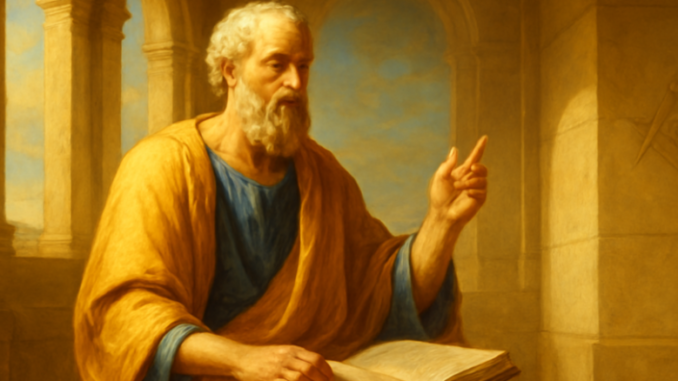
How do you shape a human being into a virtuous one? This question has occupied philosophers for millennia, and few have explored it as thoroughly as Plato in the third book of The Republic. In this remarkable text, the Athenian thinker presents his vision of education as the key to a just society — a vision that resonates strikingly with the way Freemasonry forms its members. In this article, we bring two worlds into conversation: the classical Athens of Plato and the symbolic workshop of the Masonic lodge. What do they share, and what can we learn from the comparison?
The Heart of Book III: Music, Gymnastics, and the Soul
In the third book of The Republic, Plato continues his dialogue through Socrates about the ideal state. The central question is how the Guardians — the protectors of the city — should be educated. Plato identifies two pillars: musical training for the soul and gymnastic training for the body. This division is far from arbitrary. The philosopher believes that harmony in the soul must precede harmony in the state.
Musical education, in Plato’s framework, encompasses far more than music in the modern sense. It includes poetry, storytelling, and myth. Plato is rigorous in his selection: only stories that promote virtue may be told to young souls. Tales of gods who lie or heroes who succumb to fear are excluded. The reasoning is straightforward — what a child absorbs early in life shapes the patterns through which they will later think and act.
Plato’s Perspective: Education as Sculpture
For Plato, education is comparable to the work of a sculptor who transforms a rough stone into a work of art. The young soul is malleable material that must be shaped with care. This places an enormous responsibility on the educator. Harmful influences can permanently deform the soul, while the right formation lays a foundation for lifelong virtue.
Particularly striking is Plato’s emphasis on rhythm and harmony. He argues that certain musical modes elevate the soul, while others weaken it. The Dorian and Phrygian modes are praised for their ability to cultivate courage and temperance. Other modes, those that evoke indulgence or softness, must be avoided. This may seem strange to the modern reader, but it reveals Plato’s deep conviction that beauty and morality are inseparably connected.
The Masonic Perspective: Formation Through Ritual
Freemasonry approaches the formation of character in its own distinctive way, yet the parallels with Plato are remarkable. Where Plato speaks of music and storytelling, the lodge employs rituals and symbols as vehicles for inner growth. The rough ashlar — a central symbol in Freemasonry — represents the unworked human being who must be refined through labor upon the self into a perfect ashlar, fit to take its place in the edifice of humanity.
Like Plato, the Freemason believes that formation is a gradual process. The three degrees — Entered Apprentice, Fellowcraft, and Master Mason — mark stages of inner development. Each ritual contains stories and symbols that, much like Plato’s carefully selected myths, are designed to awaken specific virtues. The candidate does not undergo passive instruction but an active transformation in which he must take up the chisel himself.
Education is not the filling of a vessel, but the kindling of a flame. Plato and Freemasonry share this conviction: true formation comes from within.
What Both Worlds Share
Despite a distance of more than two thousand years, Plato’s Athens and the Masonic lodge share fundamental convictions about human formation. Both see the human being as a creature that does not naturally flourish on its own but requires conscious guidance. Both recognize the power of symbols, stories, and rituals to shape the soul in ways that purely rational instruction cannot match.
Consider the key similarities: both emphasize that character matters more than knowledge alone; both use stories and symbols as pedagogical tools; both view formation as a lifelong process rather than a fixed endpoint; and both believe that inner harmony must precede outer order.
A crucial difference, however, lies in the direction of formation. Plato’s education is aimed at the state — the Guardian is shaped to serve the community. Freemasonry, by contrast, focuses primarily on the individual, trusting that an improved person will naturally contribute to a better world. This difference in focus leads to different emphases but not to irreconcilable visions.
What We Can Learn Today
The comparison between Plato and Freemasonry invites reflection on our own time. In a world where education is often reduced to knowledge transfer and measurable skills, both traditions remind us of a deeper dimension. Formation is not only about what you know — it is about who you become. The question is not merely what information we pass on to younger generations, but which stories, symbols, and rituals will shape their character.
Plato’s strict selection of stories may seem extreme, but the underlying insight remains profoundly relevant: not everything we consume nourishes the soul. The Freemason who quietly works upon his rough ashlar acknowledges this same truth. Formation requires discernment, patience, and the courage to reject certain influences while embracing others.
Plato’s third book of The Republic and the formative tradition of Freemasonry may seem like worlds apart at first glance. Yet they share a deep conviction: that the human being is not complete at birth but must be shaped through carefully chosen influences. Whether this happens through the music of ancient Greece or through the rituals of the lodge, the goal remains the same. Formation is the kindling of an inner fire that illuminates the individual and enables them to take their place in the world with dignity. This wisdom — ancient and yet timeless — invites us to reconsider what true education really means.
Copyright text & image: devrijmetselaar.nl
Texts are based on the ideas and content of the author of devrijmetselaar.nl, reviewed, corrected, and supplemented with the assistance of OpenAI. Images are created based on the ideas of the author of devrijmetselaar.nl using OpenAI/DALL-E.


Be the first to comment