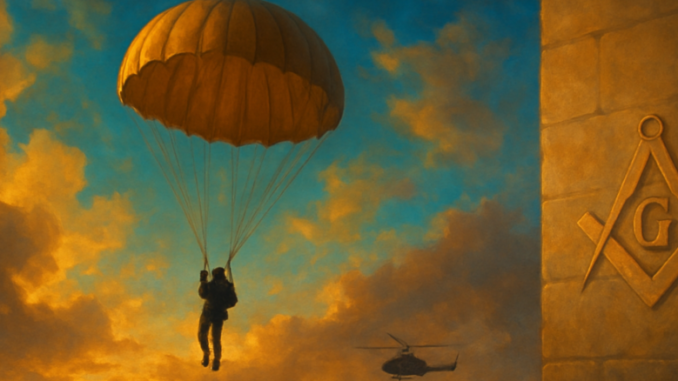
When a fighter pilot goes down over hostile territory, a race against the clock begins — not just for the pilot, but for every person who has sworn never to leave someone behind. The recent account of an American crew member rescued after a crash touches on something far deeper than military protocol. It strikes at the very heart of what Freemasons call brotherhood: the unconditional willingness to act for another, even when circumstances are anything but favorable.
What Drives People to Risk Their Lives for Another?
This may be the central question that occupies both soldiers and Freemasons alike. When rescue teams venture into dangerous airspace to recover a single person, they are not acting out of self-preservation. They are acting from a deep-rooted conviction that no one should be left alone in their darkest hour. Freemasonry holds this principle as one of its foundations: the duty to stand by a brother, not because it is easy, but precisely because it may be hard.
The Roman philosopher Seneca wrote that true friendship means making another person’s fate your own. In his letters to Lucilius, he emphasized that trust forms the bedrock of every meaningful bond. Without trust, brotherhood is merely a word. With trust, it becomes a living force that carries people through the severest trials.
Is Brotherhood Learned or Innate?
An interesting question naturally follows from stories of rescue and sacrifice. Are people born with the impulse to help others, or is it something that must be cultivated? Freemasonry firmly embraces the latter view. The rituals, the degrees, the symbolism — everything is designed to shape character and to strengthen and refine the natural inclination toward fraternity.
Aristotle, the great Greek thinker, distinguished three forms of friendship: those based on utility, on pleasure, and on virtue. Only the last, he argued, is truly enduring, because it is rooted in mutual respect for each other’s character. When a rescue team puts everything on the line, we see this highest form of human connection in action — driven not by what one can gain, but by who one aspires to be.
Brotherhood is not a sentiment but an act: the choice to show up when it matters most.
How Does Military Brotherhood Translate to Everyday Life?
It is tempting to reserve the concept of brotherhood for extreme situations — war, disaster, life-threatening emergencies. But Freemasonry teaches that the true test of brotherhood lies in the ordinary. It is easy to be a hero when the cameras are rolling; it is far more difficult to be a dependable friend, colleague, or family member day after day.
The legend of Hiram Abiff, the master builder of Masonic tradition, illustrates this powerfully. Hiram died because he refused to betray the secrets of his craft. His steadfastness was not the product of a single heroic moment but of a lifetime spent building integrity. Brotherhood, likewise, is not something you can improvise. It is the result of consistent choices made over time.
What Can Freemasons Learn from This Rescue Story?
The story of the rescued pilot offers several lessons that resonate directly with the Masonic approach to life:
Preparation makes the difference. Rescue teams train endlessly for moments that may never come. In the same way, a Freemason prepares for moral challenges through study, reflection, and the deliberate practice of virtue.
Trust is a two-way street. The pilot had to trust that people would come looking for him. The rescue team had to trust that he would hold on. Brotherhood only works when both sides do their part.
Actions outweigh words. No promise of brotherhood means anything without the willingness to honor that promise when the stakes are high.
Idealism or Realism?
Critics might argue that stories like these paint an idealized picture of human connection. And it is true — not every rescue succeeds, and not every bond endures. But Freemasonry is not a utopia. It acknowledges human weakness. Its strength lies precisely in the recognition that we are all imperfect and that brotherhood demands ongoing effort.
Johann Wolfgang von Goethe, himself a Freemason, wrote that a person only truly becomes human in relation to others. Our individuality gains meaning through our connectedness. The rescue story making headlines around the world is therefore more than a news item — it is a reminder of what becomes possible when people decide to stand up for one another.
How Do You Put This into Practice?
The question that remains is a personal one: how do you give brotherhood shape in your own life? It does not have to be a heroic rescue. It can begin with listening attentively when someone is struggling. With being present during a difficult conversation. With the willingness to endure discomfort for the sake of another person. These are the small rescue operations of everyday life, and they are no less valuable than the grand ones.
The account of the rescued pilot reminds us that brotherhood is not an abstract ideal but a living practice. Freemasonry provides a framework for cultivating that practice — through ritual, through reflection, through community. Ultimately, the question is not whether we will ever need to be rescued, but whether we will be ready to rescue another when that moment arrives. In that readiness lies the true meaning of brotherhood.
Copyright text & image: devrijmetselaar.nl
Texts are based on the ideas and content of the author of devrijmetselaar.nl, reviewed, corrected, and supplemented with the assistance of OpenAI. Images are created based on the ideas of the author of devrijmetselaar.nl using OpenAI/DALL-E.

Be the first to comment