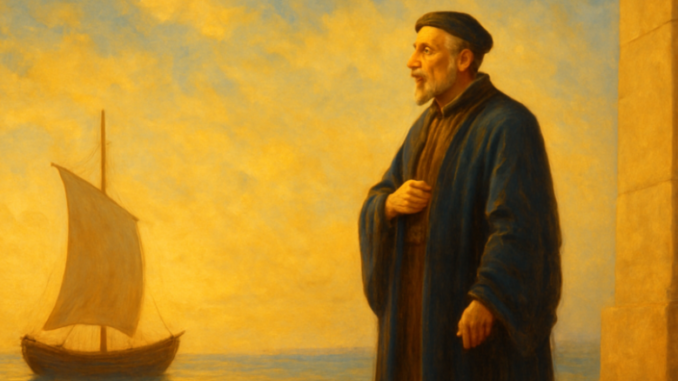
Picture a lodge meeting somewhere in the mid-seventeenth century. Candlelight flickers softly as a brother, following the close of the ritual, poses a question that silences the room: “If honor only holds value when it remains undivided, what does it mean to carry it together?” It is a question Michel de Montaigne raised centuries earlier in his brief but incisive essay On Not Sharing One’s Honor. And it is a question that strikes at the very heart of what binds Freemasons together.
What Montaigne Meant by Undivided Honor
In the forty-first essay of the first book of his celebrated Essays, Michel de Montaigne addresses a seemingly simple theme: the human tendency to divide honor, to delegate it, or to spread it across others. Montaigne observes that those who pursue fame and recognition are often inclined to inflate their achievements by associating them with great names or powerful allies. But in doing so, he argues, honor becomes diluted. It loses its force when draped like a cloak over too many shoulders.
In this essay, Montaigne draws on examples from classical antiquity. Generals such as Julius Caesar and Alexander the Great understood that true glory was personal and indivisible. They did not claim their victories by hiding behind their armies but by assuming full responsibility themselves. Montaigne admires this attitude — not out of vanity, but because he recognizes in it a profound honesty: whoever accepts honor must also bear its weight. That demands courage, self-reflection, and an unwavering sense of one’s own worth.
The Paradox of Individual Honor and Brotherhood
At first glance, Montaigne’s plea for undivided honor seems at odds with the Masonic ideal of brotherhood. In the lodge, after all, it is not the individual who is glorified but the collective pursuit of truth and light. Yet there is no contradiction here. What Montaigne advocates is not the rejection of collaboration or community, but the safeguarding of authenticity. Honor that you have not earned yourself is borrowed brilliance. And borrowed brilliance fades.
This insight is deeply recognizable within Freemasonry. Every brother walks his own path of inner growth. The degrees and rituals are shared experiences, certainly, but the transformation they bring about is inalienably personal. No one can undergo your initiation for you. No one can fill the silence within you with someone else’s insights. The lodge provides the framework, the brotherhood provides the warmth, but the work must be done by you alone. In this sense, Montaigne’s vision of honor aligns seamlessly with the Masonic ideal of self-reflection and moral perfection.
True honor in Freemasonry is not a title you receive, but an inner attitude you build by looking at yourself honestly and remaining faithful to your own path of growth.
Connection Without Dissolution
Montaigne’s essay touches on a subtle but essential distinction: the difference between connection and dissolution. Connection presupposes that two or more individuals come together from a place of their own strength, their own identity. Dissolution occurs when people surrender their individuality to merge into a group without knowing who they themselves are. The French philosopher warns against this, even if he never quite states it so explicitly. His message is more of an invitation: know yourself, stand firmly, and from that foundation, seek out the other.
This echoes an ancient principle deeply rooted in Freemasonry as well. The Greek philosopher Socrates made the maxim “know thyself” the cornerstone of his thinking, and centuries later that same maxim resounded through the lodges of the eighteenth century. James Anderson, who in 1723 codified the first constitutions of modern Freemasonry, emphasized that a brother must first and foremost be a good and sincere man — not good because others expected it of him, but good out of personal conviction. Montaigne would undoubtedly have recognized and endorsed that principle.
The Virtue of Honesty Toward Yourself
One of the most valuable lessons in this essay is Montaigne’s implicit call for honesty toward oneself. Sharing honor is not merely a matter of vanity — it is also a form of flight. Those who attribute their success to others need not look at themselves. Those who spread their failure across a group need not take personal responsibility. Montaigne sees through this evasion and invites the reader to sit with an uncomfortable question: am I willing to be the full owner of my actions, both the glorious and the shameful?
In Freemasonry, this honesty is symbolized by the ritual of self-examination that permeates every meeting. The rough ashlar that must be shaped into a perfect cube is an image every Freemason knows. But that work always begins with an honest assessment of one’s own imperfections. Without that honesty, there is no growth — only pretense. Montaigne might have put it this way: honor that is not rooted in self-knowledge is merely theater.
Masonic Values That Resonate with Montaigne’s Thought
Several core Masonic values find a striking echo in Montaigne’s philosophy of undivided honor:
Self-reflection: The honest examination of your own motives and actions, without hiding behind the group.
Virtue: Honor that springs from sincere action, not from borrowing another’s reputation.
Brotherhood: True connection arises when individuals come together from a place of personal strength, not from dependence.
Inner growth: The willingness to take responsibility for your own development, step by step.
The pursuit of truth: The ability to distinguish genuine merit from superficial appearance.
Why This Essay Still Matters Today
In an age when reputations are built through shared posts, endorsements, and strategic alliances, Montaigne’s message sounds more relevant than ever. The temptation to derive our sense of worth from external validation — from likes, titles, or association with the powerful — is enormous. Yet Montaigne reminds us that true honor is not something conferred upon you by the crowd. It is something you forge within yourself through honest self-examination, courageous action, and the willingness to stand alone when integrity demands it.
For Freemasons, this is not an abstract philosophical idea. It is a lived practice. Every time a brother enters the lodge and engages with the ritual, he is invited to set aside the masks of daily life and confront himself as he truly is. That is where genuine honor begins — not in the applause of others, but in the quiet, unshakable knowledge that you have done the work.
Montaigne’s short essay on undivided honor carries a message that transcends centuries and traditions. It speaks to anyone who has ever felt the pull between personal authenticity and the comfort of the collective. For Freemasons, it serves as a powerful reminder that the lodge is not a place to hide within the group, but a sacred space where each brother is called to stand in his own truth. Brotherhood does not mean the erasure of the individual — it means the meeting of individuals who have each done the hard work of knowing themselves. That is where real connection begins, and that is where honor, undivided and undiminished, finds its truest expression.
Copyright text & image: devrijmetselaar.nl
Texts are based on the ideas and content of the author of devrijmetselaar.nl, reviewed, corrected, and supplemented with the assistance of OpenAI. Images are created based on the ideas of the author of devrijmetselaar.nl using OpenAI/DALL-E.


Be the first to comment