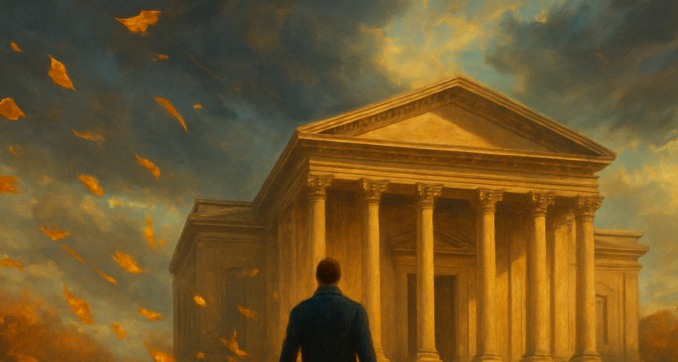
When an Eastern European leader arrives in The Hague seeking diplomatic support ahead of a harsh winter, the scene may seem purely geopolitical. But beneath the surface lies a timeless question that has fascinated Freemasons for centuries: what does a person’s conduct in times of crisis reveal about their true character? And how does the Masonic tradition help us think about the deliberate shaping of personality?
Why Diplomacy Touches the Core of Personality
Diplomacy is one of the great stages on which personality becomes visible — not the personality of polished smiles and rehearsed gestures, but the deeper kind: the inner constitution that reveals itself when the stakes are highest. How does a person behave when necessity presses? Which values rise to the surface when pressure mounts?
For the Freemason, this is no abstract question. The work within the lodge constantly circles around a central inquiry: who are you when no one is watching, and who do you become when everyone is? The rough ashlar — the central image of the Craft — represents nothing less than the ongoing refinement of character. In the Masonic tradition, personality is not a fixed trait you are born with. It is a lifelong project, a building raised stone by stone.
What Do We Really Mean by Personality?
It is tempting to equate personality with temperament or with the impression someone makes on others. But the philosophical tradition teaches us that personality reaches much further. Aristotle described character in his Nicomachean Ethics as the product of habit: you become just by performing just acts, courageous by making courageous choices. Personality, in this view, is not an inherited trait but a structure you build deliberately over time.
Marcus Aurelius, the Roman emperor and Stoic philosopher, took the idea a step further. In his Meditations, he wrote that the true character of a person is not revealed in prosperity but in adversity. It is precisely when winter approaches — literally and figuratively — that we see what remains of a personality after comfort has been stripped away. That thought resonates powerfully with what we observe in diplomatic life: a leader who does not wait for the cold to arrive but moves ahead, seeking allies and preparing for what is to come.
How Freemasonry Approaches the Formation of Character
Within Freemasonry, the formation of personality is not a side effect of membership — it is the very purpose of the entire ritual system. The three degrees of Entered Apprentice, Fellowcraft, and Master Mason represent stages of inner growth. The Apprentice learns to know himself. The Fellowcraft learns to understand the world. The Master learns to confront mortality and responsibility. At each stage, the Freemason is invited to look honestly at his own shortcomings and to work on them actively.
The ritual provides a safe space for this work. As the Scottish philosopher and Freemason Andrew Michael Ramsay argued in the eighteenth century, the lodge is a training ground for the virtues needed in the wider world. Courage, justice, temperance, and wisdom — the four cardinal virtues — stand at the heart of both classical philosophy and Masonic thought. Personality, in this light, is the result of continuous practice, not of a single defining moment.
Personality is not a mask you put on for the outside world. It is the structure that remains when all masks have been removed.
What the Metaphor of Winter Teaches Us About Ourselves
The approaching winter that plays such a central role in the diplomatic talks at The Hague is more than a season. It is an ancient symbol of trial and testing. In virtually every cultural tradition, winter represents the period in which abundance gives way to scarcity, in which human beings are thrown back on their essence. The question is never whether winter will come, but how you prepare for it.
Johann Wolfgang von Goethe, himself a Freemason and one of the greatest thinkers in European cultural history, wrote that it is only in darkness that we discover who truly carries light. That idea connects seamlessly with the Masonic principle that the journey from darkness to light is not a one-time event but a cycle that repeats with every new stage of life. Every winter brings a fresh invitation to grow.
Is Determination a Virtue or a Pitfall?
An intriguing question raised by the diplomatic scene in The Hague is where determination ends and stubbornness begins. When does healthy perseverance tip over into rigidity? The Stoics — Seneca and Epictetus among them — drew a sharp line between what lies within our power and what lies beyond it. Determination is a virtue as long as it is directed at what we can actually influence. The moment it becomes a refusal to accept reality, it turns into a burden.
This tension is a recurring theme in lodge discussions. The Freemason strives for improvement yet accepts that perfection is a horizon never fully reached. The balance between ambition and humility, between pressing forward and letting go, may be the most difficult lesson in the formation of character. It is a lesson that applies not only to heads of state at negotiating tables but to anyone trying to live with integrity in an uncertain world.
What Can We Take Away from This Reflection?
It is easy to reduce the news from The Hague to political strategy. But those willing to look deeper will find a mirror in it. Personality reveals itself in action under pressure. Freemasonry offers a framework for shaping that personality consciously — not by imposing dogma, but by creating a space in which honest self-knowledge becomes possible. Aristotle called it phronesis, practical wisdom: the capacity to do the right thing in every situation, not because the rules demand it, but because your character calls for it.
Personality is forged through action, not through intention alone. Whether on the diplomatic stage or within the quiet walls of a lodge, the same truth holds: character is not what you claim to be — it is what you demonstrate when it matters most. The approaching winter, in all its symbolic weight, reminds us that preparation, self-awareness, and the courage to act with integrity are not just Masonic ideals. They are the foundations of a life well lived.
Copyright text & image: devrijmetselaar.nl
Texts are based on the ideas and content of the author of devrijmetselaar.nl, reviewed, corrected, and supplemented with the assistance of OpenAI. Images are created based on the ideas of the author of devrijmetselaar.nl using OpenAI/DALL-E.
Frequently Asked Questions
What does Freemasonry teach about character and personality?
According to Masonic tradition, personality is not a fixed trait you are born with, but rather a lifelong project of deliberate refinement. The Craft teaches that character is built stone by stone, similar to the rough ashlar symbol. Freemasonry emphasizes that true personality is revealed through your conduct when no one is watching and especially during times of crisis and pressure, not through polished gestures or rehearsed appearances.
How does diplomacy relate to revealing true character?
Diplomacy serves as a great stage where deeper personality becomes visible, particularly during high-stakes situations. According to the article, when necessity presses and stakes are highest, a person's true values and inner constitution surface. The Masonic perspective suggests that how leaders behave in crisis—such as seeking diplomatic support before a harsh winter arrives—reveals their authentic character far more than their conduct during times of prosperity.
What is the philosophical basis for Masonic character development?
Freemasonry draws on classical philosophy, including Aristotle's teaching from the Nicomachean Ethics that character is a product of habit—you become just by performing just acts. The tradition also reflects Marcus Aurelius's Stoic philosophy, which holds that true character is not revealed in prosperity but in adversity. Within Freemasonry, the ritual system and three degrees are specifically designed with character formation as their central purpose.

Be the first to comment