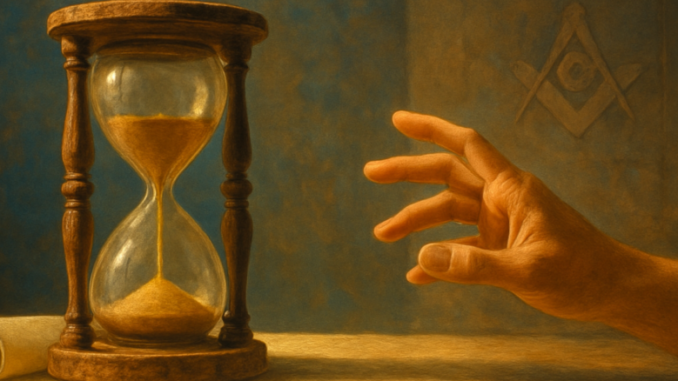
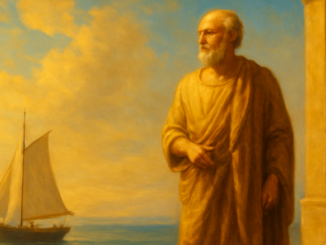
You know the feeling. Another week gone, another month that seems to have evaporated into nothing. You look back and wonder: where did the time go? Nearly two thousand years ago, Lucius Annaeus Seneca described this exact experience in his celebrated essay De Brevitate Vitae — On the Shortness of Life. His message is as simple as it is confronting: life is not short; we make it short. What follows is an accessible summary of this timeless work, along with reflections on how Seneca’s insights connect to Masonic practice and can be applied to your daily life.
The Core Idea: Time as Your Most Precious Possession
Seneca wrote this essay around 49 AD and addressed it to Paulinus, a Roman official responsible for the grain supply of Rome. His central thesis is remarkably direct: people constantly complain that life is too short, yet in reality they squander the greater part of their time on things that do not matter. Seneca argues that nature gives us more than enough time. The problem does not lie in the quantity — it lies in how we use it.
We guard our money, our homes, and our possessions with vigilance, yet we allow our time to slip away without a second thought. We permit others to lay claim to our hours, our days, and our years, never realizing that we are giving away the one thing that is truly irreplaceable. Seneca puts it sharply: no one would hand over their land to a stranger, but their life — they give it freely to anyone who asks.
Three Ways We Waste Our Lives
Throughout the essay, Seneca identifies several patterns by which people shorten their own lives. What makes them so powerful is how recognizable they remain, even in our age:
Procrastination and future-mindedness: We live as though we have unlimited time. We postpone the real business of living until tomorrow, until next year, until retirement. Meanwhile, the present slips by unnoticed. This is perhaps the most insidious trap — the assumption that meaningful life is always just around the corner.
Busyness without meaning: Seneca describes at length how people lose themselves in the pursuit of status, in endless obligations, in trivial entertainment, and in social commitments that contribute nothing to inner growth. He paints vivid pictures of Romans spending hours on their hair, at elaborate banquets, or chasing political favors. Replace these with scrolling through social media, binge-watching television, and networking for its own sake, and you have a portrait of modern life.
Living for others: Many people spend their entire lives fulfilling the expectations of others. They reach the end of their career and only then realize they never truly lived for themselves. They traded authenticity for approval and find their account of time completely spent.
Seneca’s Roman Examples — Power Is No Shield Against Wasted Time
To strengthen his argument, Seneca draws on concrete historical figures. He references Augustus, the first Roman emperor, who despite all his power and glory yearned desperately for rest and leisure. Augustus wrote letters to the Senate begging for time off, yet that moment of true freedom never arrived for him. Seneca also mentions Marcus Tullius Cicero, who in his final years found himself trapped between warring political factions and lamented living only a “half life.”
Even the most powerful and talented figures of Rome failed to live consciously, Seneca argues. Power, wealth, and status offer no protection against wasted time. This is a lesson that resonates deeply within Freemasonry, where a Brother is reminded that rank and worldly distinction count for nothing within the lodge — what matters is the quality of one’s character and the depth of one’s self-knowledge.
Against these cautionary examples, Seneca holds up the ideal of the philosopher. Those who dedicate themselves to wisdom and self-examination truly live. He points to thinkers like Aristotle and Socrates as people who spent their time meaningfully. Their lives were not necessarily longer in years, but infinitely richer in depth. They lived not for the crowd, but from inner conviction.
What This Means for Your Life — and Your Masonic Practice
The power of Seneca’s essay lies not only in its analysis but in its practical consequences. If you take this work seriously, you can begin living differently today. Seneca offers a clear framework: divide your experience of time into three categories. The past, which you can reflect upon and learn from. The present, which you can shape with intention. And the future, which is uncertain and should never be counted upon. Whoever applies this threefold distinction stops postponing and starts living.
Here is a concrete exercise: at the end of each day, ask yourself the question that also stands at the heart of Masonic reflection. What did I do today that held real value? Did I spend my time on growth, on genuine connection, on improving myself and my surroundings? Or did I allow myself to be swept along by busyness that, in hindsight, meant nothing? This kind of daily self-examination — actively encouraged in the Masonic tradition as a nightly practice — is precisely what Seneca advocates.
Life is long enough if you live it consciously. Seneca teaches us that it is not the years that count, but what you do with them. For Freemasons, this echoes the symbolism of the hourglass and the scythe — ancient reminders that time is finite, and that every moment is an opportunity to work on the rough ashlar of the self.
The Unexpected Relevance of an Ancient Essay
What makes this essay so extraordinary is that after nearly two millennia, it has lost none of its edge. The Romans Seneca describes — with their overstuffed schedules, their pursuit of status, and their inability to pause — bear a striking resemblance to us. We scroll through endless news feeds, fill our evenings with entertainment that leaves us hollow, and plan vacations to recover from a life we have made too full ourselves. Seneca would ask us the same question he asked Paulinus: when are you finally going to live?
The essay does not invite gloom — it invites action. It is a call to reclaim your time. Not by doing more, but by choosing more consciously what you do. Choose activities that enrich you. Spend your evenings in conversations that matter. Read a book that challenges you, as Michel de Montaigne would later do when he drew inspiration from Seneca for his own essays on human existence. Have the courage to say no to obligations that do not nourish your soul.
Conscious Living as a Daily Practice
Seneca’s message can be distilled into a practice you can begin tomorrow morning. Before you start your day, take five minutes to reflect on what you truly consider important. Write down three things that deserve your full attention and energy. Then, as the day unfolds, measure your actions against those intentions. This small ritual — a secular echo of the Masonic practice of daily reflection — can transform how you experience time.
The Stoic philosopher does not ask us to withdraw from the world or reject our responsibilities. He asks us to engage with life fully and deliberately, to stop sleepwalking through our days, and to recognize that every hour given to triviality is an hour stolen from meaning. In Masonic terms, it is about working with purpose on the building of your inner temple, stone by stone, day by day.
Seneca’s essay is ultimately an act of generosity — a gift from a thinker who lived in turbulent times and found in philosophy a way to live well. His words have survived because they speak to something universal in the human condition: the tension between the time we have and the time we waste. Reading him is not an academic exercise; it is a mirror held up to your own life, asking you to look honestly at what you see.
If Seneca were alive today, he might well have found a home in a Masonic lodge — a place dedicated to self-improvement, reflection, and the conscious use of one’s time on earth. His essay On the Shortness of Life remains one of the most powerful invitations ever written to stop drifting and start living with intention. The hours are passing. The question is not whether you have enough time. The question is whether you will use the time you have.
Copyright text & image: devrijmetselaar.nl
Texts are based on the ideas and content of the author of devrijmetselaar.nl, reviewed, corrected, and supplemented with the assistance of OpenAI. Images are created based on the ideas of the author of devrijmetselaar.nl using OpenAI/DALL-E.


Be the first to comment