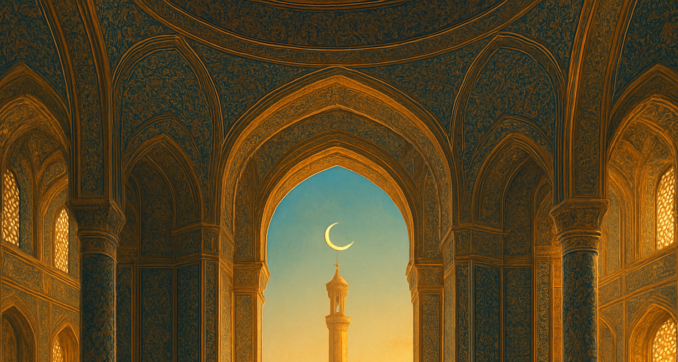
Have you ever stood before a candle in a darkened room and wondered what light truly means — beyond the mere physical phenomenon? Across spiritual traditions, light serves as a powerful symbol of truth, knowledge, and divine presence. The twenty-fourth chapter of the Quran bears the name An-Nur, meaning The Light, and contains one of the most poetic and mystical passages in Islamic scripture. For Freemasons, who ritually journey from darkness into light, this surah offers a surprising sense of recognition and rich material for reflection.
The Heart of Surah An-Nur
Surah An-Nur is the twenty-fourth chapter of the Quran and consists of sixty-four verses. While its content ranges from social legislation to spiritual elevation, the surah owes its name to the celebrated Light Verse — a passage that has inspired mystics, philosophers, and artists for centuries:
“God is the light of the heavens and the earth. His light is as a niche in which there is a lamp; the lamp is in a glass; the glass is like a radiant star, kindled from a blessed olive tree.”
This imagery invites deep contemplation on the nature of divine presence and human consciousness. The surah was revealed in Medina during a period when the early Islamic community needed practical guidance for daily life. Yet the Light Verse places those earthly prescriptions within a cosmic perspective, reminding the faithful that behind all rules and rituals lies a deeper reality — one that manifests as light in the darkness of ignorance.
The Light Verse: A Mystical Core
Over the centuries, the Light Verse has attracted countless interpretations. Islamic mystics such as the thirteenth-century scholar Ibn Arabi saw in its layered imagery a reference to different levels of consciousness. The niche represents the human heart. The lamp stands for the divine spark within every person. The glass symbolizes the purified soul — one that allows light to pass through without distorting it. The olive tree, described as neither of the East nor of the West, points to a universal source that transcends all opposites.
The light described in the Quran and the light sought by Freemasons both point to the same fundamental human quest: the journey from ignorance to insight, from darkness to illumination.
This interpretation aligns with what the medieval philosopher Al-Ghazali wrote in his treatise on the meaning of the Light Verse. He distinguished between different kinds of light and regarded intellectual and spiritual light as higher than the physical. For Al-Ghazali, the journey toward this inner light was the very essence of human existence.
Parallels with Masonic Spirituality
If you are familiar with Masonic ritual, you will likely recognize a deep resonance with the symbolism of An-Nur. The candidate who enters the lodge for the first time does so blindfolded, in symbolic darkness. The moment of receiving light forms a climactic point in the initiation, marking the beginning of a journey toward knowledge and self-improvement. As in the Light Verse, the light in question is not physical — it represents an inner transformation.
The lamp in the niche calls to mind the Blazing Star that hangs prominently in many lodges, a symbol referring to the divine spark within humanity and the search for truth. The olive tree that is neither Eastern nor Western mirrors the universal character of Freemasonry, which unites brethren of all religions and backgrounds around shared values.
Several key themes emerge as common ground between these two traditions:
- The journey from darkness to light as a metaphor for spiritual growth
- The heart as the seat of inner light and moral compass
- Purification as a prerequisite for receiving the light
- Universality that transcends cultural and religious boundaries
Historical Cross-Pollination
The symbolism of light has a long history connecting diverse traditions. Plato wrote in his Allegory of the Cave about a prisoner who climbs from darkness into sunlight and thereby comes to know truth. The Neoplatonists, whose ideas reached medieval Europe through Arabic translators, spoke of the emanation of divine light. These philosophical currents influenced Islamic mystics and the Western esoteric traditions from which Freemasonry partly emerged.
During the Renaissance, European scholars studied Arabic translations of and commentaries on Greek philosophers. Through this exchange, ideas about light, knowledge, and the perfection of the soul came into contact with Christian mysticism and Hermetic traditions. Freemasonry, which took its modern form in the seventeenth and eighteenth centuries, inherited this rich symbolic language. Thinkers such as Isaac Newton and Johann Wolfgang von Goethe — both deeply interested in alchemy and the study of light — moved in circles where these traditions converged.
An Invitation to Reflect
What does it mean to you to seek the light? The question is not exclusively Islamic or Masonic — it is profoundly human. Surah An-Nur invites us to consider the sources of light in our own lives: moments of insight, experiences of connection, and those instances when confusion gives way to clarity. The lamp in the niche does not burn on its own; it requires care, attention to what is pure and what obscures.
For Freemasons, studying other spiritual traditions is not a threat but an enrichment. By recognizing how universal the search for light truly is, our understanding of our own symbols and rituals deepens. The Light Verse of the Quran is not a foreign text — it is a variation on the same timeless theme that has united people of goodwill across the ages.
Surah An-Nur reminds us that light is far more than a physical phenomenon. It is a metaphor for the deepest aspirations of the human spirit — the longing for truth, understanding, and a connection to something greater than ourselves. Whether encountered in a Masonic lodge or in the pages of the Quran, the call to journey from darkness into light remains one of humanity’s most enduring and unifying themes.
Copyright text & image: devrijmetselaar.nl
Texts are based on the ideas and content of the author of devrijmetselaar.nl, reviewed, corrected, and supplemented with the assistance of OpenAI. Images are created based on the ideas of the author of devrijmetselaar.nl using OpenAI/DALL-E.

Be the first to comment