
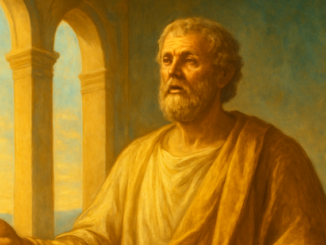
Picture a man in a toga standing in a crowded Roman colonnade, surrounded by senators and merchants flaunting their wealth. He raises his hand and calmly declares that none of them are truly happy. The crowd falls silent. That man is Lucius Annaeus Seneca, and his words about the happy life remain as sharp today — nearly two thousand years later — as they were then.
What Is This Essay About?
The essay known as De Vita Beata — or On the Happy Life — is the second essay from the ninth book of the Letters to Lucilius, the vast collection of letters Seneca wrote to his younger friend Lucilius. In this text, Seneca poses a deceptively simple question: what is happiness, really, and how do we achieve it? The answer he offers is anything but superficial. Seneca dissects the common assumptions about wealth, pleasure, and status, and sets against them a radically different ideal: a life guided by reason, lived in harmony with nature, and steered by inner virtue.
The Central Idea: Happiness as an Inner Disposition
The central theme of the essay is that true happiness does not depend on external circumstances. Seneca firmly rejects the notion that wealth, fame, or bodily pleasure hold the keys to a happy existence. He argues that a happy life springs from a mind free of fear and craving — a mind that finds rest within itself. For Seneca, happiness is not something that happens to you; it is an attitude you cultivate. It is the result of deliberate choices, self-discipline, and a constant alignment with what truly matters.
In this, Seneca aligns closely with the broader Stoic tradition, but he adds his own distinctive nuance. Where some philosophers, such as the Cynics, rejected all material possessions outright, Seneca acknowledged that wealth is not inherently evil. The problem only arises when a person becomes possessed by their possessions. A wise person can own wealth without becoming its slave, he argues. This idea makes his reasoning remarkably accessible: he does not demand total renunciation, but rather a conscious, thoughtful relationship with whatever life brings you.
According to Seneca, the happy life is not the life that others admire, but the life in which the mind is at peace with itself and free of inner turmoil.
Seneca’s Refutation of Hedonism
A significant portion of the essay is devoted to dismantling the idea that pleasure is the highest good. Here, Seneca indirectly addresses the legacy of Epicurus, the Greek philosopher who taught that pleasure is the measure of the good life. Seneca treats Epicurus with a degree of respect, but pointedly observes that most people fundamentally misunderstand his teachings. They use Epicurean philosophy as a license for unbridled indulgence, whereas Epicurus himself actually advocated a simple, modest existence. Seneca argues that whoever elevates pleasure to the ultimate aim of life will inevitably become a slave to their desires. The pursuit of pleasure leads to restlessness, not peace.
He employs the vivid image of a crowd surging in one direction like a herd, without ever questioning whether that direction is the right one. It is a powerful metaphor: most people blindly follow the prevailing assumptions about happiness without ever pausing to ask whether those assumptions hold true. Anyone who truly wants to be happy must have the courage to swim against the current and chart their own course.
The Role of Virtue
For Seneca, virtue is the only true good. By this he does not mean mere niceness in the everyday sense, but a deeply rooted inner quality: the capacity to do the right thing in every situation, guided by reason. Virtue encompasses courage, justice, temperance, and wisdom. A virtuous life is, by Seneca’s definition, a happy life, because the virtuous person does not depend on circumstances beyond their control. He points to the example of Cato the Younger, the Roman statesman who chose death over the surrender of his principles. For Seneca, Cato’s life demonstrates that inner freedom outweighs outward success.
The Paradox of Seneca’s Own Life
What makes this essay particularly compelling is Seneca’s awareness of the apparent contradiction in his own position. He was one of the wealthiest men in Rome, adviser to Emperor Nero, and lived in great luxury. Yet he preached moderation and inner simplicity. In the essay, he addresses this criticism head on. He acknowledges that he does not always live as he teaches, but insists that the striving toward wisdom matters more than its flawless execution. A philosopher need not be without fault, he argues, as long as he remains honest about his shortcomings and continues working to improve. This candor gives the essay a surprising vulnerability and humanity.
What Can We Learn From This Essay Today?
Seneca’s message is timeless. In a world dominated by social media, consumer culture, and the relentless comparison with others, his call to seek happiness not outside yourself but within resonates more powerfully than ever. His insight that possessions cannot make you happy unless you are inwardly free in relation to them touches on fundamental questions of meaning and purpose — questions that also stand at the heart of traditions like Freemasonry.
Freemasonry teaches its members to work continuously on themselves — to shape the rough ashlar of their own character into something nobler. That ideal of constant self-improvement is precisely what Seneca describes when he says that the journey toward wisdom is never complete. The Masonic principle of refining oneself through moral and philosophical reflection mirrors the Stoic conviction that virtue is not a destination but a lifelong practice.
Just as Montaigne centuries later would rediscover and weave Seneca’s ideas into his own essays, Stoic wisdom remains a wellspring from which each new generation draws. On the Happy Life is not a manual with ready-made answers, but an invitation to think — to question what you truly value and to have the courage to live accordingly.
Seneca’s On the Happy Life challenges us to look beyond the surface of wealth, status, and pleasure, and to seek true contentment in the disciplined cultivation of virtue and self-knowledge. For Freemasons and seekers alike, his words serve as a timeless reminder: the real work — the Great Work — is always the work we do on ourselves. The journey toward wisdom never ends, and that is precisely what makes it worthwhile.
Copyright text & image: devrijmetselaar.nl
Texts are based on the ideas and content of the author of devrijmetselaar.nl, reviewed, corrected, and supplemented with the assistance of OpenAI. Images are created based on the ideas of the author of devrijmetselaar.nl using OpenAI/DALL-E.



Be the first to comment