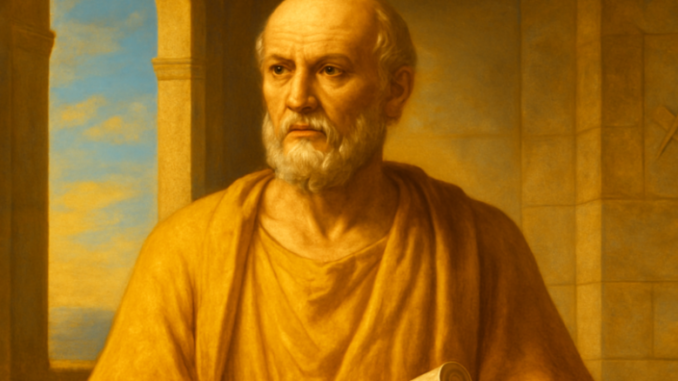
An old man sits at his writing desk, the oil lamp casting dancing shadows across rolls of parchment. Outside, evening descends over Rome, but Lucius Annaeus Seneca barely notices. He is writing to his friend Lucilius about something that has occupied his mind for years: the approach of death and the art of truly living. In this twenty-sixth letter, a rich philosophical tapestry unfolds — woven from threads of Stoicism, Epicureanism, and ancient Greek wisdom. What thinkers and traditions shaped Seneca’s reflections on the ultimate transition, and why do they still matter to Freemasons today?
The Stoic Foundation: Living in Accordance with Nature
Seneca’s thinking about death and life is deeply rooted in Stoic philosophy, a school founded by Zeno of Citium around 300 BCE. The Stoics taught that death is not an evil but a natural part of the cosmic process. Chrysippus, one of the great systematizers of early Stoicism, developed the concept of the logos — the rational order that permeates the universe. For Seneca, this means that death need not be feared, because it is part of the very same logos that makes life possible.
In Letter XXVI, Seneca applies this teaching to his own aging. He describes how his body is weakening, but emphasizes that the mind can remain independent. This aligns with the Stoic conviction that only our inner disposition — the hegemonikon, or ruling faculty of the soul — truly belongs to us. External circumstances, including physical decline and death itself, lie beyond our control and therefore belong to the adiaphora: matters of indifference.
Epicurus: The Unexpected Ally
Remarkably, Seneca regularly quotes Epicurus in his letters — the founder of a rival philosophical school. In Letter XXVI, the Epicurean insight rings clearly: death does not concern us, because where we exist, death is not, and where death is, we no longer exist. Seneca appreciates this clear-eyed reasoning, even though he differs fundamentally from Epicurus on many other points.
This willingness to learn from philosophical opponents is characteristic of Seneca’s eclectic approach. He regarded wisdom as the common heritage of humanity, not the exclusive property of any single school. This openness resonates powerfully with Freemasonry, where brothers from diverse religious and philosophical backgrounds come together around shared values. Just as Seneca transcended sectarian boundaries in his pursuit of truth, so does the Craft embrace the best of every noble tradition.
Death is not the end of life, but its completion: only those who learn to die well have truly lived.
Socrates and the Art of Dying
Behind both Stoicism and Epicureanism stands the towering figure of Socrates, whose death in 399 BCE became a benchmark for all subsequent philosophy on mortality. Plato’s dialogue Phaedo describes how Socrates calmly drank the hemlock, convinced that philosophy is a rehearsal for dying. This idea echoes throughout Seneca’s work: every day we must prepare ourselves for the end — not out of morbidity, but in order to live fully.
Seneca repeatedly refers to Socrates in his letters as the ultimate example of philosophical fearlessness. The wise person does not accept death passively but actively: he has lived his life in such a way that the end brings no regret. This ideal of praemeditatio mortis — the premeditation of death — became a central Stoic practice, one that Seneca personally applies in Letter XXVI.
The Roman Context: Honor, Duty, and Philosophia
Seneca did not write in a vacuum. As adviser to Emperor Nero and a prominent member of the Roman elite, he moved in a world where philosophy and politics were constantly intertwined. The Roman tradition had its own relationship with death, shaped by concepts such as dignitas and virtus. A Roman was expected to live — and die — with dignity.
Cicero, a generation earlier, had made Greek philosophy accessible to a Roman audience. His Tusculan Disputations extensively address the question of how the wise person faces death. Seneca builds on this work but adds a more personal, intimate register. Where Cicero writes as orator and statesman, Seneca speaks as friend to friend, as seeker to seeker. It is precisely this intimacy that gives Letter XXVI its enduring emotional power.
Freemasonry and the Philosophical Legacy
The themes of Letter XXVI connect directly to central Masonic symbols. The rough ashlar that must be shaped into a perfect cube represents the lifelong task of self-improvement. But this work takes place in full awareness of our finitude. The memento mori — the reminder of death — is not an expression of gloom but a call to live with meaning and purpose.
In the Third Degree of Freemasonry, the confrontation with mortality plays a central role. The candidate is symbolically brought face to face with death — not to frighten, but to be transformed and raised anew. This ritual echoes the Stoic and Socratic teachings that Seneca articulates so eloquently: whoever has contemplated death with honesty lives with greater intensity and purpose.
Seneca’s philosophical synthesis — drawing on Stoic acceptance, Epicurean logic, and Socratic courage — mirrors the Masonic ideal of gathering light from every worthy source. The lodge is a place where ancient wisdom is not merely studied but lived, where the symbols on the tracing board invite each brother to reflect on his own journey from the rough to the polished stone, from birth to the inevitable passage beyond.
The Enduring Relevance of Seneca’s Question
Letter XXVI is not a detached treatise — it is a living document from a man confronting his own finitude. Seneca was in his seventies when he wrote it, feeling his body wear down. Yet there is no despair in his words, only a serene determination to make the most of every remaining day.
The philosophical threads he weaves together form a coherent and deeply humane vision. Stoicism provides the framework: death is natural and not to be feared. Epicurus supplies the argument: death and consciousness are mutually exclusive. Socrates offers the example: philosophy as preparation for dying. The Roman tradition adds dignitas: the imperative to live and die with honor.
Together, these strands form the fabric from which Seneca composed his letter. For the modern reader — and for Freemasons in particular — this legacy extends a timeless invitation: reflect regularly on your mortality, not to flee from life, but to embrace it at its deepest level.
Seneca’s Letter XXVI stands on the shoulders of centuries of philosophical thought about life and death. Its genius lies not in offering easy answers, but in weaving together the wisdom of multiple traditions into a single, deeply personal meditation. For Freemasons, who encounter the mystery of mortality in their own rituals and symbolism, Seneca remains a kindred spirit — a seeker who understood that the contemplation of death is, ultimately, the highest affirmation of life.
Copyright text & image: devrijmetselaar.nl
Texts are based on the ideas and content of the author of devrijmetselaar.nl, reviewed, corrected, and supplemented with the assistance of OpenAI. Images are created based on the ideas of the author of devrijmetselaar.nl using OpenAI/DALL-E.

Be the first to comment