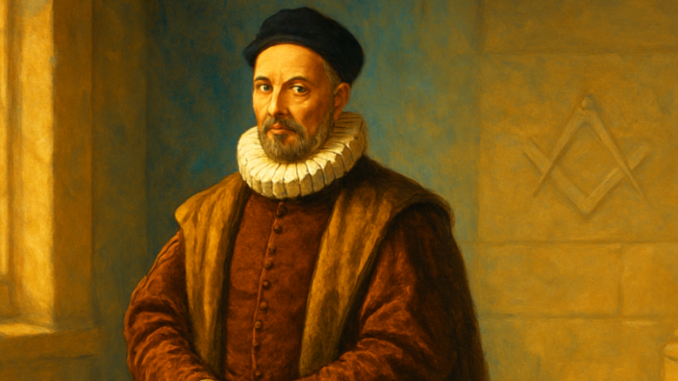
When Michel de Montaigne writes that the distance between two people is smaller than we think, he is doing far more than making a modest observation. He is delivering a philosophical verdict rooted in centuries of thought about human worth, outward appearance, and inner virtue. His forty-second essay from the first book of the Essays, “On the Inequality That Exists Among Us,” is not a stray reflection but a crossroads where Stoic ethics, Skeptic doubt, and Renaissance humanism converge. The question he raises strikes at something that also stands at the heart of Freemasonry: if outward display tells us nothing about a person’s true nature, what determines their real standing?
A Thesis That Burns Through: Outward Versus Inward
Montaigne opens his essay with a paradox that works like a magnifying glass focusing sunlight into a single burning point. He argues that we constantly impose inequalities on people based on wealth, title, clothing, and rhetoric, while the true measure of a person lies elsewhere entirely. That true measure is virtue — the inner capacity to live well. In making this claim, he places himself in a tradition stretching back to Greek antiquity, but one that was anything but self-evident in the sixteenth century. In a society saturated with class distinctions, asserting that a peasant could possess as much inner dignity as a king was an act of genuine intellectual courage.
That courage was not unfounded. Montaigne could draw on a rich philosophical heritage that he had studied with care and that he — true to form — never adopted uncritically but rather tasted and weighed with characteristic deliberation.
Seneca and the Stoic Idea of Equality
The strongest philosophical current running through this essay is Stoicism. Seneca, whom Montaigne read and quoted extensively, argued in his Letters to Lucilius that fortune and birth do nothing to diminish the moral equality of human beings. A slave who lives virtuously stands, in the Stoic sense, higher than a tyrant governed by his passions. This idea cut across the entire Roman class system, and it is precisely this thought that Montaigne takes up and applies to the France of his own day. Where Seneca wrote from a cosmopolitan ideal in which all people share in the same universal reason, Montaigne translates that into a personal, tangible observation: look around you, and you will see that rank and status guarantee nothing about character.
Alongside Seneca, the essay echoes the voice of Epictetus, the former slave who taught that the only thing truly ours is our inner disposition. Montaigne owned the Enchiridion in translation and knew its essence well: freedom is not a matter of chains or their absence, but of the mind that either allows itself to be chained or refuses to submit.
Plutarch and the Art of Comparison
Besides the Stoics, Plutarch was one of Montaigne’s most beloved sources. Plutarch’s Parallel Lives offered a method that Montaigne eagerly adopted: placing two figures side by side so that comparison yields insight. In the essay on inequality, Montaigne employs a similar technique. He sets the outward splendor of kings against the sober but authentic lives of ordinary people. Where Plutarch compared great Greeks and Romans to weigh their virtues, Montaigne compares social classes and roles to expose the emptiness of outward display.
Plutarch also offered Montaigne something the Stoics provided less of: a certain gentleness, an acknowledgment that people are fallible and that wisdom does not mean standing above others but knowing yourself. This ethic of self-knowledge resonates throughout the entire essay.
Skeptical Doubt as a Method
Montaigne’s thought is inseparably linked to Pyrrhonist skepticism, the philosophical tradition holding that we cannot pass certain judgment on most matters. His personal motto, “Que sais-je?” (“What do I know?”), is not merely a rhetorical question but a way of life. In the essay on inequality, this attitude works subtly beneath the surface: if we cannot even be certain about the nature of our own character, how can we claim with any confidence that one person is worth more than another? Skeptical doubt undermines every hierarchical system built on apparent certainties such as birth or wealth.
Sextus Empiricus, whose works came back into circulation in the sixteenth century and profoundly influenced Montaigne, provided the tools for this dismantling. Skepticism gave Montaigne the freedom to doubt conventions that others took for natural law.
Renaissance Humanism: The Human Being as the Measure
The broader intellectual climate in which Montaigne wrote was that of Renaissance humanism. Thinkers like Erasmus and Pico della Mirandola had already argued that human dignity did not depend on birthright but on the capacity for reason, creativity, and moral choice. Pico’s famous Oration on the Dignity of Man proposed that the human being is the only creature capable of shaping itself. Montaigne takes up that idea but adds his characteristic modesty: yes, human beings can shape themselves, but they usually do so far worse than they imagine.
This combination of humanist confidence and skeptical caution makes Montaigne’s position unique. He is neither an idealist who glorifies humanity nor a cynic who writes it off. He observes, he weighs, and he leaves the verdict open.
The Ethical Core and Its Masonic Resonance
What makes this philosophical background relevant to Freemasonry? The Lodge is a space where outward distinctions are set aside. Title, profession, and social position have no bearing within the work of the Temple. What matters is the inner striving toward improvement — what Montaigne calls “virtue” and what the Masonic tradition calls “working the rough stone.” The Stoic idea of equality, the Skeptic’s doubt toward outward certainties, and the Humanist’s trust in human potential to grow and improve — all three of these currents flow directly into the Masonic worldview.
Montaigne never wrote about Freemasonry — organized speculative Masonry as we know it emerged after his lifetime. Yet his philosophical sensibility anticipates the Masonic ethos with remarkable precision. The insistence that a person’s worth is measured not by rank or riches but by inner character; the invitation to know yourself before presuming to judge others; the humble recognition that certainty is rare and self-deception is common — these are principles that any Brother or Sister will recognize from the rituals, symbols, and moral teachings of the Craft.
Reading Montaigne’s essay through a Masonic lens does not distort his meaning. Rather, it illuminates a shared philosophical ancestry. Both Montaigne and the Masonic tradition draw from the same deep wells — Stoic virtue, Skeptic humility, Humanist hope — and both arrive at a similar conclusion: the only inequality that truly matters is the one between who we are and who we could become.
Montaigne’s essay on inequality is far more than a Renaissance curiosity. It is a living text that challenges us to look beyond the surface — of others and of ourselves. Its philosophical roots in Stoicism, Skepticism, and Humanism provide a framework that remains as vital today as it was in the sixteenth century. For Freemasons especially, Montaigne’s insistence on inner virtue over outward appearance is not just a philosophical argument — it is a daily practice, enacted every time a Lodge meets on the level and parts on the square. In a world still obsessed with titles, wealth, and status, Montaigne’s quiet, probing question endures: What do I know? And perhaps more importantly: What kind of person am I, really?
Copyright text & image: devrijmetselaar.nl
Texts are based on the ideas and content of the author of devrijmetselaar.nl, reviewed, corrected, and supplemented with the assistance of OpenAI. Images are created based on the ideas of the author of devrijmetselaar.nl using OpenAI/DALL-E.

Be the first to comment