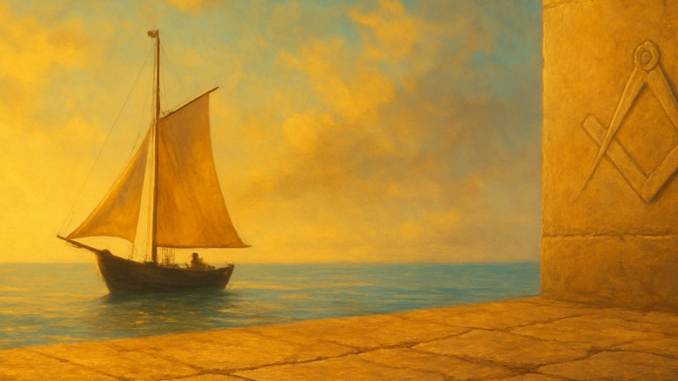
On July 27, 2026, seismologists recorded a minor earthquake — just 1.6 on the Richter scale — beneath the village of Sappemeer in the northern Netherlands. Most residents barely felt it. Yet the event raised a question that resonates far beyond geology: how solid is the ground we stand on? Not just the physical earth beneath our feet, but the inner foundation we’ve built for ourselves. In Freemasonry, this question sits at the very heart of the Craft. How do you build a character that can withstand the inevitable tremors of life?
The Ground Beneath Your Feet
Picture this: you’re sitting at the kitchen table on an ordinary morning, coffee in hand, when the floor trembles. Just for a second. You might blame a passing truck, but then you check the news and discover the earth itself shifted beneath you. For many people living in earthquake-prone regions, this isn’t an abstract concept — it’s the reality of life on unstable ground.
But this isn’t really about geology. It’s about what that experience reveals about us. The ground we walk on feels permanent and reliable — and so does our sense of self. We assume we know who we are, what we can handle, how we’ll react under pressure. Then something knocks us off balance. An unexpected job loss. A painful conflict with someone we love. A small tremor in what we believed was stable ground. That’s when we discover how solid our foundation truly is.
The Rough Ashlar and the Work of Self-Improvement
In Freemasonry, every seeker begins as a rough ashlar — an unworked stone. This is not a criticism; it’s a starting point. The rough ashlar represents the individual as they arrive: full of potential, but not yet shaped. The Freemason’s work consists of gradually refining that stone, chipping away what is superfluous, strengthening what proves valuable. This is not a one-time effort. It is the work of a lifetime.
Character formation isn’t about shielding yourself from tremors. It’s about developing the ability to stand back up after every shock.
Marcus Aurelius, the Roman emperor and Stoic philosopher, wrote extensively about this idea. In his Meditations, he emphasized that the quality of our lives depends not on what happens to us, but on how we respond. An earthquake of 1.6 magnitude rarely damages buildings. But the shockwaves in our personal lives don’t have to be large to throw us off balance.
Four Practical Steps Toward Inner Solidity
How do you translate these principles into daily life? Here are four concrete practices inspired by the Masonic tradition of self-development.
1. Reflect daily. Take five minutes each evening to look back on a moment when you felt off-balance. Don’t judge yourself — seek to understand. What triggered your reaction? What might you have done differently? This mirrors the Masonic practice of nightly self-examination.
2. Seek out small discomforts. Deliberately place yourself in situations that create mild unease. Have a difficult conversation. Learn a new skill. Meet a stranger. Every small challenge strengthens your foundation, the way repeated minor stresses reinforce a structure.
3. Surround yourself with honest voices. Find people who will give you candid feedback. In the lodge, we call this brotherly admonition — counsel offered not to wound, but to help each other grow. Seek out those who care enough to tell you the truth.
4. Cultivate a daily ritual. Establish a consistent practice you repeat every day. It might be meditation, a morning walk, writing three sentences in a journal, or even mindfully drinking your morning coffee. Rituals create anchor points in a world that never stops moving.
Why Small Tremors Carry Great Lessons
A 1.6-magnitude earthquake rarely makes the national news. No buildings collapse, no evacuations are ordered, no communities mourn. And yet it’s precisely these small tremors that carry the most valuable lesson. They remind us that stability can be an illusion — that the ground beneath our feet is always in motion, even when we don’t notice it.
Goethe, himself a Freemason, wrote about the necessity of continual self-renewal. He saw life as a series of transformations in which we must constantly learn to stand again — not by becoming rigid, but by being flexible enough to move with the shaking without falling over. The Japanese art of building pagodas illustrates this principle beautifully: these structures survive earthquakes not through rigidity, but by swaying with the forces acting upon them.
From Shaky Ground to Solid Character
The residents of earthquake-prone regions learn to live with the knowledge that the ground can shift at any moment. That awareness changes how you look at your home, your neighborhood, your future. It demands a different posture — not one of fear, but of realism. You cannot stop the earth from moving. What you can do is build in a way that withstands the shaking.
The same applies to your character. You cannot strip life of its unexpected shocks. What you can do is work on building a self that doesn’t collapse at the first tremor. This doesn’t require perfection — it requires willingness. The willingness to examine yourself honestly, to acknowledge your weak points, and to choose growth over comfort, day after day.
A minor earthquake beneath a quiet Dutch village reminds us of a profound truth: inner strength is not a given — it is a choice, made fresh every day. Freemasonry offers no guarantees against life’s tremors, but it does offer a method for building yourself into someone who remains standing. Start today. Not because the ground will stay still, but because you want to be ready when it moves.
Copyright text & image: devrijmetselaar.nl
Texts are based on the ideas and content of the author of devrijmetselaar.nl, reviewed, corrected, and supplemented with the assistance of OpenAI. Images are created based on the ideas of the author of devrijmetselaar.nl using OpenAI/DALL-E.
Frequently Asked Questions
What does the 'rough ashlar' mean in Freemasonry?
The rough ashlar represents a person at the beginning of their Masonic journey—full of potential but not yet refined. It symbolizes that Freemasonry is a lifelong process of self-improvement and personal development, where members gradually strengthen their character and remove what is unnecessary or harmful. This concept teaches that we all start imperfectly, and that's perfectly acceptable as long as we commit to continuous growth.
How does Freemasonry help develop inner strength?
Freemasonry teaches that inner strength comes not from avoiding life's challenges, but from developing the ability to respond to them wisely and recover from setbacks. Through daily reflection, seeking self-understanding, and deliberately facing small discomforts, Masons build a solid foundation of character that allows them to weather life's inevitable 'tremors' with resilience and integrity.
Is Freemasonry a one-time experience or ongoing practice?
Freemasonry is fundamentally a lifelong journey of self-improvement and character development. The work of refining oneself, like shaping a rough stone into a perfect ashlar, is never truly complete—it's an ongoing commitment to becoming a better person and contributing positively to society throughout one's life.
What practical exercises do Freemasons use for self-development?
Freemasons practice daily reflection by examining their actions and reactions to understand themselves better without judgment. They also deliberately seek out small challenges and discomforts—like difficult conversations or learning new skills—to build resilience and prevent complacency. These practices strengthen character in tangible, achievable ways that can be applied to everyday life.



Be the first to comment