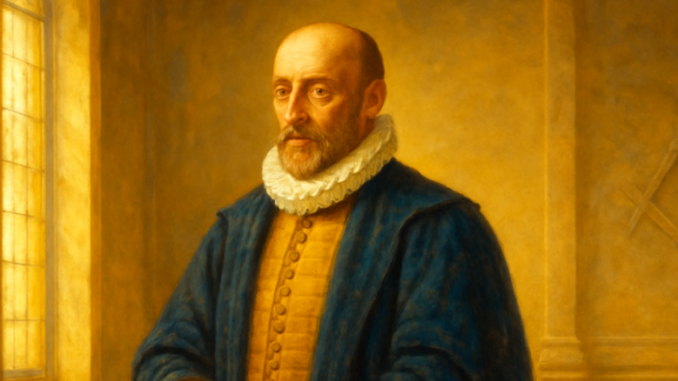
Imagine standing at the threshold of a difficult decision. You feel the tension in your body, the doubt racing through your mind. How do you remain steadfast when circumstances seem to conspire against you? Michel de Montaigne wrestled with precisely this question when he wrote his twelfth essay. In ‘On Constancy,’ he examines what it truly means to be resolute — and why we should not be too quick to congratulate ourselves when we merely appear courageous.
The Core Idea of the Essay
In this brief but powerful essay, Montaigne poses a surprising question: is constancy really what we think it is? He argues that true constancy does not simply mean standing in the face of danger. What matters is how you respond inwardly to threat. You might appear brave as you stride toward a drawn sword, but if you are trembling with fear on the inside and only pressing forward out of shame, can that really be called courage?
Montaigne draws a sharp distinction between outward behaviour and inner disposition. He observes that many people we regard as courageous actually act out of impulse, pride, or even ignorance of the danger they face. The true test of constancy lies not in what others see, but in what you feel while you act.
Historical Examples Montaigne Draws Upon
As is typical of his essays, Montaigne draws generously from classical antiquity. He references the Stoic philosophers, who taught that a wise person should not be swept along by external circumstances. Marcus Aurelius and other Roman thinkers understood that true strength comes from within. Montaigne also cites military examples — soldiers who stood unmoved while chaos erupted around them. Yet he wonders whether these soldiers truly experienced inner calm, or whether they were simply too shocked to react.
Particularly interesting is his reference to the ancient Greeks, notably Aristotle, who wrote about the difference between recklessness and genuine bravery. Montaigne builds on this idea: courage without insight is not a virtue but a form of foolishness. A man who rushes into a burning building without realising the roof could collapse is not brave — he is ignorant.
The Central Theme: Self-Knowledge as the Foundation
What Montaigne ultimately argues is that constancy begins with honesty toward yourself. Know your own fears. Acknowledge your weaknesses. Only when you truly understand what frightens you can you make a conscious choice to act in spite of it. This self-knowledge is the bedrock upon which genuine constancy rests.
Constancy is not the absence of fear but the ability to act consciously and with dignity despite that fear.
This insight resonates deeply with Freemasonry, where self-knowledge is regarded as one of the highest virtues. The famous injunction ‘Know Thyself,’ originating from the Oracle at Delphi and later placed at the centre of Socratic philosophy, also serves as a guiding principle within the Lodge. You cannot become a master of your fate if you are not first a master of your own mind.
The Symbolism of the Rough Ashlar
In Freemasonry, we work symbolically upon the Rough Ashlar — an image of our imperfect soul that must be refined through labour and reflection. Montaigne’s essay on constancy fits seamlessly into this work. The Rough Ashlar represents all our unconscious reactions: the panic, the flight reflex, the tendency to buckle under pressure. Through self-examination — through honestly observing how we respond to adversity — we can smooth these rough edges.
The Perfect Ashlar, the symbol of the mature individual, represents someone who has achieved inner constancy. Not because they never feel fear, but because they recognise it, accept it, and refuse to be governed by it. This is precisely what Montaigne means when he writes about the difference between apparent and true bravery.
Practical Wisdom for Today
What can you take from this essay into your own life? Montaigne invites you to look at yourself with a critical eye. The next time you congratulate yourself on your courage, pause and ask: did I truly act from inner strength, or was I driven by something else entirely? Perhaps it was pride, the desire not to be seen as a coward, or simply the absence of any alternative.
Consider these four principles drawn from Montaigne’s thinking:
Honesty: Acknowledge when you feel fear, rather than suppressing it. Awareness: Make your choices from a place of insight, not mere reaction. Patience: Constancy grows slowly through practice and reflection. Humility: Recognise that you are not always as courageous as you believe yourself to be.
Montaigne’s message is ultimately a hopeful one. He does not claim that true constancy is unattainable. He simply reminds us not to confuse the path with the destination. By being honest about where we stand right now, we can genuinely grow toward where we wish to be.
Michel de Montaigne’s essay on constancy is far more than a philosophical exercise. It is an invitation to self-examination — one that remains relevant for anyone striving toward personal growth. Within the tradition of Freemasonry, we find the same enduring values: the courage to know yourself, the honesty to acknowledge your weaknesses, and the perseverance to keep working on your inner temple despite every obstacle. The next time you face a challenge, ask yourself honestly: am I acting from true constancy, or am I merely playing a part? The answer may be more illuminating than you expect.
Copyright text & image: devrijmetselaar.nl
Texts are based on the ideas and content of the author of devrijmetselaar.nl, reviewed, corrected, and supplemented with the assistance of OpenAI. Images are created based on the ideas of the author of devrijmetselaar.nl using OpenAI/DALL-E.
Frequently Asked Questions
How does Montaigne's essay relate to Freemasonry?
Montaigne's emphasis on self-knowledge as the foundation of constancy aligns perfectly with Freemasonry's core teachings, where 'Know Thyself' is a guiding principle. In the Lodge, Masons learn that true mastery of one's fate begins with understanding one's own mind and inner nature. This Masonic virtue of self-awareness enables Freemasons to face life's challenges with genuine courage and integrity.
What is the difference between appearing brave and true constancy?
According to Montaigne, appearing brave—acting courageously while trembling with fear or acting from shame—is not true constancy. True constancy requires inner awareness and conscious choice to act despite fear, rather than simply being driven by pride, impulse, or ignorance. This distinction teaches us that genuine courage is rooted in self-knowledge and honest acknowledgment of our fears.
Why does Montaigne say courage without insight is foolishness?
Montaigne illustrates this with the example of a man rushing into a burning building unaware the roof might collapse—such recklessness stems from ignorance rather than bravery. True courage requires understanding the reality of a situation and consciously choosing to act with dignity despite the real dangers. This wisdom reflects the Masonic principle that virtue must be guided by knowledge and wisdom.
How can I develop genuine constancy in my own life?
Montaigne teaches that genuine constancy begins with honest self-knowledge—acknowledging your fears and understanding your weaknesses rather than denying them. By recognizing what truly frightens you, you can make conscious, dignified choices to act despite that fear. Freemasonry supports this personal development through its teachings and practices, helping members cultivate the self-mastery that leads to authentic strength of character.
What role does self-knowledge play in Masonic practice?
Self-knowledge is regarded as one of the highest virtues in Freemasonry, reflecting the ancient Delphic maxim 'Know Thyself' that Montaigne also emphasizes. Masonic education encourages members to understand their own minds and inner nature as the essential foundation for personal growth and moral development. Through this self-awareness, Masons cultivate the wisdom and constancy needed to live with integrity and purpose.



Be the first to comment