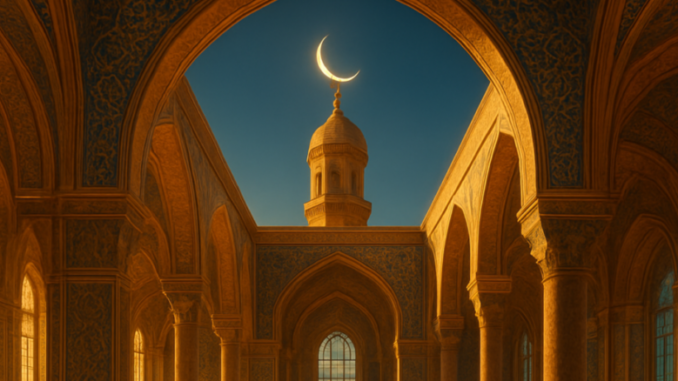
There is a paradox rarely spoken aloud: we grow the most in the very moments we feel the smallest. It is not reassurance but overwhelm that proves to be the true engine of reflection. This paradox resonates powerfully in the eighty-eighth chapter of the Quran, known as Al-Ghashiyah — The Overwhelming. And it is the same paradox a Freemason recognizes when he first enters the temple and realizes the edifice is far greater than himself.
A Chapter That Seizes the Reader
Al-Ghashiyah opens with a direct, almost confrontational question: Has the news of the Overwhelming Event reached you? This is no rhetorical trick. It is designed to lift the listener out of daily autopilot, to tear away the veil of habit. The chapter then paints two contrasting human conditions: faces cast down with exhaustion and fruitless labor, and faces radiant with satisfaction and inner peace. The distance between them is measured not in miles, but in awareness.
What is striking about this short text is the sharp transition from the cosmic to the everyday. After describing the overwhelming reckoning, the chapter redirects our gaze to creation itself: the camel and how it was made, the sky and how it was raised, the mountains and how they were set firm, the earth and how it was spread out. It is as though the text says: you need not wait for an end time to be overwhelmed. The reality around you is already a revelation — if you are willing to truly look.
Awe as the Gateway to Knowledge
The philosopher Aristotle once wrote that philosophy begins with wonder. Centuries later, the medieval Islamic thinker Ibn Rushd — known in the West as Averroës — echoed that same principle from a different vantage point: reason and revelation do not exclude each other but complement one another. Al-Ghashiyah seems to support that thought. The chapter does not call for blind faith but for observation. Look at the camel. Look at the sky. Use your eyes, your intellect, your capacity for awe.
For a Freemason, awe is a familiar concept. The lodge ritual is saturated with moments in which the candidate is invited to pause, both literally and figuratively. The journey from darkness to light, which stands at the heart of the Masonic tradition, does not begin with answers but with the willingness to be overwhelmed by one’s own ignorance. Only the person who acknowledges that he does not know can begin to seek. This attitude connects the Quranic call for contemplation with the Masonic principle that knowledge requires an inner journey.
Two Faces, Two Paths
The contrast in Al-Ghashiyah between weary, downcast faces and radiant, contented faces invites reflection on the nature of human endeavor. The chapter suggests that not all effort bears fruit. There is labor that exhausts without enlightening — work that fills the hands but leaves the soul empty. Set against this is the effort that leads to fulfillment, not because it is easy, but because it is meaningful.
This duality mirrors a theme deeply rooted in Masonic philosophy: the difference between the rough stone and the polished stone. The rough ashlar represents the person who leaves his talents unused, who works without direction, who builds without a blueprint. The perfect ashlar is the result of conscious self-work — the chiseling of character, the polishing of conduct. Johann Wolfgang von Goethe, himself a Freemason and poet, wrote that a person truly lives only when he forms himself. Al-Ghashiyah seems to proclaim that same truth, though in a different language and from a different spiritual landscape.
Awe is not weakness but a gateway: whoever dares to be overwhelmed by the grandeur of existence opens the path to genuine knowledge and moral growth.
The Counterpoint: Can Overwhelm Be Dangerous?
Yet this thesis deserves nuance. Overwhelm can also paralyze. History offers countless examples of people who, confronted with the immeasurable, did not grow but shrank. Blaise Pascal, the seventeenth-century mathematician and thinker, described the silence of infinite spaces as terrifying. Not everyone experiences the cosmic as an invitation. Some experience it as a threat.
Freemasonry offers an interesting response here. The ritual structures the experience of awe. The candidate is not simply thrown into the deep end — he is guided. There are brethren who know the way, not because they possess all the answers, but because they have themselves undergone the process of being overwhelmed and rising again. This fraternal guidance makes the difference between paralysis and transformation. Al-Ghashiyah does something remarkably similar: after confronting the reader with the awe-inspiring, the chapter returns to the visible creation — the mountain, the earth, the animal. As if to say: you need not lose yourself in the infinite. Return to what is near and recognize the sublime within it.
Where the Quran and the Lodge Meet
It is important to emphasize that Freemasonry is not a religion and makes no claim to theological truth. It is a brotherhood that places virtue, self-knowledge, and tolerance at its center. Precisely for this reason, it is valuable to study sacred texts from various traditions — not to claim them, but to distill from them a wisdom that transcends any single confession.
Al-Ghashiyah offers just such a source of boundary-crossing wisdom. The call to contemplate creation resonates with the Masonic ideal of the Grand Architect of the Universe — a deliberately open concept that every brother may interpret according to his own understanding. The distinction between futile labor and meaningful effort echoes the building symbolism that characterizes Freemasonry. And the awe that the chapter evokes is the same awe that fills the lodge when the ritual works as it should: not as performance, but as lived experience that shifts something within.
When we allow ourselves to study texts like Al-Ghashiyah through the lens of Masonic thought, we do not diminish their sacred character. On the contrary, we honor them by engaging with them seriously, by asking what they reveal about the human condition — about our restless striving, our need for meaning, and our capacity to be transformed by something greater than ourselves.
The eighty-eighth chapter of the Quran and the Masonic journey share a profound insight: transformation does not begin with comfort but with the courage to face what is overwhelming. Whether it is the vastness of creation described in Al-Ghashiyah or the symbolic darkness of the lodge before the light is revealed, growth requires the humility to feel small. The rough stone becomes polished not through ease but through deliberate, meaningful work. In the end, awe is not an obstacle on the path to wisdom — it is the very door through which we must pass.
Copyright text & image: devrijmetselaar.nl
Texts are based on the ideas and content of the author of devrijmetselaar.nl, reviewed, corrected, and supplemented with the assistance of OpenAI. Images are created based on the ideas of the author of devrijmetselaar.nl using OpenAI/DALL-E.
Frequently Asked Questions
What is the connection between Al-Ghashiyah and Freemasonry?
Both Al-Ghashiyah and Freemasonry share a paradoxical principle: that growth occurs in moments of feeling small and overwhelmed. The Quranic chapter calls readers to contemplation of creation and cosmic awareness, while the Masonic lodge ritual guides candidates through darkness toward light, requiring them to acknowledge their ignorance before seeking knowledge. Both traditions use awe as a gateway to deeper understanding.
How does Al-Ghashiyah encourage reflection and awareness?
Al-Ghashiyah opens with a confrontational question designed to jolt readers out of daily autopilot and break the veil of habit. Rather than offering abstract cosmic reckoning alone, it redirects focus to everyday creation—the camel, sky, mountains, and earth—suggesting that overwhelm and revelation are already present in observable reality if one is willing to truly look and contemplate.
What role does awe play in gaining knowledge according to this article?
The article argues that awe is fundamental to knowledge, citing Aristotle's principle that philosophy begins with wonder. Al-Ghashiyah demonstrates this by inviting observation and intellectual engagement rather than blind faith. In Freemasonry, awe is cultivated through ritual pauses that help candidates recognize their own ignorance—a necessary first step toward genuine seeking and understanding.



Be the first to comment