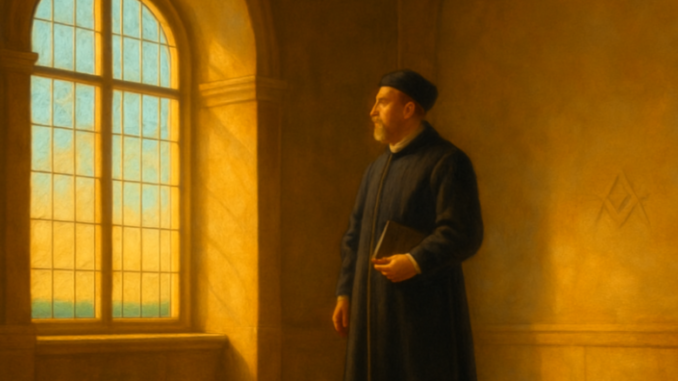
What if humanity’s greatest enemy is not ignorance, not cruelty, but the simple word ‘tomorrow’? In his brief yet incisive essay ‘On Deferral’ — the fourth essay of the second book of his Essais — Michel de Montaigne poses a question that has lost none of its edge over four centuries: why do we postpone what can be done today, when we know full well that tomorrow is promised to no one? It is a question that strikes at the heart of Freemasonry’s central teaching: the duty to live consciously and act purposefully in the present moment.
The Danger of Delay
Montaigne opens his argument with what appears to be a modest confession. He freely admits that he himself is not immune to the habit of putting things off. This honesty is characteristic of his method: by exposing his own failings, he invites the reader into genuine self-examination. But beneath this personal tone lies a far more serious claim. Procrastination, Montaigne argues, is not merely an innocent character flaw. It is a form of self-deception that alienates us from reality. The person who constantly defers does not live in the present — he lives in an imaginary future that may never arrive.
Montaigne stresses that the habit of postponing decisions is particularly dangerous for those in positions of authority and leadership. He points to examples from antiquity, including the Roman general and statesman Marcus Crassus, whose indecisiveness and hesitation cost him both military and political opportunities. The lesson is clear: whoever lets the right moment pass is not punished by fate, but by his own sluggishness.
Classical Echoes and Historical Examples
As in nearly all of his essays, Montaigne draws richly from classical literature. He references Plutarch, whose biographical sketches of Greek and Roman statesmen serve as a recurring touchstone throughout the Essais. The echoes of Seneca are also unmistakable — the Stoic philosopher who, in his letters to Lucilius, repeatedly warned against postponing the good life. The Stoic conviction that we truly possess only the present moment forms the philosophical undercurrent of Montaigne’s argument.
The influence of Marcus Aurelius is palpable as well, even though Montaigne does not mention him by name in this particular essay. The Stoic emperor wrote in his Meditations that every action should be performed as though it were one’s last — a thought that dovetails seamlessly with Montaigne’s case against the eternal ‘tomorrow.’
What sets this essay apart from a purely Stoic treatise, however, is Montaigne’s distinctive tone. He does not moralize from on high. He observes, hesitates, and reflects. He admits that even he does not always act when the moment calls for it. That vulnerability makes his message paradoxically more powerful: if a mind as sharp as Montaigne’s struggles with procrastination, how much more true must it be for the rest of us?
Decisiveness as a Moral Virtue
Beneath the surface of this compact essay lies a deeper understanding of virtue. For Montaigne, decisiveness is not a matter of temperament or talent — it is a matter of moral discipline. To postpone a good deed is, in his eyes, not fundamentally different from failing to do it at all. Whoever knows what is right and still waits consciously chooses stagnation. In Montaigne’s framework, that stagnation becomes almost an ethical category: a subtle form of cowardice dressed up in reasonableness.
Montaigne teaches us that procrastination is not innocent lost time — it is a moral choice. To defer the good is to choose not to do it.
This theme resonates strongly with the thinking of Aristotle, who emphasized in his Nicomachean Ethics that virtue does not consist in knowing the good, but in doing it. Knowledge without action is hollow. Montaigne places himself firmly in that tradition, but adds his characteristic element of doubt. Where Aristotle reasons systematically, Montaigne gropes his way forward — like a man searching for a door handle in a half-lit room.
The Lodge as a Training Ground for the Present
Freemasonry carries within it a profound awareness of impermanence. The ritual continually reminds the Brother that life is finite and that every moment offers an opportunity for improvement. The principle that one should not defer what can be accomplished today is not an abstract ideal within the lodge — it is lived practice. The work on the rough ashlar, the central image of Masonic formation, presupposes that one begins now, not tomorrow. Every lodge meeting is an invitation to take the present seriously.
Montaigne’s essay connects directly to what the eighteenth-century founders of modern Freemasonry — among them James Anderson and Jean Théophile Désaguliers — regarded as a core value: that moral development does not happen in theory, but in the practice of daily life. Anderson’s Constitutions speak of the Brother’s duty to be useful to society — a duty that tolerates no postponement.
The rough stone will not shape itself while we wait for a more convenient day. The chisel must be taken up now, with whatever strength and skill we currently possess. This is the Masonic echo of Montaigne’s philosophical plea: the work of self-improvement is always urgent, because the time we have is always uncertain.
A Paradox That Lingers
What makes ‘On Deferral’ so fascinating is that Montaigne names a problem for which he offers no neat solution. He does not write as a sage who possesses the answer, but as a human being who feels the weight of the question. That is precisely what makes this essay, despite its modest length, one of the most relatable texts in the entire Essais. Every person knows the temptation of delay. Every person knows the quiet shame when a moment has passed unused.
Montaigne invites us not to rationalize that shame away, but to use it as fuel for action. Not tomorrow. Now. For as he remarks elsewhere in his work, there is no guarantee that tomorrow will come. That thought is not bleak — it is liberating. Whoever truly grasps that the present is all he possesses no longer postpones. He acts. He lives.
And so this small essay leaves behind a large question: if we truly understand that tomorrow is not promised, what are we still waiting for? For the Freemason, the answer is embedded in every ritual, every symbol, every moment of shared reflection in the lodge. The rough stone demands our attention today. Montaigne, writing alone in his tower four hundred years ago, arrived at the same truth that Masons enact together in their temples: the only moment we can work with is this one. Let us not waste it.
Copyright text & image: devrijmetselaar.nl
Texts are based on the ideas and content of the author of devrijmetselaar.nl, reviewed, corrected, and supplemented with the assistance of OpenAI. Images are created based on the ideas of the author of devrijmetselaar.nl using OpenAI/DALL-E.

Be the first to comment