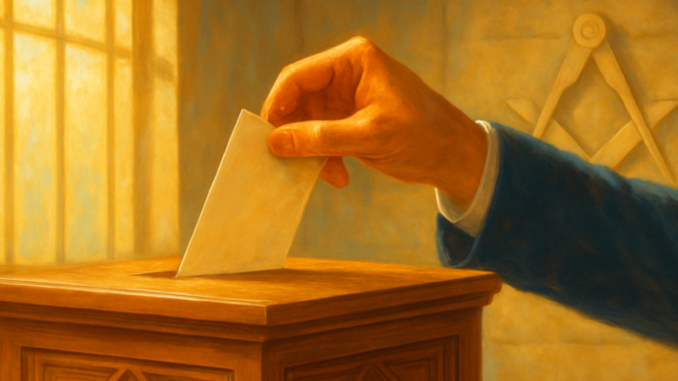
As the world braces for what many consider the most complex elections in modern history, a fascinating question emerges: what does the way we vote reveal about who we truly are? The outside world sees elections as a democratic mechanism — a practical necessity. The Freemason recognises something deeper: a mirror of human personality, with all its contradictions and possibilities for growth.
The Outsider’s View: Complexity as Obstacle
For the average observer, complex electoral systems are above all confusing. Multiple parties, coalition-building, rounds of voting, electoral thresholds, and regional representation make it difficult to understand what a single vote actually means. The focus remains firmly on outcomes: who wins, who loses, which coalition emerges. The person behind the vote stays invisible, reduced to a statistical data point.
In this worldview, the voter is a passive participant in a system larger than themselves. Complexity is treated as a problem to be solved, not as an invitation to reflect. People search for simple answers in a world that stubbornly refuses to be simple. Political commentators analyse voting behaviour as though it should be predictable, while the true motivations of millions of individuals remain elusive.
The Freemason’s View: Choosing as an Inner Process
The Freemason approaches the concept of choosing from an entirely different perspective. Within the lodge, one learns that every choice — no matter how small — is both an expression of personality and an opportunity to shape it. The ritual continually poses the question: who am I, and who do I wish to become? This question resonates powerfully when one stands before societal choices that reach far beyond self-interest.
Where the outside world asks, “Which party serves my interests?”, the Freemason asks, “Which choice aligns with the person I aspire to be?” This is not a political stance but a philosophical posture. Jean-Jacques Rousseau wrote about the difference between the “will of all” and the “general will” — the former merely adding up individual desires, the latter striving toward the common good. The Freemason recognises in that tension an echo of their own inner work.
Where Both Worlds Converge
Despite their different starting points, both perspectives share a fundamental insight: choosing is difficult precisely because it reveals something about who we are. The complexity of modern elections mirrors the complexity of human personality itself. We are not one-dimensional beings; our values sometimes clash, our interests contradict one another, and our ideals sit in uneasy tension with our practical concerns.
Every considered choice is an act of self-knowledge: it shows not only what we want, but who we truly are.
Immanuel Kant argued that the moral worth of an action lies not in its outcome, but in the intention behind it. Applied to the voting booth, this means it is not only about which choice one makes, but about the degree of awareness and integrity with which one chooses. This is precisely where the Masonic approach to personality intersects with the democratic ideal.
Personality as a Work in Progress
In Freemasonry, personality is not viewed as a fixed given but as a rough stone that is continually being shaped. This process has no endpoint — one is never “finished.” Elections, with all their complexity and uncertainty, offer a comparable challenge. They compel us to take positions while acknowledging that our knowledge is incomplete and our perspectives are limited.
Johann Wolfgang von Goethe, himself a Freemason, wrote about the continual transformation of the self. He saw in every choice a moment of becoming, not of being. The voter who truly reflects on their ballot undergoes a process that reaches far beyond politics. They encounter themselves — with all their uncertainties and convictions — and must take responsibility for that encounter.
What We Can Learn from This
Comparing these two worlds teaches us that complexity is not the enemy of democracy but its precondition. A system that demands simple answers denies the richness of human personality. A system that leaves room for nuance acknowledges that people change, grow, and sometimes change their minds.
The outsider sees complexity as a problem; the Freemason sees it as an invitation. Choosing reveals not only preference, but character. Personality is not a possession but a process. Democracy and self-knowledge both require courage and humility.
Voltaire warned against the danger of complacency — the belief that one already possesses the truth. In both the lodge and the voting booth, openness is the first requirement. Not the kind of openness that accepts everything indiscriminately, but the kind that acknowledges the limits of one’s own perspective and recognises that others may see what we ourselves miss.
As the world wrestles with complicated ballots and impenetrable coalition negotiations, the Freemason may remember that every choice is a mirror. The complexity of elections is no different from the complexity of our own inner landscape. Those who learn to choose consciously — with attention to their own blind spots and respect for other perspectives — work not only on society but on themselves. And that, ultimately, is where true personality is forged: in the willingness to choose, again and again, who one wishes to be.
Copyright text & image: devrijmetselaar.nl
Texts are based on the ideas and content of the author of devrijmetselaar.nl, reviewed, corrected, and supplemented with the assistance of OpenAI. Images are created based on the ideas of the author of devrijmetselaar.nl using OpenAI/DALL-E.
Frequently Asked Questions
What is the main difference between how Freemasons and outsiders view elections?
Outsiders view elections as a practical democratic mechanism focused on outcomes and winners, treating voters as passive participants in a complex system. Freemasons, by contrast, see voting as an inner process and expression of personality, asking not just which party serves their interests, but which choice aligns with the person they aspire to become.
How does Freemasonry interpret the concept of choosing in the context of voting?
Within Freemasonry, every choice—including voting—is seen as both an expression of personality and an opportunity for personal growth. The Masonic perspective draws on the philosophical distinction between the 'will of all' (individual desires) and the 'general will' (striving toward the common good), viewing electoral choices as a reflection of one's inner work and values.
Why does the article suggest that electoral complexity mirrors human personality?
The article proposes that the complexity of modern electoral systems is not merely a practical problem but a reflection of human complexity itself. Both voting systems and human personalities are inherently contradictory and multifaceted, making simple answers impossible. This complexity invites reflection rather than frustration, revealing deeper truths about who we are.
Be the first to comment