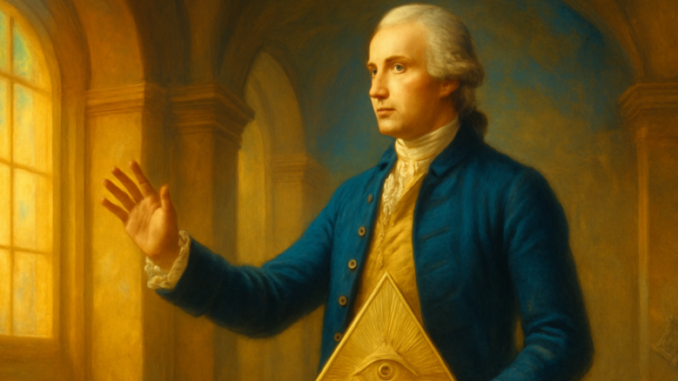
On a cold winter evening in 1776, a young professor in Ingolstadt sat by candlelight, committing his thoughts to paper. Adam Weishaupt, just twenty-eight years old, dreamed of founding a society that would spread the ideals of the Enlightenment among like-minded thinkers. What he began that evening would still capture imaginations two centuries later — though often tangled up in wild speculation and fundamental misunderstandings.
A Professor With a Vision
Adam Weishaupt held a professorship in canon law at the University of Ingolstadt in Bavaria. Frustrated by what he perceived as religious narrow-mindedness and political oppression, he founded a secret society on May 1, 1776. He initially called it the Order of the Perfectibilists, later renaming it the Order of the Illuminati. Its goals were ambitious: to promote rational thinking, combat superstition, and cultivate moral improvement among its members.
The structure of Weishaupt’s order was layered, with multiple degrees of initiation. Members often knew each other only by code names. Weishaupt himself adopted the name Spartacus, after the Roman gladiator who led a slave revolt. This secrecy was not a sign of sinister intent — it was a practical necessity in a Bavaria where freethinking could carry serious consequences.
The Encounter With Freemasonry
Here lies a crucial historical fact that is frequently overlooked: the Order of the Illuminati and Freemasonry were two entirely separate organizations. Weishaupt was not initially a Freemason. It was only in 1777, a full year after founding his own order, that he joined a lodge in Munich. He recognized in Freemasonry’s existing structure an opportunity to accelerate the growth of his own society.
Baron Adolf von Knigge, an experienced Freemason, joined Weishaupt’s order in 1780 and helped reorganize its degree system. Some Freemasons did indeed become members of the Illuminati as well, just as people today may belong to multiple organizations. But this overlap in no way means the two organizations were identical or pursued the same objectives.
The Bavarian Order of the Illuminati existed for only nine years and was dissolved in 1785. Freemasonry, by contrast, has maintained an unbroken tradition spanning more than three centuries.
A Swift Demise
In 1784 and 1785, Bavarian Elector Karl Theodor banned all secret societies, including the Order of the Illuminati. Documents were seized, members were prosecuted, and Weishaupt fled to Gotha in exile. The order collapsed. What remained were papers, letters, and rituals that were later published — often stripped of context and distorted by opponents.
It is essential to understand that this order never counted more than two thousand members, most of them active in Bavaria and a handful of other German states. After 1785, it effectively ceased to exist as a functioning organization. Any claims of its survival or global influence lack historical evidence.
Freemasonry: A Different Tradition Entirely
Freemasonry traces its roots back to the medieval stonemason guilds and was formally organized in 1717 with the founding of the Grand Lodge of London. Enlightenment thinkers like Voltaire, who was initiated in 1778 at the Parisian lodge Les Neuf Sœurs, found their way into the Craft. But Freemasonry as a whole has never pursued political goals in the manner Weishaupt envisioned.
Where Weishaupt’s order was explicitly aimed at societal reform and combating religious influence, Freemasonry deliberately refrains from political and religious positions. A Masonic lodge is a space where people of different backgrounds and convictions meet in brotherhood, focused on personal growth and moral development.
Why the Persistent Confusion?
So why are the two organizations so often conflated? Part of the answer lies in the secrecy that characterized both — though for very different reasons. Another part lies in the deliberate blurring of boundaries by nineteenth-century authors who, often motivated by anti-Enlightenment sentiment, lumped both groups together as dangerous conspirators.
The historical reality is far more prosaic. Weishaupt’s experiment lasted less than a decade and died a quiet death. Freemasonry, on the other hand, continues to flourish to this day, with lodges around the world dedicated to spiritual depth, ethical reflection, and human connection.
Spirituality as Common Ground — and Point of Departure
What both traditions did share was a search for meaning beyond dogmatic frameworks. Weishaupt sought this through rational enlightenment; Freemasonry finds it through symbolism, ritual, and inner transformation. The spirituality of Freemasonry invites self-reflection without imposing a specific concept of the divine. It offers space for people of all religions and philosophies to work together on what unites them: the desire for wisdom, integrity, and brotherhood.
This openness stands in contrast to Weishaupt’s more directive approach. Where he sought to impose reform, Freemasonry invites personal discovery. It is this difference in spiritual approach that fundamentally distinguishes the two traditions, despite the superficial similarities that lead some to confuse them.
The Bavarian Order of the Illuminati was a short-lived experiment by an idealistic professor, born from the specific circumstances of eighteenth-century Bavaria. Freemasonry is a centuries-old brotherhood with its own distinct tradition, purpose, and spiritual practice. Confusing the two does a disservice to the historical record and feeds unnecessary mystification. Anyone who truly wants to understand what Freemasonry is would do well to look past the noise and focus on what the brotherhood actually represents: a living tradition of self-improvement, moral reflection, and genuine human connection.
Copyright text & image: devrijmetselaar.nl
Texts are based on the ideas and content of the author of devrijmetselaar.nl, reviewed, corrected, and supplemented with the assistance of OpenAI. Images are created based on the ideas of the author of devrijmetselaar.nl using OpenAI/DALL-E.


Be the first to comment