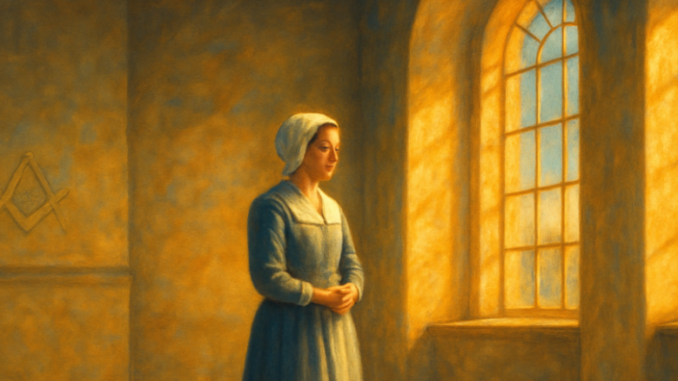
In the middle of the seventeenth century, while England was torn apart by civil wars and religious strife, a movement emerged that was radically different from anything Christianity had produced before. No minister, no liturgy, no prescribed prayers — only silence. And in that silence, the first Quakers believed, something greater than any human voice spoke: the Inner Light. This conviction would not only give rise to an entirely unique form of worship but also establish a spiritual principle that lies surprisingly close to the heart of Freemasonry.
George Fox and the Birth of a Silent Movement
The story of the Quakers begins with George Fox, the son of a shoemaker from Leicestershire, who in 1647 underwent a series of intense religious experiences. Fox was deeply disillusioned with the clergy of his time. He traveled across England searching for spiritual leaders who could guide him, but everywhere he encountered the same emptiness. Then, by his own account, he heard a voice that said: “There is one, even Christ Jesus, that can speak to thy condition.” This moment of inner revelation became the cornerstone of an entirely new religious practice. Fox concluded that no priest, church, or sacrament was necessary to experience God. The divine presence dwelled within every person and could be directly perceived by becoming still and listening inward.
Fox called this principle “that of God in every man.” His followers, who named themselves the Religious Society of Friends, gathered in meetinghouses where there was no altar, no pulpit, and no religious ornamentation of any kind. They sat together in silence, sometimes for an hour or longer, waiting until someone felt called to speak. This radical simplicity was not born of indifference but from the deep conviction that silence itself was sacred.
The Inner Light: A Concept with Deep Roots
The concept of the Inner Light has theological roots that reach far beyond the seventeenth century. The Evangelist John already wrote about “the true light, which enlightens everyone” (John 1:9). The Church Father Augustine of Hippo spoke in the fifth century of an inner teacher dwelling within the human heart. And the medieval mystics, such as Meister Eckhart, described a divine spark in the human soul directly connected to God. Fox and his contemporaries drew — both consciously and unconsciously — from this long mystical tradition.
What made the Quakers unique, however, was that they did not reserve this idea for monks or scholars. Every person, regardless of gender, origin, or education, carried this Light within. This democratization of the divine was extraordinarily revolutionary in the seventeenth century and would have lasting implications for how the movement engaged with the wider world.
Robert Barclay and the Theological Foundation
While George Fox was the inspired preacher, Robert Barclay became the intellectual voice of the early Quaker movement. In 1676, Barclay published his Apology for the True Christian Divinity, a systematic work in which he defended the Inner Light against both the Protestant and Catholic theology of his day. Barclay argued that the Inner Light was not at odds with Scripture but rather illuminated it. Without inner receptivity, he maintained, the Bible remained a dead letter. It was the living Light that brought the words to life.
Barclay also emphasized that this Light was universal. It was not confined to Christians but present in all people, including those who had never heard of Christianity. This idea was remarkably inclusive for its time and laid the foundation for the later Quaker tradition of religious tolerance and social engagement — values that would resonate powerfully with other movements of the era.
Silent Worship in Practice
What did an early Quaker meeting actually look like? The Friends gathered in austere meetinghouses — often nothing more than a bare room with wooden benches arranged in a square or circle. There was no minister, no music, and no predetermined program. The meeting began as soon as the first person sat down and ended when a designated elder shook hands with a neighbor. In between, silence reigned, broken only by moments when someone stood up to speak.
But even that speaking was not a sermon in the traditional sense. It was regarded as an expression of the Inner Light, not a personal opinion. If no one felt called to speak, an entire meeting could pass in complete silence — and this was not seen as a failure but as an especially powerful form of communal worship.
The key characteristics of Quaker silent worship include: no fixed liturgy, prayers, or religious symbols; full equality in which anyone may speak when moved by the Light; silence as an active, communal spiritual practice; no distinction between clergy and laity; and the meeting understood as a collective act of listening to an inner source.
Striking Parallels with Freemasonry
At first glance, the Quakers and the Freemasons seem to have little in common. The former rejected all ritual and hierarchy, while Freemasonry is rich in rituals and degrees. Yet both traditions share a fundamental premise that runs deeper than outward form: the conviction that within every person lies an inner capacity to recognize truth, goodness, and the sacred.
What the Quakers call the Inner Light resonates strongly with what Freemasonry sometimes refers to as the divine spark, or the spiritual edifice that every Brother must erect within himself. Both traditions place the individual’s inner experience at the center of spiritual life, without binding it to a specific dogma. The Mason working with his symbolic tools to refine his rough ashlar and the Quaker sitting in silence waiting for the Light to speak are engaged, in essence, in the same profound act of inner transformation.
Moreover, both movements had their formative period in the same seventeenth-century England. The Constitutions of James Anderson, published in 1723 as the founding document of modern speculative Freemasonry, breathed the same spirit of religious tolerance that the Quakers had been advocating for decades. Both insisted that a person’s relationship with the divine was ultimately a personal matter, not to be dictated by ecclesiastical authority. Both attracted individuals who valued conscience, moral integrity, and the belief that spiritual insight could be found through personal experience rather than imposed doctrine.
It is also worth noting that the Quaker commitment to equality — their refusal to distinguish between clergy and laity, their early embrace of women’s spiritual authority — anticipated the Masonic ideal of meeting “on the level.” While Freemasonry developed its own elaborate symbolic language and initiatory structure, the underlying impulse was remarkably similar: to create a space where individuals could pursue spiritual and moral growth, free from the constraints of orthodox religion.
The Quaker tradition of silent worship and the concept of the Inner Light offer a profound reminder that some of the most transformative spiritual experiences occur not through outward ceremony but through quiet, inward attention. For Freemasons, the parallels are both instructive and inspiring. Whether one sits in the stillness of a Quaker meetinghouse or stands within the sacred geometry of a Masonic lodge, the essential quest remains the same: to listen for that still, small voice within — that divine spark — and to let it guide the work of building a better self and a more just world.
Copyright text & image: devrijmetselaar.nl
Texts are based on the ideas and content of the author of devrijmetselaar.nl, reviewed, corrected, and supplemented with the assistance of OpenAI. Images are created based on the ideas of the author of devrijmetselaar.nl using OpenAI/DALL-E.


Be the first to comment