A broken sword lies half-buried in mud on a battlefield. Its hilt is still warm from the hand that gripped it. What does this object tell us — not as a weapon, but as a witness? Michel de Montaigne looked at the Battle of Dreux in precisely that way in his forty-fifth essay. He saw neither a tale of heroism nor a tragedy, but something that cut deeper: the paradox of human conviction in times of conflict. It is exactly this perspective that makes him an unexpected ally of the Masonic tradition.
The Sword as Mirror
Picture a sword. Not the romanticised blade of chivalric legend, but the real object: cold steel, forged to sever what was once joined. At the Battle of Dreux in December 1562, thousands of such swords were raised as Catholics and Huguenots clashed in the French Wars of Religion. Both sides were utterly convinced they served the truth. Both fought for what they believed was just. And yet, in his brief, incisive essay on this battle, Montaigne offered neither praise for courage nor admiration for strategy. Instead, he offered something else entirely: wonder at the confusion that war reveals.
Montaigne described how the Battle of Dreux followed a remarkably strange course. Both sides claimed victory. The commanding generals on each side were captured by the enemy. What should have been a decisive engagement dissolved into a tangle of contradictory narratives. The sword, meant to settle the matter, settled nothing. It became a mirror in which each side saw its own righteousness reflected back. And in that mirror lies a lesson that reaches far beyond the battlefield.
Uncertainty as Virtue
For Montaigne, the Battle of Dreux was not evidence of military chaos but of a fundamental human trait: our inability to see events clearly and unambiguously. What one side calls a victory, the other experiences as defeat. Montaigne — who throughout his famous essay “That to Philosophise Is to Learn to Die” and across his broader work consistently championed intellectual humility — saw no weakness in this. He saw an invitation to self-reflection. Anyone who looks honestly at a conflict discovers that the line between right and wrong is thinner than the edge of any blade.
This attitude strikes a deep chord in Freemasonry. The Craft holds no dogma claiming to possess absolute truth. On the contrary, the search for truth in Freemasonry is an ongoing process, not a final destination. The lodge is a space where brethren from different backgrounds, beliefs, and life experiences come together — not to reach agreement, but to seek together. Montaigne’s refusal to take sides in the Battle of Dreux is essentially the same posture a Freemason assumes upon entering the lodge: a willingness to suspend one’s own convictions in favour of a deeper truth.
True connection begins where the need to be right ends — precisely as Montaigne shows us at Dreux and as Freemasonry teaches us in the lodge.
The Battlefield and the Lodge: Two Spaces of Encounter
At first glance, a sixteenth-century battlefield and a Masonic lodge seem like polar opposites. One is a place of destruction, the other a space of construction. Yet they share an unexpected quality: in both, people are confronted with the limits of their own perspective. On the battlefield at Dreux, the commanders discovered that their certainties could not withstand reality. In the lodge, the Freemason discovers that his own vision is merely one facet of a much larger whole.
The philosopher Blaise Pascal, writing a generation after Montaigne, would later observe that man is a reed — the weakest thing in nature — but a thinking reed. That thought echoes what Montaigne had already sensed: our strength lies not in our certainties but in our capacity for reflection. Freemasonry translates this insight into the practice of ritual. In the ritual work, the brother is invited to contemplate his own imperfection — not as self-punishment, but as a precondition for growth. The rough ashlar is not shaped into a perfect cube by brute force, but by patient, deliberate work with the chisel.
Connection Beyond Division
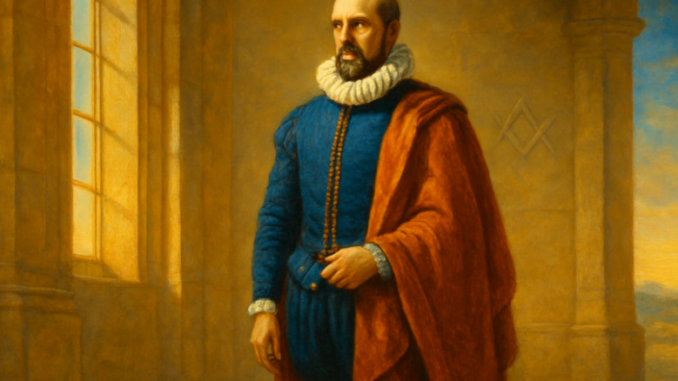
What ultimately makes Montaigne’s essay on the Battle of Dreux so valuable to the Freemason is its lesson about connection. The Wars of Religion in the sixteenth century tore France apart. Families, villages, and entire cities were divided along religious lines. Montaigne, himself a Catholic but with close ties to the Protestant camp, refused to be confined to one side. His entire body of work is a plea for the ability to see beyond boundaries.
Freemasonry was formally established a century and a half later, in the early eighteenth century, in an era similarly marked by religious and political division. James Anderson and Jean-Théophile Désaguliers, the architects of the first Grand Lodge, deliberately chose to create a brotherhood that transcended religious fault lines. But the roots of that ideal stretch back further than 1717. They reach towards thinkers like Montaigne, who in the solitude of their writing chambers were already practising what the lodge would later give ritual form: the art of transcending the self and seeking connection with the other.
What the Freemason Recognises in Montaigne
Several of Montaigne’s core principles resonate powerfully with Masonic values. First, there is self-reflection as the essential first step towards understanding others. Then the courage to question one’s own certainties — a practice that lies at the very heart of Masonic self-improvement. Brotherhood, as Montaigne implicitly teaches, is a conscious choice, not a byproduct of thinking alike. The search for truth is understood as a journey, not a destination. And finally, there is a profound respect for opposing perspectives as a genuine source of wisdom rather than an obstacle to be overcome.
These are not abstract ideals borrowed from philosophy and grafted onto Masonic practice. They are living principles that every brother encounters in the lodge — in the silence before the work begins, in the exchange of ideas during instruction, and in the symbolic labour on the rough stone that represents the self.
Let us return to that sword in the mud at Dreux. Montaigne shows us that the true turning point is not the moment the sword is raised, but the moment it is released. The hand that lets go of the hilt is the hand that becomes free to grasp another hand. That, in its simplest form, is the promise of Freemasonry — and the quiet wisdom Montaigne left us more than four centuries ago. Connection does not begin with the assertion of certainty. It begins with the grace to set it aside.
Copyright text & image: devrijmetselaar.nl
Texts are based on the ideas and content of the author of devrijmetselaar.nl, reviewed, corrected, and supplemented with the assistance of OpenAI. Images are created based on the ideas of the author of devrijmetselaar.nl using OpenAI/DALL-E.
Frequently Asked Questions
What is the connection between Montaigne's essay on the Battle of Dreux and Freemasonry?
Montaigne's analysis of the Battle of Dreux reveals how both opposing sides believed they were righteous, yet the battle produced only confusion and contradictory narratives. This perspective of intellectual humility and uncertainty aligns with Masonic philosophy, which does not claim to possess absolute truth but instead views the search for truth as an ongoing process rather than a final destination.
What did Montaigne observe about the Battle of Dreux that was unusual?
Montaigne noted that the Battle of Dreux in December 1562 followed a remarkably strange course: both sides claimed victory, both commanding generals were captured by the enemy, and the battle failed to settle the conflict decisively. Rather than seeing military chaos, Montaigne viewed this as evidence of humanity's inability to see events clearly and unambiguously.
How does Montaigne's concept of 'uncertainty as virtue' relate to Masonic teachings?
Montaigne championed intellectual humility and the recognition that the line between right and wrong is thinner than we assume. This resonates deeply with Freemasonry, which creates a space for brethren from different backgrounds and beliefs to gather together. The Masonic lodge embraces ongoing inquiry rather than dogmatic certainty, making it an unexpected alignment with Montaigne's philosophical approach to understanding truth and human conflict.

Be the first to comment