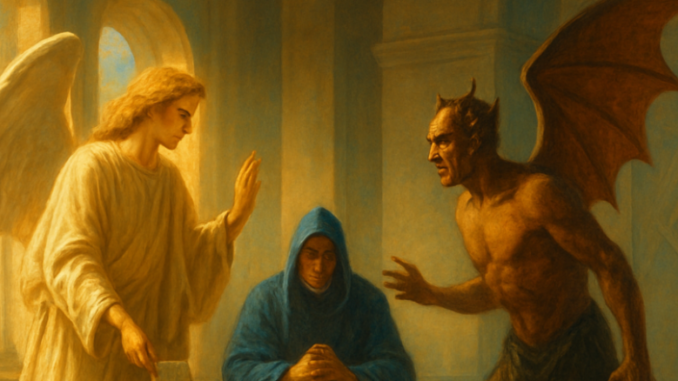
What if someone told you that electing a pope is a life-and-death struggle involving kidnapped cardinals, secret tunnels, and a ticking clock counting down to an explosion? That is essentially the premise Dan Brown offers in his bestselling thriller Angels & Demons. But how much of his portrayal actually aligns with the real procedure? And why might a Freemason find this topic particularly fascinating? Let’s take a closer look.
What Is a Conclave, and Does Dan Brown Get It Right?
The word “conclave” derives from the Latin cum clave, meaning “with a key.” It refers to the locked space in which cardinals gather to elect a new pope. Dan Brown gets this part right: in Angels & Demons, the cardinals are indeed sealed off from the outside world, and the Sistine Chapel is correctly identified as the historic location of the conclave.
But that is roughly where the factual accuracy ends. In reality, the conclave is governed by the apostolic constitution Universi Dominici Gregis, issued in 1996. This document specifies in meticulous detail how the voting takes place, who may be present, and what oaths of secrecy must be sworn. It is a carefully ordered ritual — not a chaotic race against the clock.
Are Cardinals Really Kidnapped During a Conclave?
No. The scenario in which the four leading papal candidates are abducted and murdered one by one is pure fiction. That said, the real history of papal elections is not entirely free of conflict. Consider the conclave of 1268–1271 in Viterbo, which dragged on for nearly three years before city officials removed the roof of the palace and put the cardinals on a diet of bread and water. But the systematic kidnapping of papabili belongs firmly in the realm of imagination.
What Dan Brown does capture well is the intense pressure and political maneuvering behind closed doors. Historians like Frederic Baumgartner have documented in their studies of papal elections how factions, alliances, and back-channel conversations shape the outcome. That human element is very real — even if it is far less spectacular than a thriller demands.
How Does the Voting Actually Work, and What About the Smoke Signals?
The famous smoke signals are one of the elements Dan Brown portrays correctly. After each round of voting, the ballots are burned. Black smoke (fumata nera) means no decision has been reached; white smoke (fumata bianca) announces the election of a new pope. Historically, the color was produced by adding straw or pitch. Today, chemical additives ensure an unmistakable signal.
Where Angels & Demons becomes less accurate is in the voting process itself. Each cardinal writes his choice on a ballot, folds it, and walks to the altar to place it in a chalice. There are a maximum of four voting rounds per day — two in the morning and two in the afternoon. A two-thirds majority is required. All of this is governed by strict rules, not the improvisation the novel sometimes suggests.
Fact: The Sistine Chapel is the actual location of the conclave.
Fact: Smoke signals are genuinely used to communicate the outcome.
Fiction: Cardinals are kidnapped and murdered as part of a conspiracy.
Exaggerated: The acute time pressure and life-threatening scenario.
Fiction: The camerlengo manipulating his way into the papacy through deception.
What Does Any of This Have to Do with Freemasonry?
At first glance, perhaps not much. But look more closely and a striking parallel emerges: both the conclave and the Masonic ritual are closed ceremonies in which a transformation takes place. In both cases, a group of initiates enters a sealed space, follows a prescribed ritual, and a changed reality emerges. In the conclave, that reality is a new pope. In the lodge, it is a brother who has attained a new degree.
James Anderson, who compiled the first Constitutions of Freemasonry in 1723, emphasized the importance of orderly procedure and secrecy in the transfer of responsibility. The oath of silence sworn by cardinals before the conclave bears a structural resemblance to the obligation of discretion a Freemason takes at his initiation. In both traditions, the point is not secrecy for its own sake but the creation of a protected space in which genuine reflection becomes possible.
The conclave and the lodge ritual share an essential conviction: that a decision of great weight deserves a closed, reverent ritual — free from the noise of everyday life.
Is It Harmful When Fiction Displaces Fact?
This may be the most important question of all. Dan Brown’s Angels & Demons introduced millions of readers to the concept of the conclave. But the knowledge they gained is colored by a story that deliberately exaggerates. Just as Freemasonry regularly contends with misconceptions born from popular culture, the Roman Catholic tradition also struggles with the impressions that fiction leaves behind.
Voltaire once wrote that superstition begins where knowledge ends. The philosopher Gotthold Ephraim Lessing — himself a Freemason — argued in his dialogues Ernst and Falk for a sharp distinction between what we know and what we wish to believe. That distinction is precisely what a fact-check like this one aims to serve. Not to condemn the novel — fiction has its own value — but to invite the reader to look beyond the story.
Dan Brown is a masterful storyteller who uses historical settings as a springboard for his imagination. The conclave in Angels & Demons contains recognizable elements — the Sistine Chapel, the smoke signals, the sealed doors — but wraps them in a narrative that prioritizes drama over accuracy. For Freemasons, the parallel is instructive: just as we know that popular portrayals of the Craft rarely capture its true spirit, so too does the conclave deserve to be understood on its own terms. The real ritual, in both cases, is far more profound than any thriller could convey.
Copyright text & image: devrijmetselaar.nl
Texts are based on the ideas and content of the author of devrijmetselaar.nl, reviewed, corrected, and supplemented with the assistance of OpenAI. Images are created based on the ideas of the author of devrijmetselaar.nl using OpenAI/DALL-E.
Frequently Asked Questions
How accurate is Dan Brown's portrayal of the papal conclave in Angels & Demons?
Dan Brown gets some basic facts right, such as the meaning of conclave (cum clave, meaning 'with a key') and the Sistine Chapel as the historic location. However, his depiction diverges significantly from reality. The actual conclave is governed by the apostolic constitution Universi Dominici Gregis (1996) and follows a carefully ordered ritual with meticulous rules about voting, presence, and secrecy oaths. Brown's portrayal of it as a chaotic race against the clock with kidnapped cardinals and explosions is pure fiction rather than an accurate reflection of the real procedure.
Are the kidnappings and murders of cardinals depicted in Angels & Demons based on real papal election history?
No. The systematic abduction and murder of the four leading papal candidates is entirely fictional. While the real history of papal elections is not completely free of conflict—such as the conclave of 1268–1271 in Viterbo that lasted nearly three years—nothing resembling Dan Brown's scenario actually occurred. However, historians like Frederic Baumgartner have documented that real conclaves do involve intense political maneuvering, factions, alliances, and back-channel negotiations behind closed doors, even if far less dramatic than a thriller portrays.
Why might Freemasons find the topic of Angels & Demons particularly fascinating?
While the article does not fully elaborate on this point, it suggests that Freemasons would find particular interest in the interplay between fictional and actual papal election procedures. The novel combines real religious institutions and rituals with conspiracy theories, a combination that often intersects with Masonic symbolism and lore in popular fiction and cultural imagination.

Be the first to comment