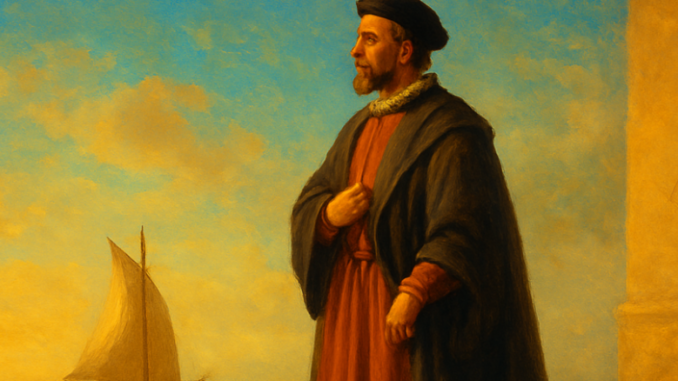
In 1580, Michel de Montaigne published a brief but penetrating reflection on the power of names. In an age when noble titles, family names, and even first names could determine a person’s fate, he posed an uncomfortable question: what remains of a person when you strip the name away? Four centuries later, that question strikes at the very heart of what Freemasons seek to practice every time they enter the lodge and meet as equals — regardless of birth, rank, or title.
A Sixteenth-Century Nobleman Who Questioned His Own Name
Michel de Montaigne was born Michel Eyquem, the son of a prosperous merchant who had acquired the Montaigne estate and, with it, adopted an aristocratic name. This change of name was no trivial detail. In sixteenth-century France, a name determined your access to courts, public offices, and advantageous marriages. Montaigne was acutely aware of this. In his forty-sixth essay from the first book of the Essais, he examines how names become hollow shells — how fame can cling to a name long after the person behind it has been forgotten, and how different individuals sharing the same name become confused with one another across the centuries.
What Montaigne exposes here is not merely a linguistic curiosity but an ethical problem. He shows that names seduce us into false certainty. We believe we know someone because we have heard a name, while the real person behind that word remains a stranger to us. It is an insight that must have unsettled his contemporaries, for it undermined the very foundation on which rank and social standing rested.
The Lodge as a Space Without Titles
Anyone familiar with Freemasonry will recognise a well-established principle in Montaigne’s reflections. When brethren enter the lodge, they leave their worldly titles at the door. The company director stands beside the carpenter; the physician beside the teacher. It is not their name or professional function that gives them their place, but their willingness to work on themselves and to contribute to the whole. This practice is far more than ritual formality — it represents a deliberate ethical choice: the conviction that genuine connection is only possible when outward labels lose their power.
Montaigne might well have recognised this principle as akin to his own thinking. Throughout the Essais, he returns again and again to the idea that honesty and self-knowledge require us to distance ourselves from the roles the world imposes on us. A name is precisely such a role. It offers a sense of stability, but it can also become a mask that prevents us from being truly seen.
Historical Roots of Nameless Brotherhood
The idea that true community lies beyond the name has deep historical roots. The medieval building guilds from which speculative Freemasonry evolved already maintained a tradition in which craftsmanship mattered more than lineage. A master stonemason earned his status not by birth but by proven skill. When James Anderson drew up the first Constitutions of Freemasonry in 1723, he built upon that heritage, writing that the Craft was open to “good and true men” regardless of their distinctions in everyday life.
Traces of this thinking reach back even further, into classical antiquity. Aristotle wrote in his Nicomachean Ethics that true friendship rests not on utility or pleasure but on shared virtue. The name of a friend matters less than his character. Plato pushed the question still further in his dialogue Cratylus, asking whether names belong to things by nature or are merely a matter of convention. These are exactly the questions Montaigne raised again centuries later, with his characteristic blend of erudition and personal doubt.
The Ethics of the Unnamed
Montaigne points us toward something that may be even more urgent in our own time than it was in his. We live in a world of personal brands, digital profiles, and carefully curated identities. Our name is no longer just a word — it is an entire ecosystem of images, associations, and expectations. The question Montaigne posed therefore sounds all the sharper today: how much of what we present to the world is truly our own, and how much is merely the decoration of a name?
True connection does not arise from the exchange of names, but from sharing what needs no name: honesty, vulnerability, and the sincere desire to become a better person.
Freemasonry offers a remarkable response to this challenge. In its rituals, the candidate is asked to divest himself of outward adornments before he receives the light. This is not humiliation — it is liberation. It is the recognition that growth begins where the façade ends. Montaigne described the very same process in his essays, albeit with pen and paper rather than with mallet and chisel. His method of self-reflection — the relentless questioning of one’s own assumptions and prejudices — is, in essence, the same inner labour that the Freemason performs within the lodge.
From Historical Insight to Everyday Practice
What can we carry forward from Montaigne’s centuries-old meditations into our lives today? First and foremost, the courage to look beyond the label. In an era of increasing polarisation, when people are quickly reduced to their group identity, political affiliation, or social category, the art of truly listening to another human being is an act of quiet resistance. The Freemason practises this art every week in the lodge, but the lesson belongs to everyone.
Montaigne also reminds us that names are perishable, but the values we embody can endure. The building blocks of brotherhood — as Montaigne himself would recognise them — are not the names we carry but the virtues we cultivate:
- Self-reflection as a daily discipline, not a luxury
- Honesty with yourself, especially when it is uncomfortable
- Openness toward others, beyond first impressions and labels
- A willingness to work toward moral improvement, one step at a time
These are not abstract ideals confined to dusty books or candlelit lodge rooms. They are practical commitments that shape the way we meet our neighbours, our colleagues, and even strangers. Every time we resist the urge to judge someone by their title, their social media profile, or their surname, we honour the spirit of both Montaigne’s philosophy and the Masonic tradition.
Montaigne ended his essay on names with the sober observation that a name, in the final reckoning, tells us almost nothing about the person who bears it. It is a thought worth sitting with — in the lodge and outside it. For if brotherhood means anything at all, it must mean the willingness to encounter another person not as a label, but as a living, unfinished work in progress. That is the quiet revolution Montaigne proposed with his pen, and that Freemasons continue to enact every time they gather as equals, leaving the world and its titles behind.
Copyright text & image: devrijmetselaar.nl
Texts are based on the ideas and content of the author of devrijmetselaar.nl, reviewed, corrected, and supplemented with the assistance of OpenAI. Images are created based on the ideas of the author of devrijmetselaar.nl using OpenAI/DALL-E.
Frequently Asked Questions
Who was Michel de Montaigne and why did he question the power of names?
Michel de Montaigne was a sixteenth-century French nobleman born Michel Eyquem who adopted the aristocratic name Montaigne when his father acquired the Montaigne estate. He questioned the power of names because in his era, names determined access to courts, offices, and advantageous marriages. In his forty-sixth essay, he examined how names become hollow shells and can obscure the real person behind them, arguing that we falsely believe we know someone merely by hearing their name.
How does Montaigne's philosophy on names connect to Freemasonry?
Montaigne's insight that genuine connection requires stripping away artificial labels directly parallels Freemasonry's core principle. In Masonic lodges, members leave their worldly titles and professional identities at the door, allowing a company director to stand as equals with a carpenter or a physician with a teacher. This practice embodies Montaigne's ethical conviction that real connection and self-knowledge are only possible when outward labels lose their power.
What ethical problem does Montaigne identify with how society uses names?
Montaigne identifies that names seduce us into false certainty and obscure true understanding of individuals. He shows that names can make us believe we know someone when the real person remains a stranger to us, and that names can perpetuate confusion across centuries when different individuals share the same name. This insight was radical because it undermined the social foundations of his time, which rested on the assumption that names and titles accurately represented a person's worth and role in society.


Be the first to comment