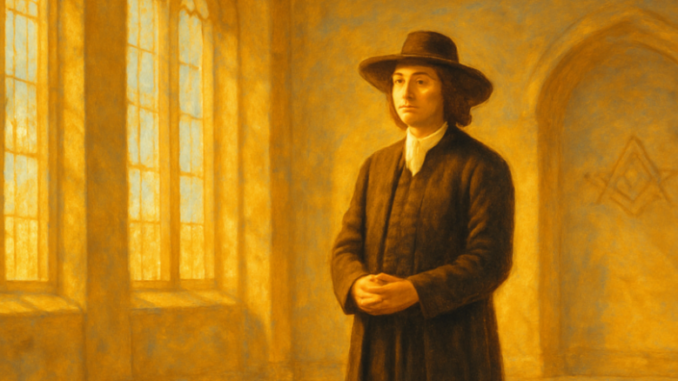
In the middle of the seventeenth century, amid religious turmoil and civil war in England, a movement emerged that was radically different from anything the Christian world had seen before. The Quakers — officially the Religious Society of Friends — rejected church hierarchy, ordained clergy, and even the sacraments. They believed that every human being has direct access to the divine, without the mediation of priests or rituals. This conviction that an inner light serves as the source of spiritual truth raises compelling parallels with other traditions that seek direct experience of the higher self, including Freemasonry.
George Fox and the Birth of a Radical Movement
The Quaker movement began with George Fox, a shoemaker’s son from Leicestershire who underwent a profound spiritual crisis during the 1640s. He visited countless preachers and churches but found no answers to his existential questions. In 1647, Fox experienced what he later described as a direct revelation: there was one who could speak to his condition — Christ himself — without the mediation of human institutions. This experience became the cornerstone of what would develop into Quaker theology.
Fox began travelling across England, proclaiming his message wherever he went. He attracted followers who recognized themselves in his emphasis on inner experience over outward forms. The name “Quakers” was originally a term of ridicule, referring to the trembling or quaking that some early members experienced during their silent meetings. They themselves preferred the name “Friends” or “Children of the Light.”
The Inner Light as Central Doctrine
The core belief of the Quakers is the concept of the “inner light,” sometimes described as “that of God in every person.” This teaching holds that every human being has a direct connection to the divine, regardless of origin, gender, or social standing. This was a revolutionary idea in an age when religious authority was organized along strictly hierarchical lines.
The Quakers taught that spiritual truth does not come through external authority but through an inner attunement to the divine light present within every person. This emphasis on inward spirituality rather than outward forms resonates with other seeking traditions. Within Freemasonry, too, there exists the conviction that true wisdom must come from within — that rituals and symbols are merely guideposts pointing toward a deeper personal transformation. Both traditions share a fundamental trust in the ability of the individual seeker to arrive at insight through their own sincere efforts.
Persecution and Steadfastness
The early Quakers were fiercely persecuted. They refused to swear oaths, which made them suspect in the eyes of the authorities. They refused to remove their hats before social superiors, because they believed all people were equal before God. Thousands of Quakers were imprisoned, including Fox himself on multiple occasions. Yet they steadfastly held to their convictions.
The suffering of the early Quakers shows a striking parallel with the persecutions endured by other spiritual minorities throughout history. Freemasonry has likewise experienced periods in which it was banned and persecuted, precisely because of its emphasis on freedom of conscience and thought. In both cases, history has shown that ideas rooted in sincere spiritual conviction are not easily suppressed.
The Silent Worship
One of the most distinctive aspects of Quaker practice is their silent worship. Quakers gather in simple meeting houses, devoid of altars, pulpits, or religious artwork. They sit together in silence, waiting for guidance from the inner light. If someone feels called to speak, that person rises and shares what has come to them. But often, the entire meeting passes in complete silence.
This practice of collective silence as a pathway to the higher is rare in Western religious tradition. Yet Freemasonry also incorporates moments of silence and contemplation, during which the brother is invited to turn inward. The temple-building that Freemasons speak of is not, after all, an external construction — it is an inner process of self-development and moral refinement.
Social Engagement and Testimony
Over the centuries, the Quakers have built a remarkable track record in the field of social justice. They were pioneers in the fight against slavery, with figures like John Woolman playing a crucial role in the eighteenth century. William Penn, himself a Quaker, founded the colony of Pennsylvania as an experiment in religious tolerance and peaceful coexistence with Indigenous peoples.
Their legacy of social engagement includes opposition to slavery from the seventeenth century onward, pioneering work in prison reform, principled pacifism and peace activism, and advocacy for equal rights for women. This commitment to justice flows directly from the Quaker belief that spirituality cannot be separated from ethical action. If there truly is that of God in every person, then this demands a certain way of treating others.
Freemasonry shares this connection between inner development and virtuous action in the world, encapsulated in the aspiration to build a better world by first working on oneself. The idea that personal transformation and social responsibility are inseparable threads of the same spiritual fabric is a powerful common ground between these two traditions.
A Lasting Invitation to Seek Within
Today, there are approximately 400,000 Quakers worldwide, spread across various branches ranging from traditionally Christian to universalist. What unites them is their trust in direct spiritual experience and the conviction that every person has access to the divine. The question they pose is not so much what you believe, but how you live based on what you have inwardly experienced as true.
This question resonates deeply with the quest undertaken by many spiritual traditions, including Freemasonry. Both invite the seeker on a personal journey inward — not to escape from the world, but to return to it with greater wisdom and compassion. In an age often characterized by noise and distraction, the Quaker example of sitting in shared silence, trusting that light will come from within, remains a quietly powerful testament to the enduring human search for meaning.
The Quakers and Freemasonry walk different paths, yet both point toward the same profound truth: that the most meaningful spiritual discoveries are those made within. Whether through the silent meeting house or the symbolic lodge room, both traditions affirm that every individual carries within them a spark of the divine — and that nurturing that spark is not just a private matter, but a responsibility to the world at large. In a time when outward noise often drowns out inner wisdom, these parallel traditions remind us that stillness, sincerity, and the courage to seek are virtues that never lose their relevance.
Copyright text & image: devrijmetselaar.nl
Texts are based on the ideas and content of the author of devrijmetselaar.nl, reviewed, corrected, and supplemented with the assistance of OpenAI. Images are created based on the ideas of the author of devrijmetselaar.nl using OpenAI/DALL-E.
Frequently Asked Questions
Who founded the Quaker movement and what was his spiritual experience?
The Quaker movement was founded by George Fox, a shoemaker's son from Leicestershire, during the 1640s. After experiencing a profound spiritual crisis and finding no answers from various preachers and churches, Fox had a direct revelation in 1647 where he encountered Christ without mediation from human institutions. This experience became the cornerstone of Quaker theology and inspired him to travel across England proclaiming his message to others.
What does the Quaker concept of the 'inner light' mean?
The 'inner light,' also described as 'that of God in every person,' is the core belief of Quakerism. It teaches that every human being has a direct connection to the divine regardless of their origin, gender, or social standing. Quakers believe that spiritual truth comes from this inner attunement to the divine rather than from external authority, priests, or rituals. This was revolutionary in the seventeenth century when religious authority was strictly hierarchical.
Why were early Quakers called 'Quakers' and what did they prefer to be called?
The term 'Quakers' was originally a name of ridicule that referred to the trembling or quaking that some early members experienced during their silent meetings. The Quakers themselves rejected this name and preferred to be called 'Friends' or 'Children of the Light,' which better reflected their belief in inner divine experience and their emphasis on community gathered in spiritual silence.

Be the first to comment