Anyone who picks up Dan Brown’s The Lost Symbol enters a world where the American capital is steeped in Masonic symbolism. Monuments, streets, and buildings all seem to be part of some grand mystery. But how does this gripping fiction compare to the reality of Freemasonry? Let’s examine the facts and discover where the novelist parts ways with the truth.
Does the Temple from the Book Actually Exist?
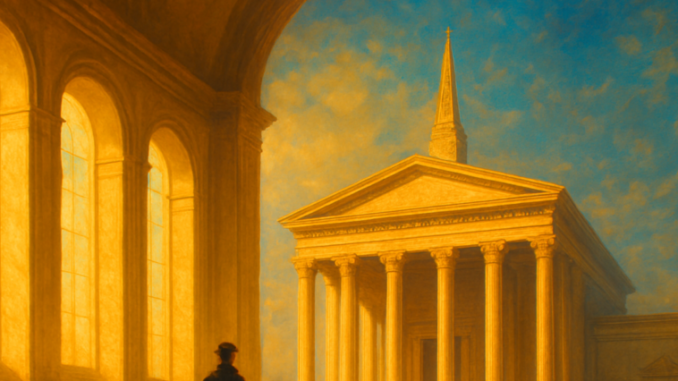
Yes, it does. The temple Dan Brown references in The Lost Symbol is a real building. It is the headquarters of the Scottish Rite in Washington, D.C., officially known as the House of the Temple. This imposing structure was completed in 1915 and was inspired by the Mausoleum at Halicarnassus, one of the Seven Wonders of the Ancient World. The building serves as the headquarters of the Supreme Council of the Scottish Rite for the Southern Jurisdiction of the United States.
This is where the similarities between fiction and reality end, however. In the novel, Brown suggests that beneath the building lie secret chambers and hidden crypts filled with mystical knowledge. The reality is considerably more prosaic: the House of the Temple houses an extensive library, archives, and ceremonial rooms — but no underground labyrinths concealing lost wisdom.
Why Did Dan Brown Choose Washington as His Setting?
Washington, D.C. provides fertile ground for stories about Freemasonry. Historically, several of America’s Founding Fathers were Freemasons, including George Washington himself. The first president ceremonially laid the cornerstone of the Capitol in 1793, dressed in full Masonic regalia. These historical facts form the foundation upon which Dan Brown builds his fictional edifice.
However, an important nuance must be made here. The role Freemasons played in the founding of America was that of individual citizens with their own personal convictions — not that of an organized brotherhood pursuing a political agenda. Freemasonry as an institution has never sought to influence government policy or urban planning. The suggestion in The Lost Symbol that monuments were strategically placed to form esoteric symbols belongs firmly in the realm of fantasy.
What Misconceptions Does the Novel Reinforce?
The biggest misconception that The Lost Symbol perpetuates concerns the nature of Masonic knowledge. In the novel, characters search for “the Ancient Mysteries” — hidden wisdom supposedly concealed in a physical location that, once discovered, would possess transformative power. This idea captures the imagination, but it misses the essence of what Freemasonry actually is.
The “secrets” of Freemasonry are not hidden facts or magical formulas. They are symbolic teaching tools that gain meaning only through personal reflection and moral growth.
The rituals and symbols of Freemasonry are indeed not made public, but this is for a practical reason: they form a pedagogical system that works through personal experience. Just as a film review cannot replace the experience of watching the film itself, knowledge about Masonic rituals cannot replicate the inner experience of participating in them. The “secrecy” is not a conspiracy — it is a deliberate educational choice.
How Did Freemasonry Respond to the Book?
Remarkably, organized Freemasonry responded largely positively to The Lost Symbol. After its publication, the Scottish Rite opened its doors for more guided tours and used the renewed public interest as an opportunity to educate people about its actual activities. Several Grand Lodges published informational brochures separating fact from fiction.
This response reflects an important characteristic of Freemasonry: it has nothing to hide that could be harmful to society. The fraternity welcomes questions and seeks dialogue. What it protects is not a dangerous secret but a personal experience that it wishes every seeker to discover for themselves.
What Can We Actually Learn from This Novel?
Despite its artistic liberties, Dan Brown touches on something genuinely meaningful. The Lost Symbol suggests that within every person lies untapped potential, and that symbolism can help us unlock it. This idea is closely aligned with Masonic philosophy. The symbols of the square and compasses, of the rough and polished stone, all point toward inner transformation — toward the possibility of growth as a human being.
The English philosopher John Locke once described how the human mind begins as a blank slate. Freemasonry would add that we ourselves are the authors of what gets written on that slate. The “lost knowledge” from the novel is not, in reality, some external artifact — it is an inner potential that every person carries within.
How Do We Distinguish Fiction from Fact?
For anyone whose interest in real Freemasonry was sparked by reading The Lost Symbol, a few guidelines are helpful. First and foremost: Freemasonry is not a secret organization but rather an organization with customs it does not share publicly. Its members are known, its buildings often bear its name, and its core principles of brotherhood, tolerance, and self-improvement are openly accessible.
Here are some key facts to keep in mind:
Freemasonry has no political or religious agenda. Symbols are teaching tools, not secret codes for power. The House of the Temple is a real building with a public library. Historical Freemasons acted as individuals, not on behalf of any conspiracy.
Dan Brown wrote a compelling thriller that captivated millions of readers, and The Lost Symbol deserves credit for that achievement. But anyone who wants to understand the true depth of Freemasonry will need to look beyond the pages of a novel. The real quest does not begin in secret cellars — it begins in one’s own heart.
Dan Brown’s The Lost Symbol brought Freemasonry back into the spotlight, sparking curiosity around the world. While the novel weaves an irresistible tale of mystery and hidden knowledge, the real story of Freemasonry is both simpler and more profound. It is not about uncovering ancient artifacts buried beneath monumental buildings. It is about the quiet, lifelong work of self-improvement — shaping the rough stone of our character into something worthy and true. For those willing to look past the fiction, the genuine philosophy of the Craft offers something no thriller ever could: a path to becoming a better version of yourself.
Copyright text & image: devrijmetselaar.nl
Texts are based on the ideas and content of the author of devrijmetselaar.nl, reviewed, corrected, and supplemented with the assistance of OpenAI. Images are created based on the ideas of the author of devrijmetselaar.nl using OpenAI/DALL-E.

Be the first to comment