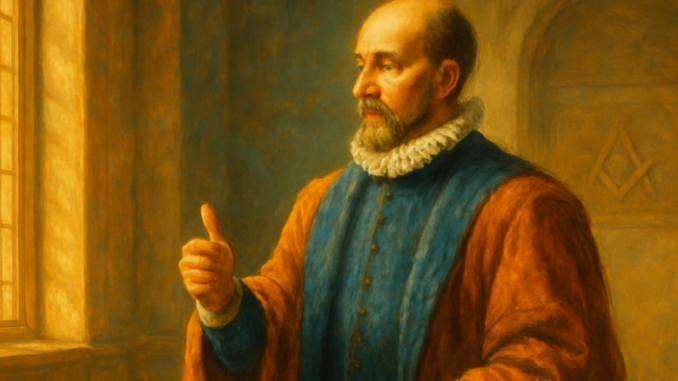
Why would a sixteenth-century philosopher devote an entire essay to the thumb? And what could such a seemingly trivial subject possibly have to do with the great questions of existence? In his essay “Of Thumbs,” Michel de Montaigne wrote no anatomical treatise but rather a philosophical meditation on power, custom, and human vulnerability. To understand what Montaigne is truly saying, we need to trace the sources that nourished him: Plutarch, the Roman Stoics, and the Renaissance humanism that coloured his world.
Which Classical Sources Inspired This Essay?
Montaigne was a voracious reader of classical texts. For this short essay, he drew primarily from the work of Plutarch, the Greek philosopher and biographer whose Moralia and Parallel Lives lay on Montaigne’s desk like daily bread. Plutarch described how Roman emperors decided life and death in the arena with a simple movement of the thumb. Montaigne seized upon this detail — not to condemn Roman cruelty, but to show how small the gesture is by which human beings decide on matters of the greatest magnitude.
Alongside Plutarch, the voices of Seneca and other Stoic thinkers resonate throughout this essay. Seneca wrote extensively about the arbitrariness of fortune and the necessity of accepting with equanimity what lies beyond our control. When Montaigne describes the thumb as an instrument of power, Seneca’s warning echoes beneath the surface: power is fleeting, and he who passes judgment today may be judged tomorrow.
What Does Skepticism Reveal About Seemingly Small Subjects?
Montaigne is widely regarded as the father of modern skepticism, and this essay beautifully illustrates his method. The skeptical tradition, stretching back to Pyrrho and Sextus Empiricus, teaches that our judgments are often less well-founded than we believe. By choosing a subject that most people would dismiss as unimportant, Montaigne demonstrates that even the smallest phenomenon can conceal profound truths.
Montaigne shows us that whoever investigates the small learns to understand the great: every symbol, however minor, bears the traces of human power and human limitation.
This skeptical starting point connects seamlessly with Freemasonry, where symbols are never taken literally. The square and compasses are not carpenter’s tools but references to a deeper reality. In the same way, the thumb in Montaigne’s essay is not merely a body part but a symbol of the human condition itself.
How Does This Essay Fit Within Renaissance Humanism?
The Renaissance brought a renewed appreciation of classical antiquity and a fresh emphasis on human dignity. Humanists such as Erasmus and Thomas More read the same sources as Montaigne and shared his fascination with the everyday as a gateway to the universal. Where medieval thinkers focused on the supernatural, the humanist discovered the sacred in the earthly.
Montaigne’s essay on thumbs stands squarely in this tradition. He elevates a body part to the subject of philosophical reflection, just as humanists regarded the human body as a microcosm of creation. The hand that builds, that writes, that blesses or condemns — in the humanist vision, it is a mirror of the human mind.
What Connection Exists With Masonic Symbolism?
Freemasonry possesses a rich tradition of symbolic interpretation in which physical objects refer to moral and spiritual truths. The working tools of the stonemason, the apron, the pillars — everything carries meaning. Montaigne’s approach to the thumb fits remarkably well within this way of thinking. He treats the body part not as a biological given but as a carrier of cultural and moral significance.
In the lodge, Freemasons learn to look beyond the surface. A rough stone is not merely a stone but a symbol of the unrefined self that is shaped and polished through labour. In the same way, the thumb in Montaigne’s essay is not an anatomical detail but a reminder of the power that people exercise over one another — and of the responsibility that comes with it.
What Can We Learn From This Philosophical Background?
The essay “Of Thumbs” teaches us that philosophy begins with wonder at the everyday. Montaigne combined the wisdom of Plutarch with the inner discipline of the Stoics and the curiosity of the Renaissance. He demonstrated that no subject is too small for deep reflection — precisely as Freemasonry teaches that every symbol, however simple, can be a key to self-knowledge.
Plutarch provided the historical material on Roman customs. Stoicism offered the philosophical framework of power and impermanence. Skepticism inspired humility about our judgments. And Renaissance humanism contributed the appreciation for the earthly and the physical.
Anyone who reads Montaigne today encounters a thinker who invites us to pause and consider what we overlook. The thumb we thoughtlessly use to unlock a phone, to confirm a decision, to express approval or disapproval — it carries centuries of human history within it. Montaigne would smile at our like buttons and emojis. The gesture changes; the human condition endures.
Montaigne’s essay on thumbs is no curiosity but a demonstration of his philosophical method. By weaving classical sources with personal observation, and by treating the smallest detail with the seriousness that others reserve for grand themes, he shows us what genuine thinking means. For Freemasons, this essay holds up a mirror: we, too, seek meaning in symbols; we, too, know that the rough stone and the polished cube are more than what they appear. In that quest, Montaigne is a brother in spirit, four centuries ahead of our time.
Copyright text & image: devrijmetselaar.nl
Texts are based on the ideas and content of the author of devrijmetselaar.nl, reviewed, corrected, and supplemented with the assistance of OpenAI. Images are created based on the ideas of the author of devrijmetselaar.nl using OpenAI/DALL-E.

Be the first to comment