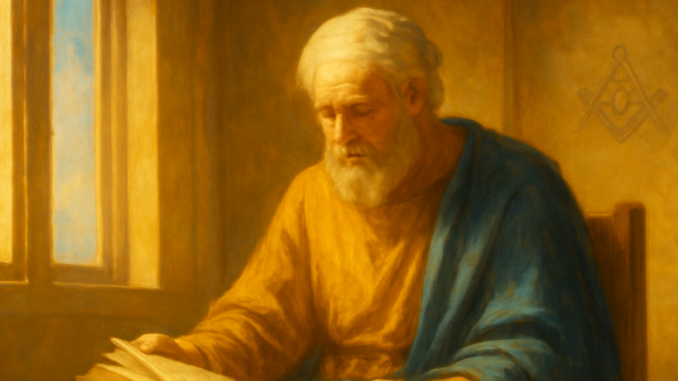
What truly happens when we read? And what should happen when we write? In his eighty-fourth letter to Lucilius, the Stoic philosopher Seneca unfolds a thought that seems simple at first glance but reveals itself, upon reflection, to be a profound philosophical thesis. Reading without processing, he argues, is like eating without digestion. Only when we transform what we have read into something of our own does knowledge become wisdom. This letter stands as a meditative high point in Seneca’s correspondence with Lucilius — and it touches on questions that lie at the very heart of Freemasonry: how does inherited tradition relate to personal growth?
The Core Idea: The Bee as Teacher
Seneca opens his letter by describing a journey through Campania, contrasting the tranquility of nature with the restlessness of city life. He soon turns to his real subject: the question of how we can best read and write. His answer is surprisingly concrete. He compares the reader to a bee flitting from flower to flower. The bee does not simply collect pollen — it transforms that raw material into honey, a substance fundamentally different from its original ingredients.
This metaphor forms the beating heart of the letter. The person who reads merely to collect, who piles up quotations without truly thinking them through, remains nothing more than a hoarder of other people’s thoughts. Only the reader who digests what has been read, who reshapes it and makes it part of their own intellectual being, truly grows in wisdom. Seneca explicitly warns against the danger of superficial reading — the habit of leafing through many books without pausing to dwell on any single one.
Digestion as Spiritual Labor
The comparison with digestion is no accident. Just as the body must break down food to extract strength from it, the mind must process knowledge to distill wisdom from it. Seneca emphasizes that this process demands time and attention. It is not enough to read widely; what matters is to read deeply, to reread, and to let what has been read settle until it becomes part of who we are.
True wisdom does not arise from accumulating knowledge, but from digesting it into something unmistakably our own.
This insight has far-reaching consequences for how we engage with tradition and inherited teachings. Seneca suggests that copying great thinkers does not make us great. On the contrary, the person who merely imitates without transforming remains a shadow of another. The writing that emerges from authentic reading bears the stamp of one’s own mind, even when its building blocks have been borrowed from predecessors.
The Paradox of Originality
Here Seneca touches on a paradox that continues to occupy thinkers today. How can we be original when everything we know comes from what others have taught us? Seneca’s answer is elegant in its simplicity: originality does not lie in inventing entirely new thoughts, but in the unique fusion that emerges when we pass different insights through our own mind.
He compares this to a choir in which many voices come together to form a single harmony. Each voice remains recognizable, yet the whole is greater than the sum of its parts. In the same way, our own voice can remain distinct even though it has been shaped by listening to others. The key lies in processing — not in rejecting — what has been handed down to us.
Freemasonry and the Art of Digestion
For those familiar with Freemasonry, Seneca’s argument resonates in a particularly powerful way. The Masonic tradition carries a rich heritage of rituals, symbols, and texts passed from generation to generation. Yet the intention has never been for Brethren to receive this tradition passively. The rough ashlar must be worked — so runs one of the central images in Masonic symbolism. This work is personal, unique, and unrepeatable.
Ritual in Freemasonry does not function as a script to be recited but as a wellspring to be drawn from. Only when a Brother has filtered the meaning of the symbols through his own experience — when he has digested and transformed them — do they truly become his own. This is precisely what Seneca means when he writes that we must strive for a voice of our own, one that nonetheless carries the echoes of our teachers within it.
Writing as a Mirror of the Soul
Seneca concludes his letter with a reflection on writing itself. The person who writes after having truly read does not merely record thoughts — he discovers who he has become. Writing thus becomes a mirror of the soul, a means of self-knowledge. This insight connects the letter to the broader Stoic tradition, in which self-reflection and self-improvement stand at the center of philosophical practice.
The parallel with Freemasonry is once again striking. In the Lodge, the Brother is invited to work upon himself — to shape the rough stone of his character into a perfect ashlar that fits into the greater edifice. This process requires not merely the reception of knowledge but active transformation. Just as Seneca’s bee transforms collected nectar into honey, so the Freemason transforms his experiences into virtue and insight.
An Invitation to Deeper Reading
Letter 84 is not a manual for efficient reading. It is an invitation to a different relationship with text and tradition. Seneca asks us to slow down, to linger over what we read, and to allow it to change us. In an age when information is abundant and attention scarce, his message sounds more timely than ever.
The Freemason who reads this letter may well recognize the echo of his own practice. The ritual invites return, repetition, and deepening. Each time a symbol is contemplated, it can reveal something new — not because the symbol has changed, but because we ourselves have changed. This is the honey that emerges when we truly read, when we allow tradition to pass through the alembic of our own experience and emerge as something both ancient and entirely new.
Seneca’s eighty-fourth letter reminds us that the most profound transformation does not come from the volume of what we consume but from the depth with which we digest it. For Freemasons, this is a familiar truth: the Craft does not ask us to memorize its symbols but to live them, to let them reshape us from within. In the quiet alchemy of reading, reflecting, and writing, we discover that wisdom is not something we find — it is something we become.
Copyright text & image: devrijmetselaar.nl
Texts are based on the ideas and content of the author of devrijmetselaar.nl, reviewed, corrected, and supplemented with the assistance of OpenAI. Images are created based on the ideas of the author of devrijmetselaar.nl using OpenAI/DALL-E.

Be the first to comment