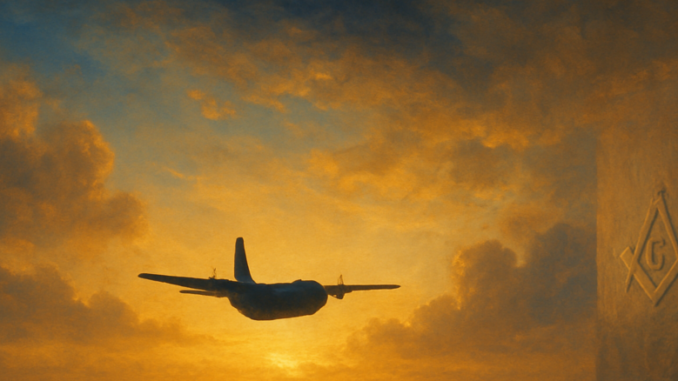
Somewhere above the dark, rolling expanse of the Black Sea, a reconnaissance aircraft climbs through the early morning haze. The pilot knows that dozens of eyes are watching through screens, connected by technology and trust. It is October 2026, and tension along this frontier is palpable. As NATO deploys additional aircraft and drones in response to recent attacks, a question emerges that resonates far beyond military strategy — one that Freemasons have contemplated for centuries: what does brotherhood truly mean when borders are guarded and alliances are tested?
Alliance as Living Ritual
NATO’s reinforced presence over the Black Sea is more than a military manoeuvre. It is the visible expression of a promise made decades ago: those who belong to this alliance do not stand alone. This idea resonates deeply with the Masonic ideal of brotherhood. In the lodge, brethren learn that a given word is not a mere formality — it is a bond that only reveals its true meaning in times of trial.
The ritual through which Freemasons recognise one another as brothers is no empty gesture. It serves as a reminder that connection must be actively maintained. A defence alliance functions in much the same way: the aircraft now patrolling those skies are the visible manifestation of years of agreements, joint exercises, and shared values. Brotherhood, it turns out, is not a comfortable state of rest but a continual choice.
The Watcher: An Archetypal Image
In Freemasonry, the figure of the watcher plays a significant role. At the entrance to the lodge stands the Tyler, who ensures that only those who are welcome may enter. This image of vigilance takes on new dimensions when we consider the drones and aircraft now monitoring the airspace over the Black Sea. They are the eyes at the edge of the alliance, alert to whatever approaches.
Yet the Masonic watcher is not a hostile gatekeeper. His task is not exclusion but the protection of what is precious within. The reinforced aerial surveillance serves a comparable purpose: not to seek escalation, but to create space in which safety and dialogue remain possible. The philosopher Immanuel Kant wrote about perpetual peace as an ideal achievable when states commit to common rules. Brotherhood between nations demands the same principles as brotherhood between individuals.
Tension and Togetherness
It would be naive to equate geopolitical tension with the harmony of a lodge meeting. Yet Freemasonry offers a compelling perspective. It is precisely in moments of disagreement or threat that brotherhood is truly tested. The eighteenth-century Constitutions of James Anderson already emphasised that Freemasons of different nations and backgrounds must treat one another as equals, even when their countries are in conflict.
Brotherhood is not a reward for easy times — it is a compass for difficult ones.
History has tested this ideal more than once. During the First World War, Freemasons served on both sides of the front lines yet still acknowledged their Masonic bond despite the hostilities. This paradox — fighting on the battlefield while remaining brothers in spirit — illustrates how profoundly the principle of brotherhood can reach when it is taken seriously.
Trust as Foundation
At the heart of every brotherhood lies trust. In the lodge, trust is built through shared experiences, rituals, and the keeping of promises. In an alliance like NATO, trust functions in a remarkably similar way: member states rely on one another to honour their part of the agreement. The additional aircraft over the Black Sea are tangible proof of that commitment.
Trust, however, is fragile. It demands transparency, consistency, and the willingness to make sacrifices. Johann Wolfgang von Goethe, himself a Freemason, wrote about the necessity of character as the foundation for all human bonds. What holds true for individuals holds equally true for nations: without reliable action, any alliance loses its cohesion.
The Quiet Question Behind the Radar
Behind the technical reports on flight patterns and drone detection lies a deeper question: how do we build a world in which such vigilance becomes less necessary? Freemasonry offers no political answer, but it does offer a method. By fostering individual moral development, by teaching brethren to listen and reflect, it contributes to a culture of understanding.
This is not naivety. It is the recognition that every pilot over the Black Sea, every diplomat at the negotiating table, and every citizen following the news is ultimately a human being with the capacity for empathy. Brotherhood does not begin with treaties or aircraft — it begins with the acknowledgement of our shared humanity. The philosopher Martin Buber, though not a Freemason, put it memorably: genuine encounter arises when we approach the other not as an object but as a fellow human being.
What We Can Learn
The events unfolding over the Black Sea invite us to reflect. Brotherhood — whether in a lodge or between nations — requires active engagement. It calls for watchers who act not out of fear but out of care. It calls for rituals that are not hollow but meaningful. And it calls for the courage to remain connected, even when tension is at its height.
Brotherhood is a deed, not a status. Vigilance serves protection, not exclusion. Trust is built through consistency. Shared values transcend geographical borders.
As reconnaissance aircraft trace their routes above the dark water, Freemasonry reminds us of a timeless truth: borders are human constructs, but the need for connection is universal. Brotherhood under pressure is not a contradiction — it is the purest test of what we truly believe. The guardians over the Black Sea are watching over more than airspace. They are watching over a promise: that we do not face the unknown alone.
Copyright text & image: devrijmetselaar.nl
Texts are based on the ideas and content of the author of devrijmetselaar.nl, reviewed, corrected, and supplemented with the assistance of OpenAI. Images are created based on the ideas of the author of devrijmetselaar.nl using OpenAI/DALL-E.

Be the first to comment