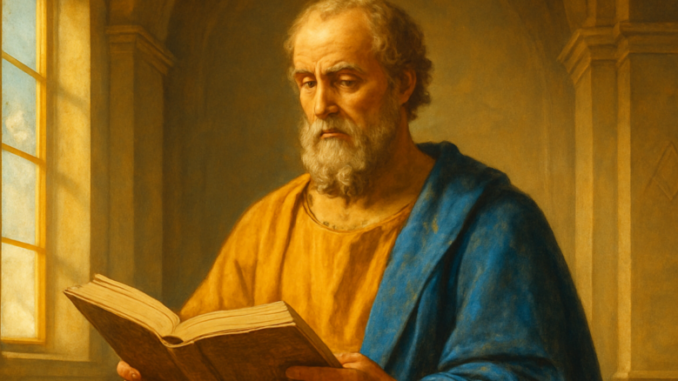
You know the feeling. Another week gone, and you find yourself wondering where the days went. Nearly two thousand years ago, Seneca opened his very first letter to his friend Lucilius with exactly this question: how are you using the time you have? For Freemasons, this question strikes at the heart of the Craft. What does it truly mean to work on yourself if you never consciously invest the time to do so?
Seneca’s Core Message
In his first letter to Lucilius, Seneca wastes no time getting to the point. He asks his friend to give an account of his time the way a good steward accounts for his resources. Time, Seneca argues, is the only thing that truly belongs to us. Money can be lost and earned back. Possessions come and go. But every minute that passes is gone forever. And yet, we treat time as though it were infinite while clinging desperately to material things that can be replaced.
Seneca invites Lucilius to close each day with a simple question: how much of this day did I actually live? Not how many hours was I busy — but how many moments contributed to my growth as a human being? This distinction between being busy and living consciously forms the thread that runs through his entire letter.
Time as Building Material
For Freemasons, Seneca’s message carries a special resonance. Freemasonry describes life as the work of shaping the rough ashlar — transforming yourself into a better version of who you are. But every piece of sculpture doesn’t just require tools; it demands time and attention. You can own the finest chisels in the world, but if you never pick them up, the stone remains rough. Seneca reminds us that time is the indispensable building material for every form of self-development.
Those who consciously invest their time in self-improvement build something that no one can ever take away: their character.
This insight has immediate practical consequences. It means that every evening spent on mindless entertainment — when you actually wanted to read, reflect, or learn — is a missed opportunity. Not because entertainment is wrong, but because conscious choice is the key. Seneca doesn’t condemn any pastime. He simply asks: did you choose this, or did you just drift into it?
Three Practical Steps from Seneca’s Wisdom
How do you translate two-thousand-year-old Stoic wisdom into your daily life? Seneca himself points the way. Here are three practical steps you can start applying today:
First, track where your time goes for one full week. Not to judge yourself, but to become aware. How many hours go to work, to social media, to conversations that energize you, to activities that leave you feeling empty?
Second, set aside twenty minutes each day for something that contributes to your personal growth. Reading, reflecting, writing, or having a meaningful conversation. Treat this time as sacred — an appointment with yourself that you never cancel.
Third, close each day with Seneca’s question: what did I do today that made me a better person? Not as self-punishment, but as a compass for tomorrow.
The Lodge as a Training Ground
Freemasons regularly gather in their lodge. These meetings are not casual social events — they are moments of concentrated attention dedicated to inner growth and brotherhood. In the rush of modern life, the lodge is a space where time flows differently. Here, rituals that have existed for centuries are performed. Here, questions that belong to every age are contemplated.
Seneca would have recognized this immediately. He describes how Lucilius must create moments of withdrawal — away from the noise and the demands of others. The lodge functions as exactly this kind of retreat. Not as an escape from the world, but as breathing room to see more clearly what truly matters.
Connection Through Shared Attention
There is another dimension to Seneca’s letter that resonates deeply with Masonic values: the letter itself is an act of connection. Seneca takes the time to write to his friend, to share wisdom, to help someone else grow. This is not time lost — it is time invested. Freemasonry knows this principle as brotherhood: the willingness to devote time to the development of others.
When a senior Mason mentors a younger Brother, when Brethren reflect together on a text or a ritual, time is transformed into something that reaches beyond any individual life. Seneca reminds us that our time does not belong to us alone. By sharing it with those we care about and those we wish to help, we multiply its value.
Begin Today
The beauty of Seneca’s message is that it requires no preparation. You don’t need to take a course, order books, or wait for perfect conditions. All that’s needed is the decision to start now. Look at the remaining hours of this day. Which of them will you use consciously? What conversation will you have, what thought will you explore, what action will you take that aligns with the person you want to become?
Seneca wrote his letter to wake Lucilius up. Freemasonry offers a structure to stay awake. Together, they form an invitation that is just as relevant in 2025 as it was two thousand years ago: use your time as if it is finite — because it is.
Seneca’s first letter is not an abstract philosophical treatise — it is a practical guide for anyone who is serious about making something of their life. For Freemasons, his wisdom aligns seamlessly with the charge to work on oneself every single day. The question is not whether you have time, but what you do with it. And that choice is made anew, every day, starting now.
Copyright text & image: devrijmetselaar.nl
Texts are based on the ideas and content of the author of devrijmetselaar.nl, reviewed, corrected, and supplemented with the assistance of OpenAI. Images are created based on the ideas of the author of devrijmetselaar.nl using OpenAI/DALL-E.
Frequently Asked Questions
What is Seneca's main message about how we should use our time?
Seneca argues that time is the only thing that truly belongs to us, unlike money or possessions that can be lost and regained. He invites us to close each day by asking ourselves how much of it we actually lived—not just how busy we were, but how many moments contributed to our growth as human beings. The key distinction is between being busy and living consciously.
How does Seneca's philosophy on time relate to Freemasonry?
Seneca's message resonates deeply with Freemasonry's core practice of shaping the rough ashlar—transforming yourself into a better version of who you are. Just as sculpting requires time and attention, self-development in Freemasonry demands conscious investment of time. Those who invest their time in self-improvement build something irreplaceable: their character.
What does Seneca mean by the distinction between being busy and living consciously?
Seneca doesn't condemn any particular pastime or activity. Instead, he emphasizes the importance of conscious choice. The question isn't whether an activity is inherently good or bad, but whether you deliberately chose to do it or simply drifted into it. Every moment spent on something you didn't consciously choose is a missed opportunity for genuine growth.



Be the first to comment