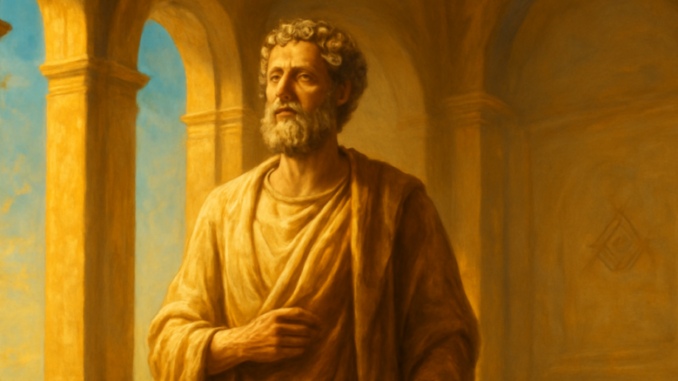
It is late in the evening when a Freemason lingers after lodge has closed. The ritual words still echo in his mind — especially that singular invocation: the Great Architect of the Universe. He opens a well-worn copy of Marcus Aurelius’s Meditations and begins reading Book XII. Slowly, a smile crosses his face. The Roman emperor, writing nearly two thousand years ago, described precisely the same intuition: an ordering principle that permeates and connects all things. How is it that this ancient Stoic wisdom aligns so seamlessly with what he just experienced in the temple?
The Divine in Stoicism: Not a Personal Deity
Throughout Book XII, Marcus Aurelius speaks repeatedly of the divine — yet his conception of God differs fundamentally from what most people today associate with religion. For the Stoics, God was not a distant creator watching from the heavens. The divine was instead an omnipresent logos, a rational principle flowing through all things. This logos orders the cosmos, gives direction to nature, and dwells within every human soul as a spark of reason.
This idea resonates remarkably with the Masonic principle of the Great Architect of the Universe. Freemasonry asks its members to believe in a higher ordering force but does not prescribe how that force should be understood. Whether a Brother is Christian, Jewish, Muslim, or holds a more liberal faith, the Great Architect remains an open symbol — one that leaves room for personal interpretation. Marcus Aurelius would have recognized and appreciated this approach.
The Architect Behind Reality
In Book XII, Marcus Aurelius meditates on the interconnectedness of all things. Nothing exists in isolation. Every atom, every being, every action is part of a larger fabric. The cosmos is not chaos but a structure with an inner logic. Here, Stoic philosophy touches the core metaphor of Freemasonry: the building of the temple.
The Freemason sees himself as a rough stone that must be shaped and refined. But this individual work takes place within a greater building plan. Each Brother contributes to the construction of a symbolic temple of humanity. Marcus Aurelius would have recognized this as a parallel to his own thought: we are all builders, working under the guidance of a universal ordering principle that we cannot fully comprehend but can nonetheless trust.
The Great Architect of the Universe is not a dogma — it is an invitation to acknowledge the order behind the visible world and to align one’s actions accordingly.
Connection as the Highest Virtue
Marcus Aurelius emphasizes again and again that we are social beings. Humanity is made for cooperation, not isolation. In Book XII, he writes that whoever separates himself from the community cuts himself off from the whole — like a branch torn from a tree. This idea aligns closely with the Masonic ideal of brotherhood.
The lodge is, above all, a place where connection stands at the center. Brothers from different backgrounds, professions, and faiths meet as equals. This unity in diversity reflects exactly what Marcus Aurelius describes: we are all branches of the same tree, animated by the same life force. The acknowledgment of the Great Architect serves as a reminder of that fundamental bond.
Self-Reflection as a Builder’s Tool
The Meditations are, at their core, a journal of self-reflection. Marcus Aurelius did not write for publication — he wrote to keep himself honest. He examined his own shortcomings, corrected his thoughts, and reminded himself of the right way to live. This process of continual self-improvement is precisely what Freemasonry means by working the rough stone.
In the rituals of the lodge, each Brother is invited to turn inward — not to condemn himself, but to grow. The gavel and chisel are symbols of this inner work. Marcus Aurelius would have immediately understood these tools as metaphors for philosophical self-discipline.
Light and Knowledge: The Search for Truth
Freemasonry speaks of a journey from darkness to light. The candidate who is initiated literally steps from the dark into the illuminated temple. This symbolizes the transition from ignorance to knowledge, from confusion to insight. Marcus Aurelius knew the same imagery. For the Stoics, wisdom was the highest good, and the logos the light that illuminates reality.
Book XII of the Meditations is filled with exhortations to think clearly, to let go of prejudices, and to see things as they truly are. This is the heart of Stoic discipline: not to flee into illusions, but to face the truth. Every Freemason recognizes in this his own charge — to seek light continually.
A Bridge Across Two Thousand Years
It is remarkable how a Roman emperor and a modern Masonic lodge ask the same fundamental questions. What is my place in the greater whole? How can I become a better person? How do I relate to the unknowable? Marcus Aurelius answered these questions with Stoic wisdom. Freemasonry offers a ritual and symbolic path toward the same insights.
Both traditions recognize an ordering principle behind reality. Both emphasize self-reflection as the path to growth. Both regard connection and brotherhood as a moral duty. And both invite their adherents to embark on a lifelong search for truth.
The Great Architect of the Universe and the Stoic logos are not identical concepts, but they point toward the same human experience: the awareness that we are part of something greater — something that orders and connects. Marcus Aurelius called it nature, or reason. Freemasonry speaks of the Supreme Architect. The words differ; the direction is the same.
When a Freemason today opens the Meditations of Marcus Aurelius, he is not simply reading ancient philosophy — he is encountering a kindred spirit across the centuries. The Stoic emperor and the Masonic Brother share a conviction that the universe is not random, that self-improvement is a sacred duty, and that our deepest purpose lies in recognizing the invisible architecture that binds all of humanity together. In the space where Stoic wisdom and Masonic symbolism meet, the Great Architect speaks a language that transcends time.
Copyright text & image: devrijmetselaar.nl
Texts are based on the ideas and content of the author of devrijmetselaar.nl, reviewed, corrected, and supplemented with the assistance of OpenAI. Images are created based on the ideas of the author of devrijmetselaar.nl using OpenAI/DALL-E.

Be the first to comment