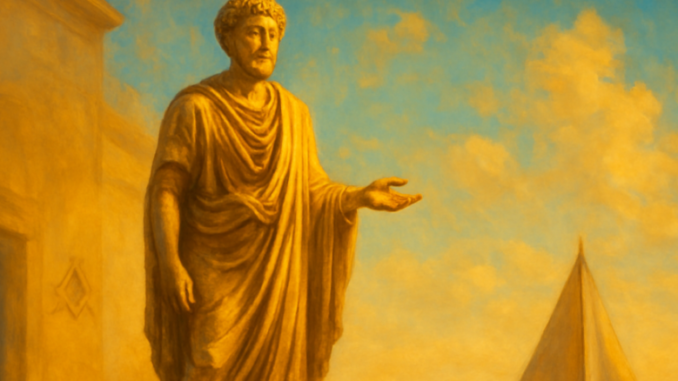
What if everything you own — your status, your reputation, even your body — were to vanish tomorrow? Would anything of real value remain? Marcus Aurelius, the Roman emperor-philosopher who ruled nearly nineteen centuries ago, posed this question to himself again and again. In the sixth book of his Meditations, he arrives at an answer that is both radical and consoling: only virtue holds genuine worth. This insight resonates profoundly with Freemasonry, where the pursuit of moral perfection and the cultivation of inner qualities stand at the very center of practice. Both traditions converge on a fundamental conviction: who you are matters far more than what you have.
The Paradox of the Powerful Philosopher
Here we enter curious territory. Marcus Aurelius wielded virtually unlimited power. As emperor, he could amass wealth, destroy enemies, and have his name chiseled in marble for all eternity. Yet night after night, he wrote in his private journal that none of these things moved him. More than that — he regarded them as distractions from what truly matters. Throughout Book VI, he repeats like a mantra that external circumstances are neither good nor bad. They are indifferent, neutral, merely the raw material with which the soul must work.
This claim might sound detached from reality, but it contains a profound truth. If happiness truly depended on possessions or circumstances, the emperor should have been the happiest man alive. He was not. And the slave Epictetus, whose leg was broken by his master, should have been the most miserable. He was not either. Both understood that true freedom begins where dependence on external things ends.
Virtue as the Only Thing That Matters
But what exactly did Marcus Aurelius mean by virtue? The Latin word virtus and the Greek aretē point to excellence — the full realization of human potential. For the Stoics, virtue comprised four cardinal elements: wisdom, justice, courage, and temperance. These qualities are not abstract ideals. They become visible in concrete choices. Do you speak the truth when a lie would be easier? Do you treat others justly, even when no one is watching? Do you dare to do the right thing when it costs you something?
Virtue is not a possession you acquire, but an attitude you choose anew in each moment of action.
This is the heart of what Marcus Aurelius wants us to understand. Virtue is not a destination, not a diploma you earn and then file away. It is a continuous exercise, a daily choice. Every situation offers the opportunity to act virtuously — or to let that opportunity pass. The value of a human life is not measured in years or possessions, but in the quality of these choices.
Where Freemasonry and Stoicism Meet
Freemasonry prescribes no dogmatic doctrines, but it does share a common orientation with Stoic philosophy. Brethren come together to work on themselves — on the rough stone that gradually takes shape. The symbolism speaks for itself. The rough ashlar represents the unrefined individual at initiation. The perfect ashlar stands for the ideal state of moral development. The tools the Freemason wields are not physical instruments but inner capacities: self-reflection, honesty, and the willingness to confront one’s own shortcomings.
Marcus Aurelius would have recognized himself in this imagery. He too regarded life as a workshop in which the soul perfects itself. In Book VI, he urges himself not to succumb to anger, envy, or self-pity — not because these emotions are forbidden, but because they distract from what truly matters: the cultivation of a virtuous character. The Freemason who labors in the temple on his inner growth performs the very same work as the emperor who ordered his thoughts by candlelight.
Brotherhood as Living Virtue
Yet there is one dimension where Freemasonry appears to go beyond the individual Stoicism of Marcus Aurelius. The brotherhood forms a community of like-minded seekers who support each other on the path toward improvement. While the emperor wrote in solitude, Freemasons work together. They meet in rituals that embody shared values. They address each other as brothers — not because they share a family bond, but because they share a common quest.
And yet, on closer inspection, Marcus Aurelius was no solipsist either. Throughout Book VI, he repeatedly emphasizes that human beings are made for one another. “We are limbs of one body,” he writes, “and the fate of the other touches me as well.” Justice, one of the four cardinal virtues, cannot exist without the other person. It is relational by definition. The virtuous person treats fellow human beings not as a means to an end, but as an end in themselves.
In this light, the Masonic concept of brotherhood is not a departure from Stoic philosophy but its natural extension. Where Marcus Aurelius articulated the ideal in solitary meditation, Freemasonry gives it a living, breathing form — a space where the relational nature of virtue is practiced in real time, among real people committed to the same moral journey.
The Question That Remains Open
We can embrace Marcus Aurelius’ conviction or challenge it. Some will object that health, safety, or love surely have value independent of our attitude toward them. Others will argue that virtue without practical utility is an empty concept. These objections are not unreasonable. The Stoic position is radical and demands a fundamental reassessment of what we typically consider important.
Perhaps the wisdom lies not in a definitive answer, but in the question itself. What would remain if everything were stripped away? What core of your being would hold firm when fortune abandons you? Freemasonry invites us not to dodge this question but to live it fully — in the silence of the temple, in the encounter with a brother, in the honest look in the mirror. Marcus Aurelius wrote for himself, but his words still speak to everyone willing to listen.
Whether virtue is truly the only value remains a question every generation must answer for itself. But that it is of immeasurable worth — on this point, there is little room for doubt. The Stoic emperor and the Masonic brother stand on common ground: both know that the measure of a life is found not in what was accumulated, but in what was cultivated within. In a world obsessed with external markers of success, this ancient wisdom may be more urgently needed than ever.
Copyright text & image: devrijmetselaar.nl
Texts are based on the ideas and content of the author of devrijmetselaar.nl, reviewed, corrected, and supplemented with the assistance of OpenAI. Images are created based on the ideas of the author of devrijmetselaar.nl using OpenAI/DALL-E.
Frequently Asked Questions
What is the main connection between Marcus Aurelius's philosophy and Freemasonry?
Both traditions emphasize that inner moral qualities and virtue matter far more than external possessions, status, or reputation. They share a fundamental conviction that who you are is more valuable than what you have, and both pursue moral perfection and the cultivation of inner qualities as central practices.
Why did Marcus Aurelius believe that external circumstances like wealth and power were unimportant?
Marcus Aurelius understood that true happiness and freedom do not depend on external circumstances, which he considered indifferent or neutral. Despite having unlimited power as emperor, he found these things were distractions from what truly matters. He illustrated this through the contrast between himself and the slave Epictetus—both understood that genuine freedom begins where dependence on external things ends.
What did Marcus Aurelius mean by virtue, and how is it practiced?
Virtue, derived from the Latin 'virtus' and Greek 'aretē,' means excellence and the full realization of human potential. For the Stoics, it comprised four cardinal elements: wisdom, justice, courage, and temperance. Virtue is not a final destination or possession to acquire, but a continuous daily choice made anew in each moment through concrete actions, such as speaking truth when lies would be easier or treating others justly.

Be the first to comment