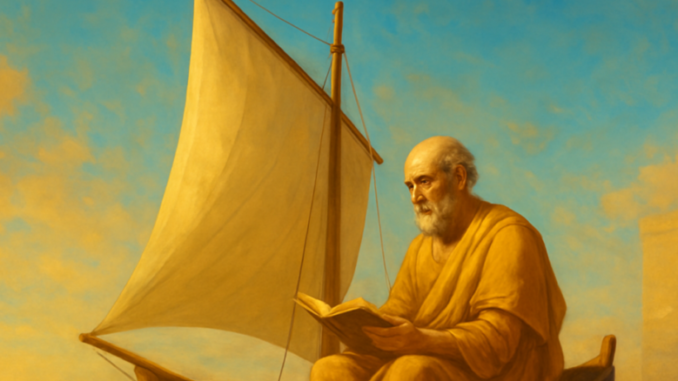
How does knowledge become wisdom? And how can engaging with the thoughts of others lead to genuine human connection? In his eighty-fourth letter to Lucilius, the Stoic philosopher Lucius Annaeus Seneca explores precisely these questions. He describes how reading and writing are not isolated activities but form an alchemical process — one in which collected material is transformed into something entirely new. For Freemasons, this strikes a deeply familiar chord: it echoes the work of shaping the rough ashlar into a more perfect whole through labor and reflection.
What Does Seneca Mean by ‘Digestion’?
In this letter, Seneca employs a striking metaphor: he compares the processing of what we read to the act of digestion. Just as bees gather nectar from many different flowers and transform it into honey, so must the reader draw ideas from diverse sources and blend them into something uniquely their own. The point is not to merely repeat what others have written. The point is transformation.
This idea touches the very heart of what Freemasons call “inner work.” In the lodge, knowledge is never passively received. Every Brother is invited to contemplate rituals, symbols, and lectures — and to arrive at personal insight through that contemplation. The hammer and chisel that shape the rough stone are, in essence, tools of the mind and the heart.
Why Does Seneca Consider Writing So Essential?
Reading alone is not enough, Seneca argues. Those who only read remain collectors of other people’s wisdom. It is only through writing that we force ourselves to organize our thoughts, to weigh them, and to clarify them. Writing is a form of self-reflection in which the mind encounters itself.
Writing is the mirror in which the mind recognizes its own shape — and refines it.
For Freemasons, this resonates powerfully. Keeping a personal journal or composing a paper for the lodge serves exactly this purpose. By committing thoughts to paper, they become tangible. They can be examined, critiqued, and refined. This is the journey from Entered Apprentice to Master Mason: not through knowing, but through understanding.
How Does Knowledge Relate to Brotherhood?
A less obvious but equally important aspect of Seneca’s letter is its emphasis on connection. He writes to a friend, Lucilius, and shares his insights not as a teacher but as a fellow seeker. His letters are not monologues — they are invitations to dialogue. Within this lies a profound Masonic truth: wisdom grows in community.
In the lodge, knowledge is not hoarded by individuals but shared freely. One Brother contributes a lecture, another poses a question, and yet another offers a listening ear. This reciprocity is exactly what Seneca means when he writes that we must both give and receive. Just as bees work together to build the hive, so do Brethren labor together to build the temple of humanity.
What Does This Teach Us About the Search for Truth?
Seneca warns against superficiality in his letter. Those who read too much without digesting what they read become confused. Those who only write without reading exhaust themselves. The balance between the two is essential. This equilibrium mirrors the Masonic pursuit of light: not as a sudden blinding flash, but as a gradual illumination.
Consider reading as receiving light from the past. Writing as refining that light into personal insight. And sharing as passing that light on to others.
The Stoic philosopher and the Freemason share this understanding: truth is not a possession but a process. It demands continuous effort, honest self-reflection, and the courage to acknowledge one’s mistakes. Marcus Aurelius, another Stoic thinker and an admirer of Seneca’s writings, put it this way: the obstacle on the path becomes the path itself.
What Does This Mean for the Modern Freemason?
In an age of information overload, Seneca’s advice is more relevant than ever. We are inundated with texts, images, and opinions. The temptation to consume without processing — to scroll without thinking — is enormous. Yet the Masonic tradition offers a powerful counterweight: the discipline of silence, the attentiveness of ritual, and the enduring value of the written word.
A Brother who writes a paper for his lodge walks in Seneca’s footsteps. He gathers, selects, organizes, and presents. He transforms collected knowledge into something personal — something that contributes to the community. This is not a selfish act but an act of service: to himself, to his Brethren, and to the shared pursuit of a better world.
Seneca’s Letter LXXXIV is far more than a practical guide to reading and writing. It is an invitation to see knowledge not as an end in itself but as a means of transformation and connection. For Freemasons, this ancient text holds up a mirror: recognize yourself in the bee that makes honey, the mason who builds, the seeker who receives light and passes it on. In that reciprocity lies the true strength of Brotherhood.
Copyright text & image: devrijmetselaar.nl
Texts are based on the ideas and content of the author of devrijmetselaar.nl, reviewed, corrected, and supplemented with the assistance of OpenAI. Images are created based on the ideas of the author of devrijmetselaar.nl using OpenAI/DALL-E.

Be the first to comment